
Cranberry fruitworm
Acrobasis vaccinii
Description
How to identify
The cranberry fruitworm, Acrobasis vaccinii, is a significant moth species belonging to the Pyralidae family. The adult moth has a wingspan of approximately 15–20 mm, featuring brownish-grey wings that provide excellent camouflage against plant debris.
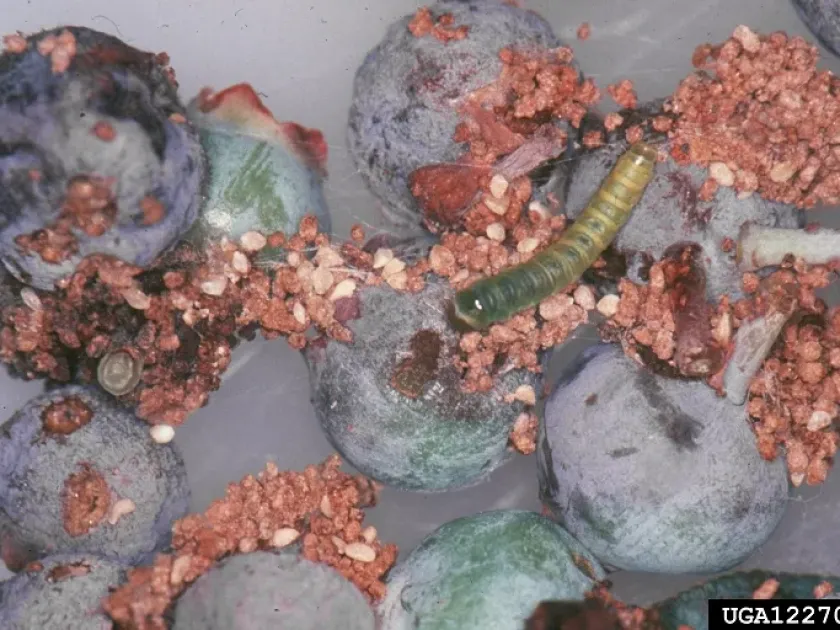
The larvae, or caterpillars, undergo several developmental stages. Initially, they appear pale yellow or green, gradually turning reddish-brown as they mature, typically possessing a distinctive dark head capsule.
The insect typically completes one generation per year. They overwinter as mature larvae inside silken cocoons located in the leaf litter or just below the soil surface beneath the cranberry vines.
In early spring, as temperatures rise, the larvae break dormancy and begin to feed on expanding buds and developing foliage, marking the start of their damaging lifecycle.
After the pupal stage, adults emerge in early summer to mate. Females lay individual eggs on the calyx end of the developing berries, ensuring that newly hatched larvae have immediate access to food.
What it damages
The primary host for Acrobasis vaccinii is the American cranberry (Vaccinium macrocarpon). While specific to this crop, it can occasionally affect other species within the Ericaceae family if populations are dense.
Larval feeding causes the most severe impact. Upon hatching, larvae bore into the berry, consuming the internal seeds and pulp, which causes the fruit to hollow out prematurely.
Infested berries often turn color (reddening) prematurely and may drop from the vine. One larva can move between multiple berries, webbing them together with silk, which leads to total crop loss in the affected clusters.
Beyond direct fruit consumption, the webbing created by larvae interferes with normal plant development and creates micro-climates that are conducive to the growth of fungal pathogens.
Without intervention, this pest can cause substantial economic loss, sometimes damaging a significant portion of the harvest if monitoring and management programs are not strictly followed.
When it appears
Larval activity begins in spring as the plants break dormancy, with larvae feeding on buds and later transitioning to the flowers as they emerge.
The critical period for fruitworm activity coincides with the fruit set stage, as newly hatched larvae seek out the young, developing berries to initiate their boring process.
Adult moth emergence typically occurs in early to mid-summer. This is the window for monitoring adult populations using pheromone traps to estimate potential infestation levels.
Larval development continues throughout the summer months inside the fruit. As the berries approach maturity, the mature larvae prepare to exit the fruit to seek overwintering sites.
By late autumn, the larvae have migrated into the soil or under organic mulch, constructing durable cocoons to survive the winter temperatures until the cycle restarts in spring.
Signs of infestation
Early season symptoms include the presence of damaged, hollowed-out terminal buds, which may be partially covered by light, silken webbing near the tip of the vine.
During the flowering stage, look for flowers that are withered and held together by silk threads, indicating larval feeding on the reproductive organs before fruit set.
The most recognizable sign is the presence of prematurely reddened or shriveled berries in the middle of summer, which contrast sharply with healthy green or ripening fruit.
Close inspection of the fruit surface often reveals a tiny entry hole, sometimes surrounded by fine frass (excrement) pellets that the larva has pushed out during feeding.
Clusters of webbed berries, where multiple fruits are tied together with silk, are a definitive indicator of an active fruitworm infestation within the cranberry bed.
Control measures
Cultural control is a cornerstone of management, involving the maintenance of clean field borders and the removal of organic debris where larvae overwinter.
Flooding the cranberry beds during the late autumn or early spring can be a highly effective, non-chemical method to drown and eliminate overwintering larval populations.
Biological control agents, such as Bacillus thuringiensis (Bt) applications, can be utilized to target young larvae during the vulnerable post-hatching stage.
Chemical control programs rely heavily on precise timing. Insecticides must be applied based on pheromone trap data and degree-day models to ensure they impact the larvae before they bore into the fruit.
- Regular use of pheromone-baited traps to track moth flight activity.
- Calibration of spray equipment for thorough coverage of the dense vine canopy.
- Implementation of Integrated Pest Management (IPM) to preserve natural predator populations.
Taxonomy
- Latin name
- Acrobasis vaccinii
- Order
- Lepidoptera (butterflies)
- Family
- Pyralidae
- EPPO code
- ACBAVA
Discussion
No discussions yet — be the first.