
Oak knot-horn moth
Acrobasis tumidana
Description
How to identify
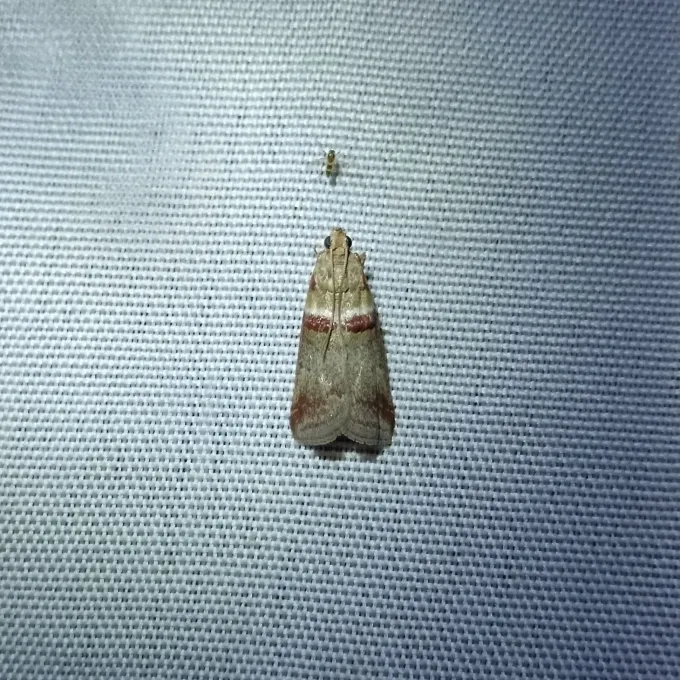
The oak knot-horn moth (Acrobasis tumidana) is a lepidopteran insect belonging to the family Pyralidae, known for its cryptic lifestyle within oak canopy foliage.
The adult moth has a wingspan of approximately 20–25 mm, with brownish-grey forewings adorned with intricate markings that provide excellent camouflage against bark.
Larvae pass through several instars, transitioning in coloration from pale white to a deep reddish-brown, often characterized by a distinct dark-colored head capsule.
Pupation occurs within robust silken cocoons, typically constructed inside rolled-up leaves or hidden deep within crevices of the tree bark for protection.
The species exhibits a life cycle finely tuned to the phenology of oak trees, making it a highly specialized herbivore within its ecological niche.
What it damages
The primary host plants for this species are various oak trees (Quercus spp.), including the common oak, which provides essential nutrients for larval development.
Larvae consume buds during the early spring flush, which can stunt the initial growth of new shoots and significantly reduce the photosynthetic area.
As the season progresses, the caterpillars feed on developing leaves, causing them to deform, brown, and wither, leading to localized leaf loss.
Flower damage is another significant impact, as larvae often consume the catkins, thereby hindering the tree's ability to produce acorns and affecting local wildlife food sources.
Heavy infestations can lead to substantial canopy thinning, which weakens the trees and makes them more susceptible to subsequent attacks by secondary pests.
When it appears
Adult moths typically emerge in late spring or early summer, depending on regional temperatures, to begin their mating and oviposition activities.
Females deposit eggs directly on the buds or the undersides of young leaves, ensuring that the neonate larvae have immediate access to soft, palatable tissue.
The peak period of larval feeding occurs throughout June and July, coinciding with the most rapid growth phase of the oak foliage.
By late summer, the larvae complete their development and transition to the pupal stage, preparing for the next generation or entering winter diapause.
Environmental variables such as spring frost and humidity levels play a critical role in the survival rate of first-instar larvae, influencing the annual population density.
Signs of infestation
The most recognizable sign of infestation is the formation of silken webs or 'tents' that larvae create by binding several leaves together with silk threads.
Brown, withered, and deformed leaf clusters in the canopy are characteristic symptoms indicating that larvae are feeding within those protected structures.
The presence of frass (larval excrement) trapped within these silken nests is a reliable diagnostic feature for identifying the moth's presence.
Buds that fail to develop in the spring, showing signs of being hollowed out or chewed, point towards early-season larval activity.
A noticeable decrease in overall canopy density, accompanied by premature leaf fall during the growing season, indicates a high infestation level.
Control measures
Integrated Pest Management (IPM) strategies are essential for managing A. tumidana populations in both forestry and ornamental settings.
Biological control, specifically using microbial insecticides containing Bacillus thuringiensis, is effective for targeting young larvae while preserving beneficial predatory insects.
Chemical control via systemic or contact insecticides may be utilized in severe cases, particularly for high-value ornamental trees, during the larval emergence window.
Cultural management practices include removing and destroying fallen leaf litter and dead wood where pupae or diapausing larvae may overwinter.
- Encouraging the presence of natural avian predators like tits and nuthatches.
- Using pheromone-baited traps for monitoring population dynamics.
- Sanitary pruning of branches heavily infested with webbed leaf clusters.
Taxonomy
- Latin name
- Acrobasis tumidana
- Order
- Lepidoptera (butterflies)
- Family
- Pyralidae
- EPPO code
- ACBATM
Discussion
No discussions yet — be the first.