
Plum fruit moth
Acrobasis suavella
Description
How to identify
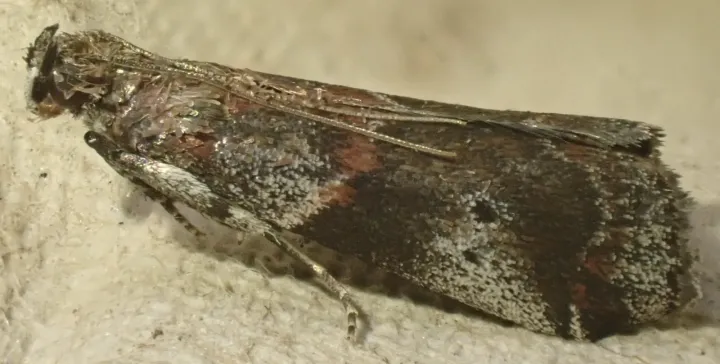
The Plum fruit moth (Acrobasis suavella) belongs to the Pyralidae family of moths and is a known pest in orchards and woodland environments.
Adult moths are relatively small, with a wingspan of about 20–22 mm, featuring greyish-brown forewings with distinct patterns for camouflage.
The larvae, which are the main damaging stage, grow up to 18 mm in length and possess a dark head capsule with a greyish or brownish body.
Like many moths, this species undergoes a complete metamorphosis involving four distinct stages: egg, larva, pupa, and adult.
One of the species' most notable biological adaptations is the creation of a hibernaculum — a durable silk cocoon where the young larvae survive the winter.
What it damages
This pest targets a range of stone and pome fruit trees, including apples, pears, plums, cherries, and common hawthorn trees.
Feeding damage occurs primarily in the spring, as emerging larvae bore into expanding buds, consuming the internal tissues and destroying the growth point.
Significant fruit yield loss is common because the larvae destroy both the flower buds and the potential vegetative shoots during their most vulnerable stage.
Later in the season, larvae move to the leaves, causing skeletonization or rolling leaves into protective silk tubes, which reduces the plant's overall vigor.
Weakened trees become susceptible to various environmental stressors and secondary fungal infections due to the loss of photosynthetic leaf area.
When it appears
Overwintering larvae emerge from their hibernacula in early spring as temperatures rise, typically coinciding with the initial bud burst of fruit trees.
Larval activity reaches its maximum intensity during the flowering period, making it a critical time for monitoring and early intervention in the orchard.
Pupation occurs in late spring or early summer, followed by the emergence of the first generation of adult moths that mate and lay eggs on leaves.
A second generation of larvae develops during the mid-summer, continuing to feed on foliage until the temperatures drop in the autumn.
As the weather cools, the late-instar larvae seek out secure locations on branches to construct their winter hibernacula, remaining dormant until the next spring.
Signs of infestation
The most visible sign of an infestation is the presence of hollowed-out or dried-up buds that fail to develop properly during the spring growing season.
Silk webbing is a definitive indicator of the larvae's presence, as they use it to bind leaves together for protection and food storage.
The accumulation of larval frass (excrement) tangled in webs on twigs and branches often signals high pest pressure within a specific section of the tree.
Rolled or skeletonized leaves located at the tips of shoots are easy to spot during regular field scouting and monitoring visits.
- Failed or hollowed-out buds.
- Silk webbing between foliage.
- Visible frass accumulation on branches.
- Rolled leaf clusters at shoot tips.
Control measures
Sanitation practices, such as pruning and destroying infested shoots with webbing, are the most effective non-chemical ways to reduce the population.
Removing old, loose bark from the trunks of older fruit trees helps eliminate the overwintering sites for the larvae, reducing their successful survival rate.
Biological control using Bacillus thuringiensis sprays can effectively target young larvae without harming beneficial pollinators in the orchard.
Systemic insecticides should be applied only if monitoring indicates that the economic injury level is likely to be exceeded during the spring growth phase.
Maintaining a diverse orchard environment helps promote populations of parasitic wasps and other natural predators that naturally suppress the moth population.
Taxonomy
- Latin name
- Acrobasis suavella
- Order
- Lepidoptera (butterflies)
- Family
- Pyralidae
- EPPO code
- EURPSU
Discussion
No discussions yet — be the first.