
Walnut shoot moth
Acrobasis juglandis
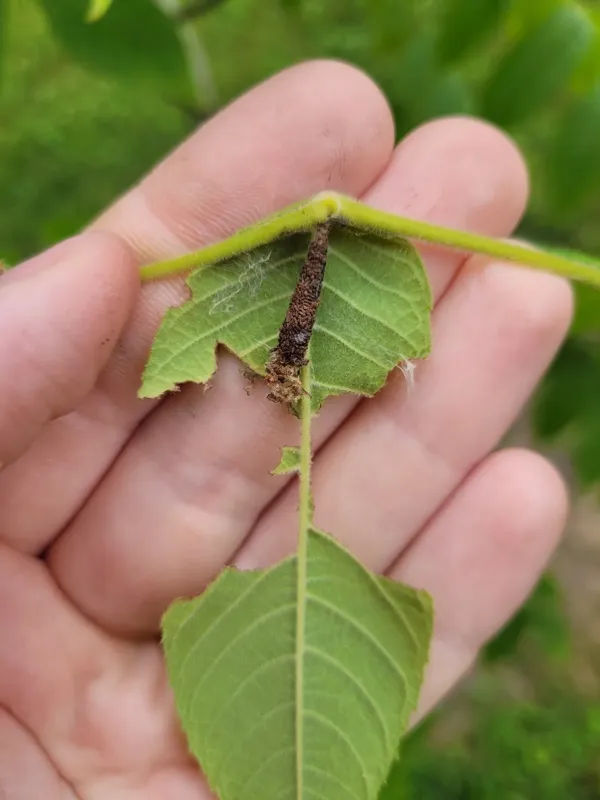
Description
How to identify
The Walnut shoot moth (Acrobasis juglandis) is a member of the Pyralidae family. The adult moth is small, with a wingspan of approximately 15–20 mm. Its forewings exhibit a complex pattern of grey, brown, and white markings, which provide effective camouflage against tree bark.
The larvae, or caterpillars, reach lengths of 12–15 mm and have a distinct dark head capsule. Their bodies are typically greyish-green to reddish-brown and are covered with fine, sparse hairs. This stage is responsible for all the damage caused to the host plant.
The eggs are small, oval, and whitish. They are usually laid singly or in small clusters on the buds, leaves, or young nutlets. Due to their size and coloration, they are difficult to spot during routine garden inspections.
Pupation occurs within the damaged plant tissue or in silk cocoons spun among debris. The species survives the winter as young larvae within protective silk structures called hibernacula, typically tucked into bark crevices or near bud scales.
Because its life cycle is tightly synchronized with the host plant's development, the moth can become a significant pest if population levels are left unchecked throughout the growing season.
What it damages
The Walnut shoot moth primarily targets Juglans species. Larvae cause damage by feeding on expanding buds and young shoots in early spring. This initial feeding can stunt the growth of new branches and destroy potential fruit-bearing areas.
As the season progresses, the larvae shift their attention to the developing nuts. They bore into the hull and eventually the kernel, consuming the interior. This feeding destroys the nut, rendering it worthless for harvest.
Infested nuts often exhibit signs of secondary decay, as the holes created by the larvae provide easy access for fungi and bacteria, leading to premature rotting and fruit drop.
Heavy infestations lead to significant yield losses. Besides the direct loss of fruit, the tree’s overall health can be compromised due to the loss of foliage and growing points caused by the larval feeding activity.
If not managed, the cumulative damage across multiple generations of the moth can significantly reduce the productivity and long-term vitality of an entire walnut orchard.
When it appears
Adult moths emerge in late spring as temperatures rise, coinciding with the bud-break of walnut trees. The timing of this emergence is critical for planning pest management strategies.
There are typically two to three generations per year, depending on the climatic zone. The first generation targets buds and early shoots, while subsequent generations focus on developing nuts throughout the summer.
Adult moths are nocturnal, spending the daylight hours hiding in the canopy. Their activity peaks during the evening and night, which is when pheromone traps are most effective for population monitoring.
The feeding damage caused by the larvae is most noticeable from mid-summer through early autumn. This is the period when protective measures are most required to save the harvest.
As autumn temperatures cool, the larvae enter their dormant state. They spin overwintering cocoons and remain in these sheltered spots until the following spring, when the cycle begins anew.
Signs of infestation
The presence of frass (larval excrement) on the surface of nut husks or at the base of shoots is a primary diagnostic sign. This debris is often mixed with silk, indicating active feeding inside.
Caterpillars often weave webbing between nuts or between nuts and leaves. This silk web acts as a protective shield and holds together the damaged cluster of fruits, making the infestation clearly visible.
Early fruit drop is another indicator. When young, shriveled, or darkened nuts fall to the ground prematurely, they should be inspected for the presence of larvae or entry holes.
Visual inspection of the nuts may reveal small, circular holes where the larvae have penetrated the shell. Once inside, the larva consumes the kernel, often leaving behind a trail of sawdust-like waste.
- Presence of brown, sawdust-like frass on nuts.
- Silk webbing connecting nuts or leaves.
- Premature drop of green, underdeveloped nuts.
- Holes in the nut shell leading to kernel damage.
- Discovery of small caterpillars inside damaged fruit.
Control measures
Cultural control is essential. Regularly collecting and disposing of fallen nuts is a highly effective way to remove larvae from the orchard before they pupate and contribute to the next generation.
Chemical control should be timed to coincide with the period of egg hatching. Using insecticides when young larvae are active on the surface, but before they have bored deep into the nut, provides the best results.
Monitoring using pheromone traps allows growers to track moth flight patterns. This information helps in applying treatments exactly when they are needed, minimizing chemical usage.
Biological control options include Bacillus thuringiensis sprays, which target the caterpillars specifically while being safer for beneficial insects and the environment.
Encouraging natural predators such as predatory bugs or parasitic wasps can help maintain moth populations at manageable levels throughout the season, reducing the need for intensive chemical interventions.
Taxonomy
- Latin name
- Acrobasis juglandis
- Order
- Lepidoptera (butterflies)
- Family
- Pyralidae
- EPPO code
- ACBAJU
Discussion
No discussions yet — be the first.