
Pecan nut casebearer
Acrobasis demotella
Description
How to identify
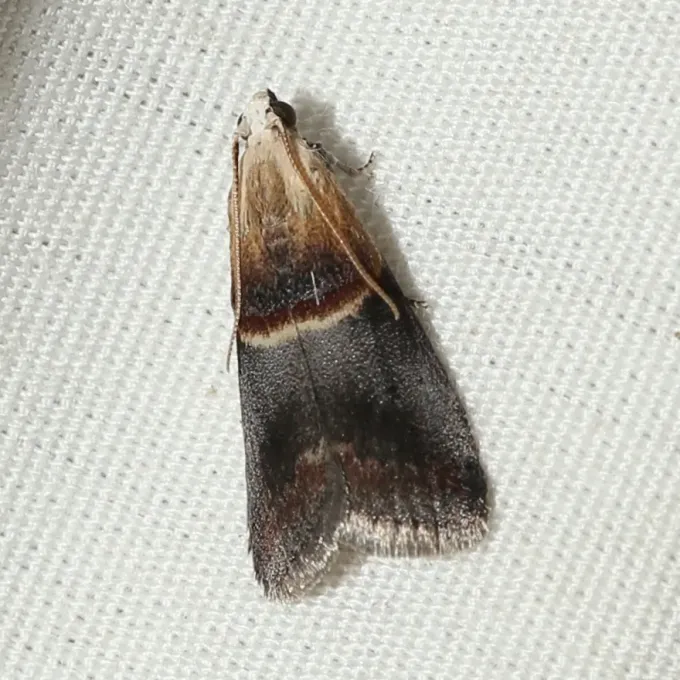
The Pecan nut casebearer (Acrobasis demotella), belonging to the family Pyralidae, is a significant pest of nut-bearing trees. The adult moth is small, with a wingspan of approximately 20 to 25 mm.
The forewings are typically grayish with various dark markings, providing excellent camouflage against the bark of host trees. This coloration makes them very difficult to spot during daylight surveys.
The larvae progress through several instars, appearing light at first and gradually turning into a dusky or reddish-brown color with a darkened head capsule.
Overwintering occurs as a larva in a small, silken hibernaculum constructed in the crevices of the bark or at the forks of branches. These are the primary sites to monitor during the dormant season.
Understanding their life cycle is crucial for orchard management, as the emergence of adults is highly dependent on spring weather conditions and temperature accumulation.
What it damages
The pest primarily targets trees in the genus Carya, with a strong preference for commercial pecan orchards, though it can also infest walnut trees under favorable conditions.
Larvae are notorious for boring into the tender new shoots during the early spring, causing the tips to wither and eventually fall off, which affects tree shape and vigor.
As the season progresses, the pest shifts its attention to the nut clusters. A single larva can destroy multiple nuts in a cluster, leading to significant yield reduction if left unmanaged.
Young trees are particularly vulnerable, as repeated damage to the terminal shoots can significantly delay their maturation and overall growth rate in the orchard.
Economic damage is most severe when the larval population builds up over consecutive years due to poor sanitation and lack of monitoring in the early growing season.
When it appears
The first adult emergence typically happens in spring, synchronized with the bud break of pecan trees. Temperature monitoring is the standard way to predict these events.
Females deposit their eggs on the foliage, buds, or small nuts. Once the larvae hatch, they seek out a suitable place to bore into the plant tissue almost immediately.
The species may complete multiple generations within a single growing season, making it a persistent challenge for farmers throughout the spring and summer months.
Activity levels are directly linked to the physiological development of the tree; as long as succulent growth or developing nuts are present, the pest remains active.
By late autumn, the larvae prepare for winter, finding protected sites on the tree branches to construct their hibernaculum and enter a period of arrested development.
Signs of infestation
One of the earliest signs of infestation is the presence of frass (larval excrement) mixed with webbing at the entrance of a burrow, often found near the base of nut clusters.
Terminal shoots showing sudden wilting, browning, or a hook-like bend are clear indications of larval tunneling inside the stem tissue.
Webbing that holds damaged nuts together or ties leaves to the stem is a classic symptom, as the larvae use silk to secure themselves while feeding.
- Wilting or dying tips of new shoot growth.
- Small, round entry holes at the base of buds or nuts.
- Accumulation of brownish granular frass on foliage.
- Premature dropping of small nut clusters.
Continued presence of these signs indicates active infestation, requiring immediate intervention to prevent the spread of the population to healthy parts of the orchard.
Control measures
Sanitation practices, including the removal and destruction of infested shoots and nuts during the early season, help in reducing the primary larval population.
Pheromone traps are essential for monitoring the flight of adult moths. This data allows for the timing of insecticide applications to coincide with the hatching of the eggs.
Applying systemic or contact insecticides is most effective when targeted at the larval stage before they have had the chance to burrow deep into the plant material.
Promoting natural biological control agents and maintaining optimal tree health through proper fertilization and irrigation helps trees withstand minor pest pressure.
Integrated Pest Management (IPM) programs are highly recommended for orchards, combining cultural, biological, and chemical methods for sustainable control.
Taxonomy
- Latin name
- Acrobasis demotella
- Order
- Lepidoptera (butterflies)
- Family
- Pyralidae
- EPPO code
- ACBADE
Discussion
No discussions yet — be the first.