
Pecan nut casebearer
Acrobasis caryaevorella
Description
How to identify
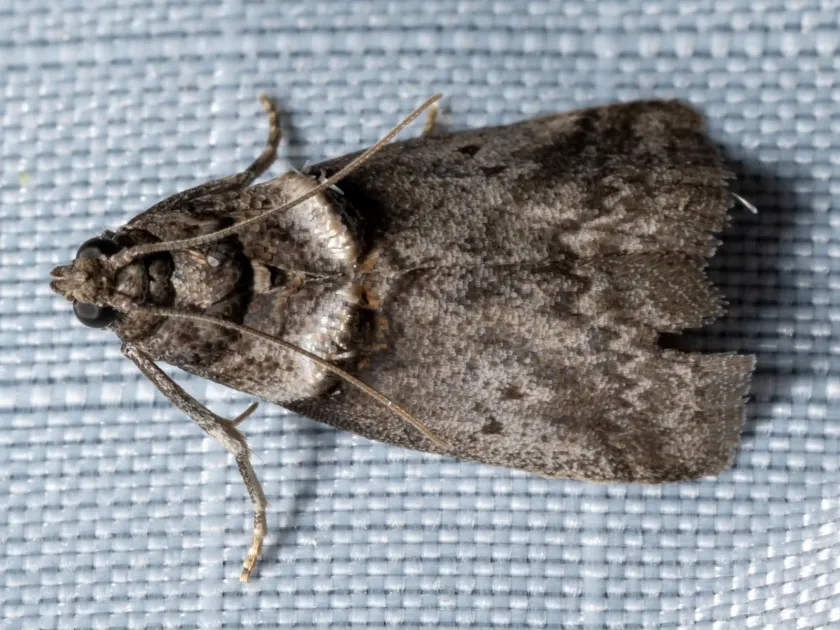
The Pecan nut casebearer, Acrobasis caryaevorella, is a moth species belonging to the Pyralidae family. It is recognized as one of the most destructive pests affecting pecan nut production worldwide.
The adult moth is relatively small, with a wingspan of approximately 20–25 mm. The forewings are characterized by a gray to brownish hue, often featuring a distinct dark ridge or band across the middle.
The larval stage is the most damaging phase. Upon hatching, the larvae are light-colored but progressively darken to a mottled greenish-gray or reddish-brown color with a distinct dark brown head capsule.
These larvae typically overwinter as second-instar larvae inside small, silk-lined hibernacula constructed in the crotches of tree branches or under bark scales.
In spring, the larvae emerge to feed on developing buds, then transition to bore into the clusters of nuts as the fruit begins to set, causing significant economic losses.
What it damages
The primary host plant for this pest is the pecan tree (Carya illinoinensis). The damage is caused by larvae feeding internally on the nut clusters, which leads to the destruction of the kernels.
Beyond the fruit, the larvae also infest the shoots and stems. By boring into these areas, they cause terminal growth to wither, turn brown, and eventually break off, weakening the tree structure.
The most severe impact is seen in the reduction of yield. Infested nuts are usually hollowed out, causing them to turn black and drop prematurely from the clusters before harvest.
A single larva is capable of destroying multiple nuts within a single cluster, effectively neutralizing the productivity of that branch for the season if left untreated.
Beyond immediate crop loss, the physical wounds created by the larvae provide entry points for secondary pathogens, such as fungi, which further degrade the quality of remaining nuts.
Signs of infestation
The hallmark sign of an infestation is the presence of silk frass (larval excrement) mixed with webbing on the surface of the nuts. This webbing helps anchor the larvae to the cluster.
One may observe small, entry holes at the base of the nut clusters. These sites are often surrounded by accumulated frass, which is a clear indicator of active larval feeding.
Shoots that suddenly wilt or exhibit "flagging" (the death of terminal leaves) are often indicative of casebearer activity in the vegetative growth stages.
The use of pheromone traps is the standard method for detection. Catching adult moths is the trigger point for scouting orchards to determine the timing of insecticide applications.
Observing fallen nuts beneath the trees that appear damaged or hollowed out is a sign that the larvae have already completed their development and emerged.
Control measures
Integrated Pest Management (IPM) is essential for controlling the Pecan nut casebearer. The cornerstone of this approach is monitoring population levels using pheromone traps to time treatments correctly.
Insecticide applications should be timed precisely to coincide with egg hatch, before the larvae successfully penetrate the shucks of the young nuts. Once inside the nut, they are protected from chemical contact.
Biological control plays a significant role in managing populations. Several species of parasitic wasps (such as Trichogramma) target the eggs of the casebearer, providing natural suppression.
Cultural practices, such as removing and destroying infested nut clusters or pruned branches, can help reduce the local population density if performed consistently throughout the season.
- Orchard scouting using pheromone traps.
- Application of insecticides during egg hatch.
- Encouraging natural biological control agents.
- Sanitation through removal of infested debris.
Taxonomy
- Latin name
- Acrobasis caryaevorella
- Order
- Lepidoptera (butterflies)
- Family
- Pyralidae
- EPPO code
- ACBACE
Discussion
No discussions yet — be the first.