
Pecan nut casebearer
Acrobasis caryae
Description
How to identify
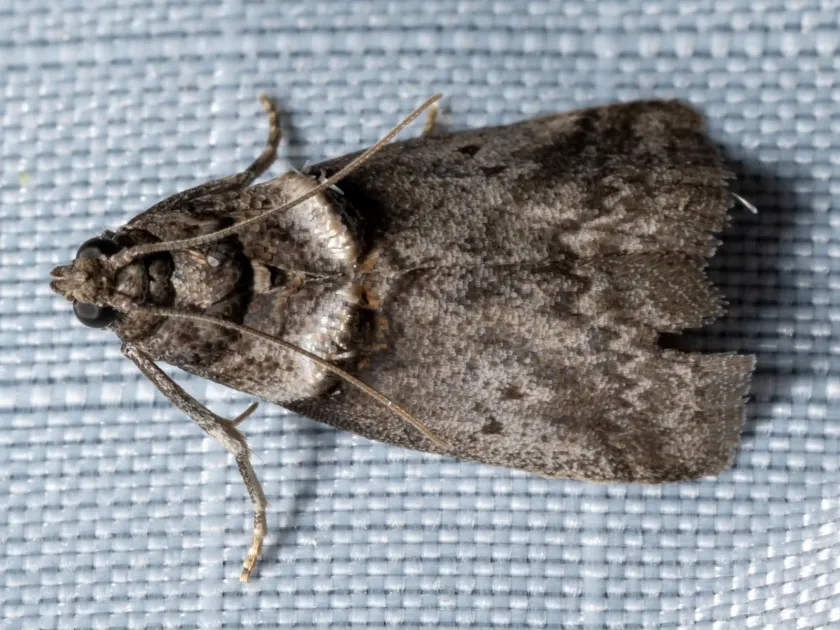
The pecan nut casebearer (Acrobasis caryae) is a moth species belonging to the Pyralidae family, well-known for its role as a significant pest in pecan orchards.
Adult moths have a wingspan of approximately 20–25 mm, with a grayish-brown color pattern on the forewings, enabling them to camouflage perfectly against bark.
The larval stage, which is the most destructive, begins as a pale yellow larva and turns into a darker, mottled olive-brown caterpillar as it develops.
Pupation typically occurs within a protective silk cocoon, which the larvae construct in crevices of the tree bark or within damaged clusters of nuts.
Proper identification of the adult moths is essential for monitoring and is usually achieved through the deployment of traps during the peak emergence flight periods.
What it damages
The primary host for this pest is the pecan tree (Carya illinoinensis), where larvae feed on the developing buds, shoots, and fruit clusters.
Damage often starts when larvae bore into the bases of young shoots, causing them to wilt and die, a condition frequently referred to as "flagging."
The most devastating economic damage occurs when the larvae attack the developing nut clusters, as they hollow out the nuts and consume the kernels.
A single larva may destroy multiple nuts within a cluster, significantly reducing the final yield and the marketable quality of the pecan crop.
If left unmanaged, heavy infestations can lead to a drastic decrease in nut production, impacting the profitability of pecan cultivation enterprises.
When it appears
The insect overwinters as a first or second instar larva inside a small silk-lined shelter, known as a hibernaculum, located near dormant buds.
In spring, as the tree begins to break dormancy, the larvae emerge from their hibernacula and start feeding on the succulent young growth.
The life cycle typically includes several generations per year, with the timing being heavily influenced by temperature accumulation and local climatic conditions.
Moths of the subsequent generations emerge throughout the summer, laying eggs on the surface of nut clusters, which leads to staggered development stages.
By late summer and early autumn, the final generation of larvae prepares for winter by constructing new hibernacula to survive the cold months.
Signs of infestation
One of the clearest indicators of an infestation is the presence of silk-webbed frass (excrement) around the points of entry into the buds or nut clusters.
- Dead or wilted shoots at the tips of branches, known as flags.
- Small, clean entrance holes found at the base of young pecan nuts.
- Accumulation of dark, granulated frass pellets held together by silk.
- Premature nut drop observed under the canopy of infested pecan trees.
- Stunted or distorted growth patterns in areas where buds were attacked early in the season.
Control measures
Management of the pecan nut casebearer relies heavily on timely insecticide applications precisely coordinated with the moth emergence cycles.
Monitoring using pheromone traps is highly recommended to pinpoint the start of the egg-laying period, ensuring that treatments occur when larvae are most susceptible.
Cultural practices, such as removing infested plant debris and maintaining tree health, can help mitigate the severity of the pest pressure within the orchard.
Biological control options, including the release of specific parasitoid wasps or the use of organic sprays, can supplement chemical management in integrated programs.
Constant scouting throughout the season is vital, as the pest's staggered emergence can result in overlapping generations that require repeated monitoring efforts.
Taxonomy
- Latin name
- Acrobasis caryae
- Order
- Lepidoptera (butterflies)
- Family
- Pyralidae
- EPPO code
- ACBACA
Discussion
No discussions yet — be the first.