
Birch casebearer
Acrobasis betulella
Description
How to identify
The Birch casebearer (Acrobasis betulella) is a species of moth in the family Pyralidae, commonly found in regions where birch trees are abundant.
The adult moth has a wingspan of approximately 20–25 mm, with brownish-grey wings featuring indistinct markings that blend perfectly with the bark of host trees.
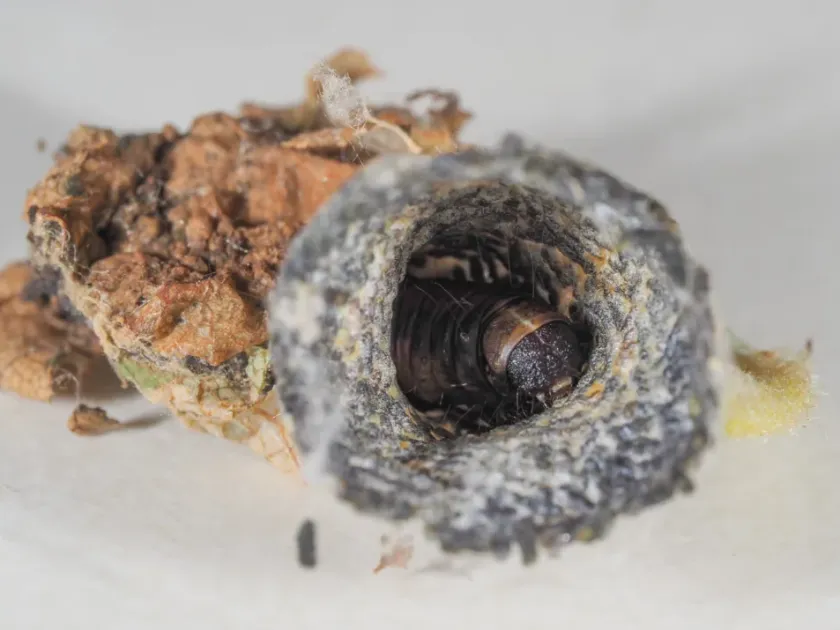
The larvae are small, active caterpillars that feed on plant tissues and construct protective structures known as cases or nests made of silk and leaves.
The species overwinter primarily as young larvae, sheltered in silken cocoons attached securely to the twigs or within crevices of the tree bark.
As part of its lifecycle, the insect undergoes a complete metamorphosis, transitioning from egg to larva, pupa, and finally to the reproductive adult moth.
What it damages
The primary host for this pest is the birch tree (Betula species), with both young saplings and mature trees susceptible to infestation.
The larvae feed on buds, new leaves, and succulent shoots, often tying the leaves together with silk to form protective nests where they feed undisturbed.
Feeding damage results in skeletonized leaves, which impairs the photosynthetic capacity of the tree and can lead to premature defoliation during the season.
Repeated damage to the terminal shoots can cause stunted growth, branch distortion, and an overall decline in the health and aesthetic value of the tree.
In cases of severe infestation, the cumulative stress makes the tree more vulnerable to secondary pests and various environmental stressors.
When it appears
The emergence of adult moths typically occurs during early to mid-summer, depending on regional climatic conditions and local phenology.
After mating, females lay eggs on the undersides of leaves or near buds, ensuring that the emerging larvae have immediate access to a food source.
The larval activity is most intense during the summer months when the tree is actively growing and the foliage is most nutritious.
As autumn approaches, the larvae seek suitable locations on the branches to build their overwintering cases, entering a state of diapause until spring.
Successful management depends on monitoring the canopy during the late spring and early summer for the first signs of nest formation.
Signs of infestation
The most distinctive sign of a Birch casebearer infestation is the presence of webbed nests or cases attached to leaves and twigs.
Malformed, skeletonized, or tied leaves are clear indicators of larval presence, often accompanied by accumulations of frass inside the silk webbing.
Terminal buds that fail to develop properly or appear dried out are also common symptoms of active larval feeding on the new growth.
The overall canopy may look thin or ragged, with patches of discolored, dead foliage scattered throughout the tree branches.
- Silken nests tying leaves together.
- Skeletonized or tattered leaf blades.
- Distorted or stunted terminal shoots.
- Presence of larval cases on bark.
Control measures
Mechanical control involves the physical removal and destruction of infested twigs and leaf clusters containing nests during the early season.
Biological control using formulations of Bacillus thuringiensis (Bt) is highly effective and safe, specifically targeting the larvae without harming beneficial insects.
In instances of high population pressure, targeted applications of systemic or contact insecticides may be necessary to preserve the tree's health.
Promoting a healthy ecosystem by providing habitats for natural predators like birds and parasitic wasps can naturally regulate moth populations.
Regular tree maintenance, such as proper pruning and irrigation, helps trees recover from stress and increases their natural resistance to pest damage.
Taxonomy
- Latin name
- Acrobasis betulella
- Order
- Lepidoptera (butterflies)
- Family
- Pyralidae
- EPPO code
- ACBABE
Discussion
No discussions yet — be the first.