
Acrobasis
Acrobasis
Description
How to identify
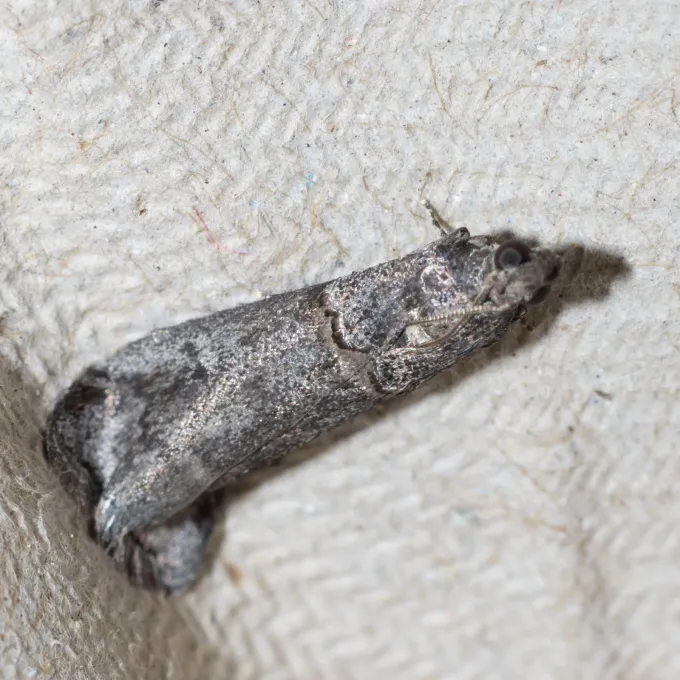
The genus Acrobasis belongs to the family Pyralidae (snout moths). Adult moths are small, typically with a wingspan of 20–25 mm, featuring brownish-grey wings marked with distinct transverse bands.
The larvae progress through several instars, usually appearing light when young and becoming darker with prominent longitudinal stripes as they mature.
Overwintering typically occurs at the larval stage. They construct sturdy cocoons hidden in bark crevices, branch forks, or within desiccated leaves webbed to the tree.
Upon the arrival of spring temperatures, the larvae emerge from their overwintering sites to begin feeding on swelling buds and developing foliage.
The life cycle involves pupation within protected areas such as bark cracks or larval shelters, followed by the emergence of adults for the next generation.
What it damages
Acrobasis species target a wide range of fruit crops, including pome fruits, stone fruits, and various nut trees like walnuts.
Larvae primarily destroy expanding buds and young flowers, which directly results in reduced fruit set and overall yield loss.
By boring into young succulent shoots, the larvae disrupt the vascular flow, causing terminal dieback and stunted development of the branches.
Developing fruit can also be compromised, as larvae often penetrate the skin, rendering the fruit unmarketable and prone to secondary rot infections.
In high-density commercial orchards, a failure to manage this pest can lead to significant economic damage and degraded product quality.
When it appears
Initial larval activity is observed in early spring, coinciding with the phenological stage of bud break in host trees.
Adult flight periods are often protracted, as the timing of successive generations depends heavily on seasonal heat accumulation.
The spring and early summer period is the most critical window for monitoring and intervention, as larvae are actively feeding during rapid tree growth.
The number of generations per year varies by climate, with warmer regions supporting two or more overlapping generations of the moth.
As autumn approaches, the final generation of larvae moves to protected niches to hibernate, remaining dormant until the following spring.
Signs of infestation
A primary indicator of infestation is the presence of silk webbing that binds together buds, leaves, or flower clusters.
Accumulated larval frass, often mixed with silk and plant debris, becomes clearly visible around the feeding sites on branches.
Wilting terminal shoots, commonly referred to as "flagging," serve as an immediate warning sign that larvae have bored into the stems.
Holes found on the surface of young fruits, frequently surrounded by brown frass, confirm the presence of feeding larvae.
Careful canopy inspection during the spring reveals small, webbed nests that house the larvae, providing a clear focal point for manual removal.
Control measures
Essential cultural practices include the systematic pruning and burning of infested twigs to physically remove overwintering or active larval populations.
Banding the trunks of fruit trees can help intercept migrating larvae, thereby limiting their ability to reach the susceptible canopy areas.
Chemical control strategies should focus on applying insecticides precisely during the window of early larval emergence to prevent initial damage to buds.
Biological control options, such as the application of entomopathogenic microbial agents, offer an effective and eco-friendly alternative for managing outbreaks.
- Use pheromone traps for consistent monitoring of adult flight to determine the optimal timing for protective spraying applications.
Taxonomy
- Latin name
- Acrobasis
- Order
- Lepidoptera (butterflies)
- Family
- Pyralidae
- EPPO code
- ACBASP
Discussion
No discussions yet — be the first.