
Larch bud moth
Zeiraphera diniana
Description
How to identify
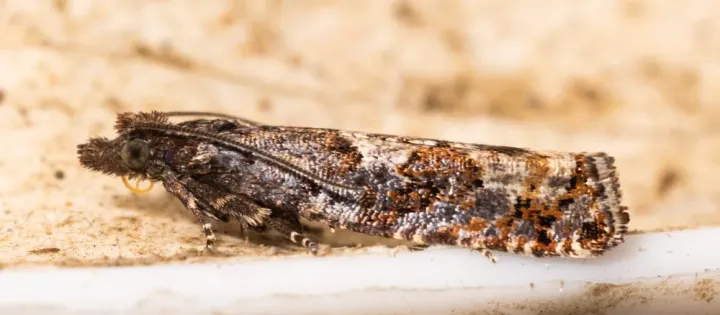
The larch bud moth (Zeiraphera diniana) belongs to the order Lepidoptera, family Tortricidae. The adult moth has a wingspan of about 20–24 mm, with forewings featuring a characteristic marbled pattern ranging from greyish-brown to almost black.
The larvae undergo several developmental stages. Early instars have a yellowish-green body with a black head, while mature larvae become darker, often showing brown or grey shades that provide excellent camouflage among the needles.
The eggs of this pest are extremely small and oval, typically laid in groups within bark crevices or under bud scales, where they remain dormant until favorable temperatures arrive in spring.
Pupae are found within silken cocoons spun by the larvae directly among damaged needles or in the natural folds of the tree bark, making them difficult to detect during standard field inspections.
The species is known for its distinct cyclical mass outbreaks, where population levels can reach critical peaks every 7–10 years, causing significant defoliation across large forest areas.
What it damages
While the primary host is the larch, high population densities can force the pest to attack spruce, mountain pine, and cedar, leading to severe damage in coniferous stands.
The most active feeding occurs during the spring and early summer when larvae emerge and immediately begin consuming young needles as they unfold from the buds, causing significant defoliation.
The damage results in the destruction of photosynthetic tissue, which weakens the trees and makes them highly susceptible to secondary attacks from bark beetles and wood-boring insects.
Damage is often localized initially at the top of the crown, after which larvae gradually move to lower branches, consuming all fresh annual growth.
Prolonged outbreaks of the larch bud moth can result in the widespread dieback of forest stands, posing a significant risk to young plantations and forest nurseries.
When it appears
The insect overwinters exclusively in the egg stage, which dictates the timing of its spring activity, perfectly synchronized with the bud burst of the larch host.
Mass emergence of larvae typically occurs between May and early June, coinciding with the opening of buds where the young caterpillars immediately begin their feeding cycle.
The pupation phase begins in July once the larvae complete their development; this process occurs either on the tree itself or within the forest floor litter, depending on environmental conditions.
Adult moths emerge in late summer, usually in August or September, marking the peak period for flight and egg-laying for the following generation.
There is only one generation per year, meaning the life cycle is strictly tied to seasonal temperature shifts and the availability of fresh vegetative growth on host trees.
Signs of infestation
The first sign of infestation is the presence of silk webbing between needles, which larvae use to pull them together, forming protective 'nests' for feeding.
Characteristic signs include yellowing and premature shedding of needles, along with the accumulation of frass (excrement) on the branches and the webbing itself.
Terminal shoots may appear scorched or bare, as larvae prefer the most succulent, young needles located at the tips of the branches.
During a close inspection of the crown in June, it is possible to spot the larvae themselves, which often drop on silk threads if disturbed by wind or movement.
- Bare terminal shoots on young branches.
- Presence of silken webs within needle clusters.
- Massive needle drop in mid-summer.
- Specific frass accumulation on branches.
Control measures
In forestry, the most effective control method involves the application of biological pesticides based on Bacillus thuringiensis, which are safe for beneficial predatory insects.
In nurseries and ornamental settings, chemical insecticides with systemic or contact-stomach action are used, provided that application timelines are strictly followed.
Cultural practices aimed at maintaining tree vigor, such as appropriate fertilization and timely watering, play a vital role in increasing the tree's natural resistance to infestation.
Promoting natural enemies, such as insectivorous birds and parasitic wasps, is crucial for keeping larch bud moth populations below the economic threshold.
Regular monitoring using pheromone traps allows for accurate forecasting of mass outbreaks, enabling foresters to implement defensive measures in a timely manner.
Taxonomy
- Latin name
- Zeiraphera diniana
- Order
- Lepidoptera (butterflies)
- Family
- Tortricidae
- EPPO code
- EPINDI
Discussion
No discussions yet — be the first.