
Xyloterinus
Xyloterinus
Description
How to identify
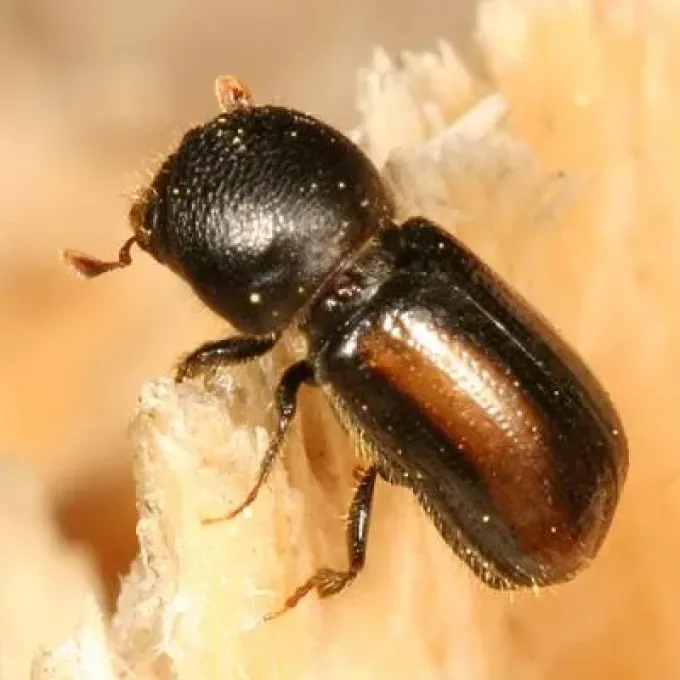
Xyloterinus is a genus of bark beetles belonging to the Curculionidae family. These insects are small, typically measuring only a few millimeters in length, with a cylindrical body shape adapted for boring into wood.
Adult beetles possess a dark, robust exoskeleton, which provides necessary protection while they navigate through the tunnels they construct within tree trunks and branches.
The life cycle consists of four distinct stages: egg, larva, pupa, and adult. Larvae are legless, white, and remain within the safety of the galleries carved by the adults.
These beetles are classified as ambrosia beetles because they farm symbiotic fungi within their tunnels. This fungus serves as the primary nutritional source for both the larvae and the adults.
Taxonomically, identifying Xyloterinus species requires close examination of the pronotum and elytral striae, as they share many physical traits with other scolytine beetles.
What it damages
Xyloterinus primarily infests stressed or dying deciduous trees, such as oak, beech, and birch. They are also known to occasionally attack weakened fruit trees in orchard settings.
The damage occurs when beetles drill galleries deep into the sapwood and heartwood. This activity disrupts the transport of water and nutrients, eventually leading to tree decline.
The introduction of ambrosia fungi into the tunnels causes dark staining in the wood, known as "ambrosia streaks," which significantly lowers the value of the timber.
If the infestation is severe and the tree is already under environmental stress, the beetle can expedite the death of the host tree within a single growing season.
In orchards, the presence of these beetles can cause dieback in branches, leading to a loss of yield and long-term tree health complications.
When it appears
The active season for Xyloterinus generally begins in early spring, as temperatures rise, signaling the emergence of adults from their overwintering sites.
The initial mating flight is triggered by specific environmental cues. Following this, females seek out suitable hosts to begin excavating new galleries.
Throughout the summer, multiple generations may be produced depending on the geographic region and the average annual temperature.
As autumn approaches, adult beetles seek shelter deep within the wood or under the bark to survive the winter temperatures, entering a state of dormancy.
Understanding the peak emergence periods is crucial for timing any preventative insecticide treatments or deploying monitoring traps in infested areas.
Signs of infestation
One of the most reliable indicators of infestation is the appearance of frass, a fine, powder-like sawdust, visible around the tiny entrance holes in the bark.
The crown of an infested tree may show signs of yellowing or wilting, which indicates that the internal vascular system has been compromised by beetle tunneling.
Upon removing a section of bark, one can observe complex, often dark-stained gallery systems. These streaks are evidence of the fungi cultivated by the beetles.
In some cases, tree sap may bleed from the entry holes, indicating that the tree is attempting to repel the invaders, though this is less common with Xyloterinus.
A hollow sound when tapping the trunk or main branches can suggest advanced tunneling, indicating that the structural integrity of the wood has been significantly weakened.
Control measures
The most effective management strategy is sanitation, which involves the removal and destruction of infested, dead, or dying trees to prevent population outbreaks.
Felling and debarking trap trees during the spring can help attract the beetle population, after which the wood can be processed to kill the developing larvae.
Insecticidal sprays applied to the bark can provide protection during the adult flight period, preventing them from successfully colonizing healthy trees.
Maintaining tree vigor through proper irrigation and nutrient management makes trees less attractive to Xyloterinus and other wood-boring pests.
- Prompt disposal of infested wood debris.
- Use of pheromone or alcohol-based lure traps for monitoring.
- Systemic insecticide injections for high-value specimen trees.
Taxonomy
- Latin name
- Xyloterinus
- Order
- Coleoptera (beetles)
- Family
- Curculionidae
- EPPO code
- XYORSP
Discussion
No discussions yet — be the first.