
Granulate ambrosia beetle
Xylosandrus crassiusculus
Description
How to identify
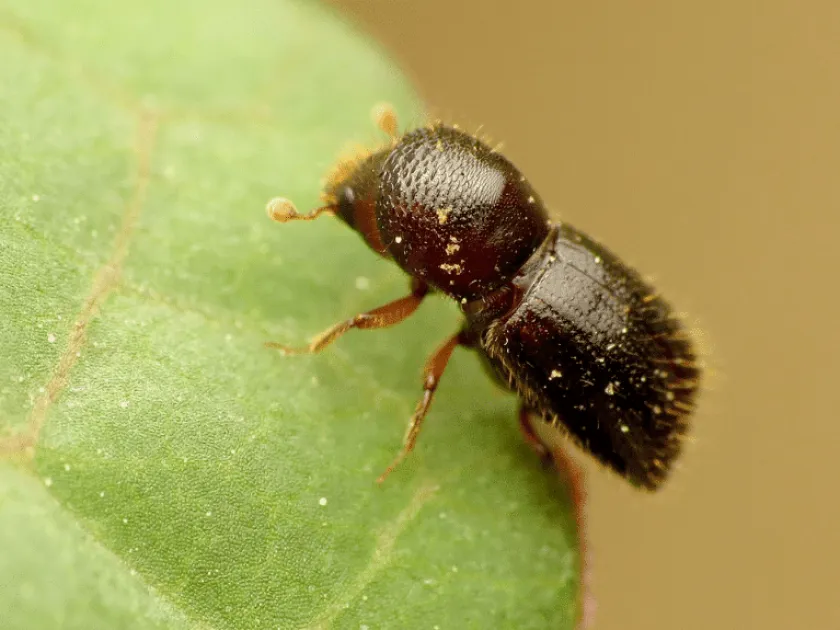
The granulate ambrosia beetle (Xylosandrus crassiusculus) is a small wood-boring insect belonging to the Curculionidae family and the Scolytinae subfamily. Adults are roughly 2–3 mm in length, possessing a stout, cylindrical body that is typically dark brown in color.
These beetles are distinctive due to their symbiotic relationship with ambrosia fungi. Adult females have specialized structures called mycangia used to transport fungal spores from tree to tree, which provide nutrition for their developing larvae.
The larvae are legless, white grubs with a well-developed, dark head capsule. They spend their entire developmental cycle inside the wood galleries created by the parent female, feeding exclusively on the cultivated fungal garden rather than the wood itself.
Due to their cryptic and internal feeding habits, these beetles are rarely seen until damage to the host plant becomes visible. Identification typically involves observing the characteristic sawdust "toothpicks" on the bark.
As an invasive species, X. crassiusculus has successfully established itself in various global regions, often transported through untreated wooden shipping materials or infested nursery stock.
What it damages
This beetle is a highly polyphagous pest capable of attacking hundreds of different woody plant species. Primary hosts include a wide variety of fruit trees like apple, pear, peach, and plum, as well as many ornamental and forest tree species.
The primary damage is caused by females boring into the sapwood to construct galleries for egg-laying. This boring process physically disrupts the tree's xylem, impeding the transport of water and nutrients to the upper canopy.
The fungal spores introduced by the beetles grow within the galleries, further staining the wood black and causing additional stress to the host tree. This often leads to wilting, branch dieback, and, in severe cases, the death of the entire tree.
Trees that are already under stress—due to drought, flooding, frost, or mechanical damage—are significantly more susceptible to successful colonization by these beetles.
In nursery settings, a single infestation can result in total crop loss, making it a critical pest for growers to manage through rigorous surveillance and sanitary practices.
When it appears
Beetle activity typically commences in the spring when ambient temperatures consistently exceed 15–18°C. Overwintering females emerge from their host trees to seek new colonization sites.
Depending on the local climate and temperature profiles, the beetle can complete several overlapping generations throughout the growing season. Peak activity often coincides with hot summer months when host trees are under physiological stress.
Adult beetles are most active during the evening and night hours, when they actively fly to search for suitable host plants by detecting ethanol and other stress-related plant volatiles.
As autumn approaches, activity declines as temperatures drop. Adults then retreat into the galleries within the wood to overwinter, remaining protected from cold temperatures and external predators.
Monitoring for the start of the beetle's flight period is essential for timing control applications, often achieved through the use of ethanol-baited traps which attract the beetles.
Signs of infestation
The most diagnostic sign of infestation is the presence of "frass toothpicks"—slender, cylindrical protrusions of wood dust pushed out from the entry holes of the beetle’s galleries.
Small circular entrance holes, roughly 1–1.5 mm in diameter, are visible on the trunk or branches. These are often accompanied by sap flow or "bleeding" from the bark, particularly on stone fruit trees.
The tree may exhibit symptoms of general decline, including leaf yellowing (chlorosis), branch dieback, or sudden wilting. These symptoms indicate that the internal vascular system has been severely damaged.
If a suspected branch is cut, the internal galleries will appear dark or blackened due to the growth of the symbiotic fungus that the beetle cultivates.
Over time, the affected tree's bark may show signs of cracking or necrosis near the entry points, signaling a long-term, established infestation that is likely irreversible.
Control measures
Sanitation is the most effective management strategy. Any tree or limb showing signs of infestation must be promptly removed and burned to prevent the adult beetles from emerging and spreading to healthy trees.
Maintaining tree vigor is paramount. Proper irrigation, fertilization, and site selection reduce the likelihood of trees releasing ethanol, which serves as a powerful chemical signal to attract the beetles.
Chemical control with insecticides can be used as a protective measure during the peak flight period, but it is often difficult due to the beetle’s protected life cycle inside the wood.
Deployment of ethanol-baited traps throughout the orchard is recommended for monitoring populations and can act as a mass-trapping tool to suppress local beetle numbers before they attack vulnerable trees.
Avoid any unnecessary mechanical damage to the tree bark during pruning or soil cultivation, as any entry point into the vascular tissue can become an ideal site for a female beetle to initiate a gallery.
Taxonomy
- Latin name
- Xylosandrus crassiusculus
- Order
- Coleoptera (beetles)
- Family
- Curculionidae
- EPPO code
- XYLBCR
Discussion
No discussions yet — be the first.