
Xylocleptes
Xylocleptes
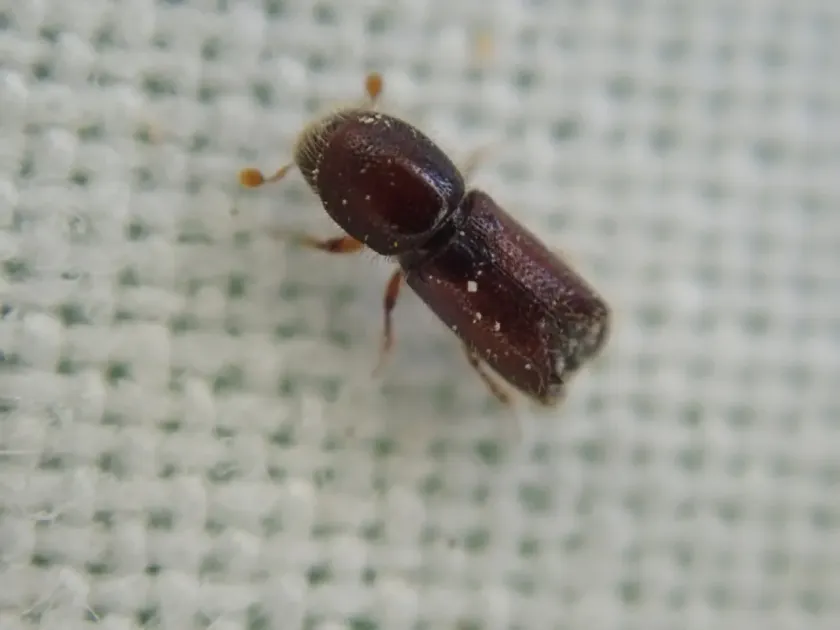
Description
How to identify
Xylocleptes is a genus of bark beetles belonging to the family Curculionidae, subfamily Scolytinae. These are small beetles, typically measuring between 2 and 3 mm in length.
The insect's body is cylindrical, dark brown or reddish-brown in color, and often covered with sparse hairs. The specific structure of the pronotum and elytra is characteristic of this group of wood-boring pests.
Adult beetles possess robust chewing mouthparts adapted for boring galleries beneath the bark and into the wood of thin branches.
Larvae are legless, white in color, with a prominent dark head capsule. They develop directly within the plant tissue, creating feeding galleries.
The most notable species is Xylocleptes bispinus, which is commonly found in gardens and forests across Europe.
What it damages
Xylocleptes primarily infests stone fruit crops, although common hosts also include Clematis. In orchard environments, they often target weakened or stressed fruit trees.
The pest prefers young shoots and branches, reducing the overall physiological vigor of the plant. Significant infestation disrupts the sap flow, causing severe stress to the tree.
Damage is caused by both adults and larvae, which bore galleries beneath the bark and gradually tunnel deeper into the branch wood.
Secondary damage occurs because the galleries created by Xylocleptes often serve as entry points for pathogenic fungi and bacterial infections.
The pest poses a significant threat to nurseries and young orchards, where damaged skeletal branches can lead to the death of the entire tree canopy.
When it appears
Beetle flight and the initiation of new host colonization typically occur in the spring, when temperatures remain consistently above 15 degrees Celsius.
One or more generations may develop during a single season, depending on the climatic conditions and humidity levels in the specific region.
The most active period for damage is observed in late spring and early summer when the new generation of adults searches for new feeding sites.
As autumn approaches, activity decreases, and the pest prepares for hibernation, remaining in the adult stage within the galleries beneath the bark.
Population monitoring is conducted using pheromone traps to detect the onset of infestation and time control interventions effectively.
Signs of infestation
The first sign of Xylocleptes presence is the appearance of tiny entry holes on the bark, often accompanied by the expulsion of boring dust (frass).
Leaves on infested branches begin to yellow, curl, and drop prematurely due to the disruption of the tree's vascular system.
Upon inspection, one may notice characteristic wilting of branch tips, which become brittle and break easily under wind pressure.
Peeling back a section of the bark reveals a network of branching galleries, which may contain larvae or adult beetles.
- Presence of boring dust at the base of the tree.
- Localized wilting of individual branches.
- Small entry holes, approximately 1.5 mm in diameter.
- Dark spots on the bark surrounding entry points.
Control measures
The primary control measure is timely sanitary pruning and the removal of infested branches, which must be destroyed by burning to eliminate the population.
Good orchard management, including proper irrigation, fertilization, and protection against sunscald, is essential to increase tree resistance to pest attacks.
In cases of heavy infestation, systemic or contact insecticides may be applied during the period when adults emerge from their overwintering sites.
It is recommended to use products based on organophosphates or pyrethroids, strictly adhering to pre-harvest intervals to ensure food safety.
Biological control strategies involve enhancing the presence of natural enemies, such as parasitic wasps and other entomophagous insects, within the orchard ecosystem.
Taxonomy
- Latin name
- Xylocleptes
- Order
- Coleoptera (beetles)
- Family
- Curculionidae
- EPPO code
- XYOESP
Discussion
No discussions yet — be the first.