
Hairy spruce bark beetle
Xylechinus pilosus
Description
How to identify
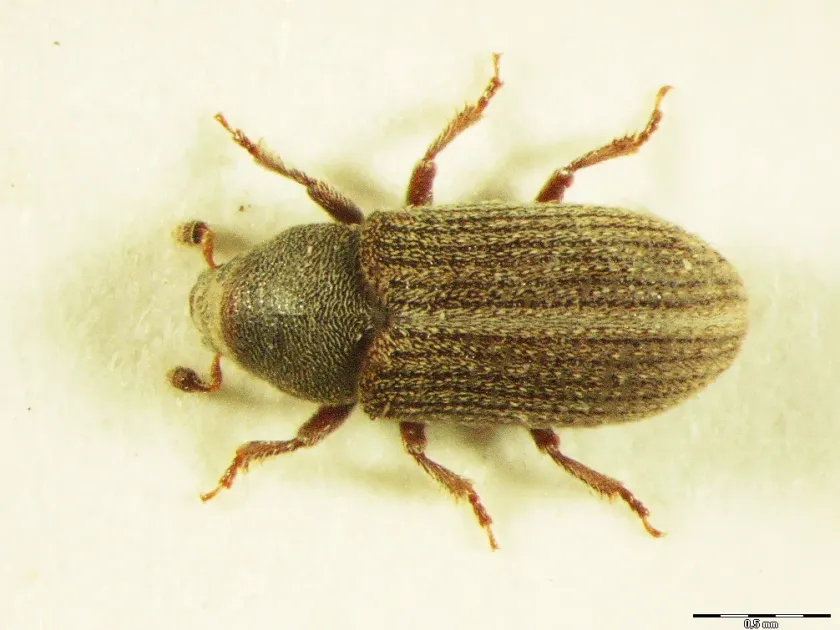
The hairy spruce bark beetle (Xylechinus pilosus) is a small beetle belonging to the Curculionidae family and the Scolytinae subfamily. Adults are roughly 3 mm long, featuring a dark brown color.
The name of the species stems from its most distinctive feature: the body is densely covered with short, erect hairs. The elytra have deep, punctured rows with clear intervals between them.
The larvae are typically wood-boring, legless, and white with a brown head capsule. They spend their entire life cycle feeding under the bark of coniferous trees, particularly spruce.
This beetle is widely distributed throughout Eurasian coniferous forests. While it often colonizes trees that are already stressed, it can reach high population densities in favorable conditions.
As a member of the Coleoptera order, its morphology is adapted for life under bark, with a concealed head under the pronotum, a common trait among Scolytinae species.
What it damages
The primary host for Xylechinus pilosus is the Norway spruce (Picea abies). The beetle tends to target young spruce trees, saplings, and the lower branches of older trees.
The beetle exploits trees weakened by environmental stressors such as drought, frost, or previous mechanical damage, making them unable to fend off the colonizing beetles.
Adults and larvae destroy the phloem layer, which disrupts the transport of nutrients within the tree. This often leads to chlorosis, branch dieback, and eventually the death of the tree.
Widespread infestations can lead to significant economic losses in young forest stands and nursery plantations, where the loss of growth or mortality is immediate.
The ecological impact involves the colonization of weakened trees, which serves as a natural thinning process, though in managed forests, this is considered a significant pest issue.
When it appears
The main dispersal and flight period for adults occurs in the spring, typically from April to May, depending on local temperatures and snowmelt patterns.
Once the beetles emerge, they seek suitable host material, where they bore through the bark to create maternal galleries. Egg-laying usually follows shortly after colonization.
Larval development takes place during the summer months. As they grow, they feed on the inner bark, creating lateral galleries that branch out from the main maternal channel.
Pupation usually occurs in the late summer, followed by the emergence of the new generation of adults. These beetles move toward hibernation sites as temperatures drop in autumn.
The species generally completes one generation per year, though in warmer southern regions of its range, the phenology can be slightly accelerated by the climate.
Signs of infestation
The presence of the beetle is indicated by tiny, round entrance holes on the bark surface. These are often difficult to spot without close inspection of the tree trunk.
Beneath the bark, one can find a distinct pattern of galleries. The maternal gallery is often longitudinal, with larval galleries winding outward, filled with fine wood dust and excrement.
Visual symptoms include yellowing and premature shedding of needles. In the later stages of infestation, the bark may peel away, revealing the underlying woody tissue.
Fine bore dust (frass) may collect at the base of the tree or in crevices in the bark, signaling that the beetles are actively boring into the tree.
Crown dieback is a critical sign of infestation. Because the beetle attacks thin-barked areas, the damage is frequently visible on the smaller-diameter sections of the spruce.
Control measures
Sanitation felling is the most effective control measure. It is essential to remove infested trees before the next generation of beetles emerges and spreads to healthy trees.
Regular forest monitoring is crucial, especially in areas hit by storms or severe droughts, to identify new infestation foci before they become large-scale outbreaks.
In forest nurseries, chemical control using systemic insecticides can be applied during the flight period to protect high-value seedlings and prevent colonization.
Promoting a diverse ecosystem encourages the presence of natural enemies, such as clerid beetles and parasitic wasps, which act as biological control agents.
Maintaining high stand vigor through proper silvicultural practices, such as appropriate density management, helps trees resist attacks from this secondary forest pest.
Taxonomy
- Latin name
- Xylechinus pilosus
- Order
- Coleoptera (beetles)
- Family
- Curculionidae
- EPPO code
- XYLCPI
Discussion
No discussions yet — be the first.