
Hairy spruce bark beetle
Xylechinus
Description
How to identify
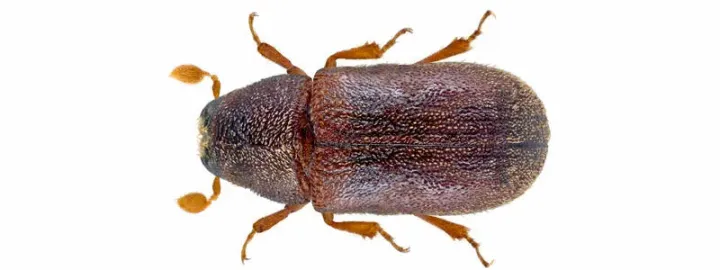
The Hairy spruce bark beetle (Xylechinus pilosus) belongs to the Curculionidae family and the Scolytinae subfamily. It is a small beetle, typically measuring between 3 and 4 millimeters in length, distinguished by its dense covering of fine, yellowish-grey hairs.
Unlike many other bark beetles that possess a smooth, shiny cuticle, this species appears matte due to its pubescence. The antennae and legs are usually reddish-brown, and the body shape is robust and cylindrical, typical for many members of this group.
What it damages
This species primarily targets coniferous trees, with Norway spruce (Picea abies) being its preferred host. It specifically attacks thin-barked sections of the tree, making saplings and the upper branches of mature trees particularly vulnerable.
The larvae feed under the bark in the cambium layer. By creating an extensive network of larval galleries, the beetles disrupt the tree's vascular system, which hinders the transport of water and nutrients, often leading to the death of the tree if the infestation is severe.
When it appears
Adult beetles become active in early spring, typically starting in April or May, when temperatures reach a threshold suitable for flight. During this time, they emerge from overwintering sites to seek fresh host trees.
The life cycle is generally completed in one year. However, if conditions are exceptionally warm, the development period can be shortened. The beetles require a steady supply of stressed or damaged trees to successfully establish their colonies.
Signs of infestation
The most reliable indicators of an infestation are small, circular entrance holes on the surface of the bark. These holes are often accompanied by resin flow or the presence of boring dust at the base of the tree.
- Needle discoloration and premature shedding of foliage.
- Formation of intricate, branching gallery patterns beneath the bark.
- Presence of 'frass' (a mix of wood particles and insect waste) in the bark crevices.
- Increased bird activity, specifically woodpeckers feeding on the larvae.
Control measures
Forest management strategies, such as the prompt removal of infested trees before the next generation of beetles emerges, are essential for control. Sanitation logging reduces the overall pressure on healthy forest stands.
Maintaining the health and vigor of spruce stands through proper silvicultural practices makes them less susceptible to initial colonization. In decorative plantations, contact insecticides may be applied during the flight period to deter the beetles from attacking the trunk.
Taxonomy
- Latin name
- Xylechinus
- Order
- Coleoptera (beetles)
- Family
- Curculionidae
- EPPO code
- XYLCSP
Discussion
No discussions yet — be the first.