
Xyleborus pfeilii
Xyleborus pfeilii
Description
How to identify
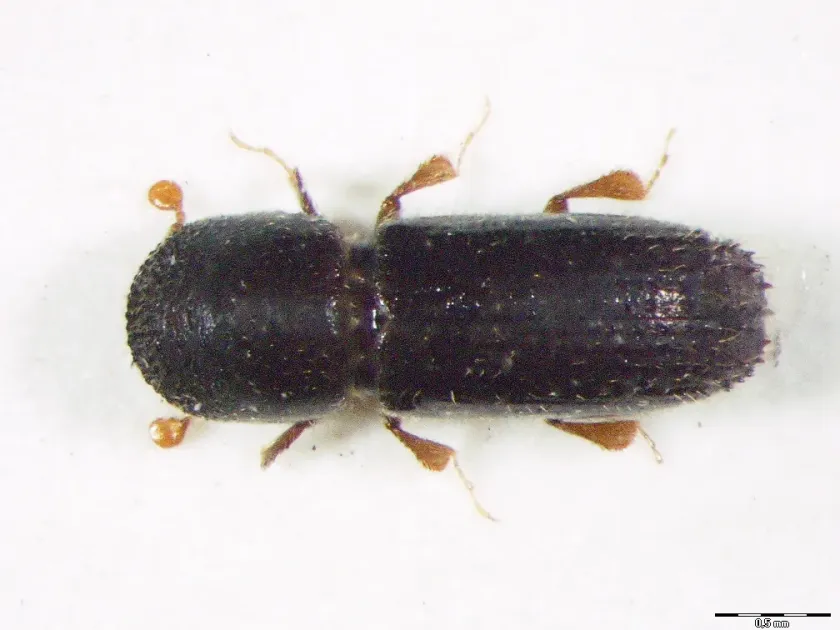
Xyleborus pfeilii is a small bark beetle belonging to the weevil family (Curculionidae) and the subfamily Scolytinae. The adult beetle typically has a cylindrical body, measuring between 2.5 and 3.5 mm in length, and displays a dark brown to black coloration.
The species exhibits sexual dimorphism: females are significantly larger, possess fully developed wings, and are capable of flight to colonize new host trees, whereas males have vestigial wings and stay within the galleries.
Morphological examination reveals that the female's pronotum is hump-shaped and covered with fine tubercles, which is a key identification characteristic for this species of ambrosia beetle.
Larvae are legless, white in color, and have a C-shaped body posture. They develop within the wood galleries and rely on the mycelium of symbiotic fungi, which is introduced by the female during the initial attack.
As a representative of the ambrosia beetle group, Xyleborus pfeilii maintains an obligatory symbiotic relationship with specific fungi (genus Ambrosiella), which serves as the primary food source for their larvae.
What it damages
Xyleborus pfeilii is a polyphagous pest capable of attacking a wide variety of deciduous tree species, including oak, beech, hornbeam, and certain fruit trees growing near forest margins.
The pest primarily targets stressed, weakened, or recently felled trees. In agricultural settings, it often colonizes trees suffering from drought, sunburn, or mechanical damage to the trunk or branches.
The boring activity of the beetles creates complex galleries inside the wood, which disrupts the vascular system and provides an entry point for secondary fungal pathogens that accelerate wood decay.
In orchards, the infestation of Xyleborus pfeilii can lead to the wilting and death of branches, resulting in reduced fruit yield and, in severe cases, the mortality of young or vulnerable trees.
The depth of gallery penetration into the wood is influenced by the tree's health; trees in poor physiological condition are often bored more deeply, leading to more extensive structural damage.
Signs of infestation
The most reliable sign of an infestation is the presence of small, circular entry holes on the bark, measuring approximately 1 to 1.5 mm in diameter, which serve as the entry points for the beetles.
Often, a pile of fine wood dust, known as frass, can be observed below the entry holes. The color of this dust varies depending on the tree species and the depth of the galleries being excavated.
Removing the bark reveals a network of branching galleries. The walls of these tunnels are often stained dark or black, indicating the presence and growth of the ambrosia fungi introduced by the beetles.
Visible symptoms on the tree canopy include premature yellowing, wilting, or thinning of the foliage on infested branches, which indicates an interruption of water and nutrient transport.
During heavy infestations, accumulation of wood shavings may be seen at the base of the trunk, especially following windy weather which causes the material to fall from the entry points.
Control measures
Preventative measures are the most effective way to manage the pest. This includes maintaining optimal tree health through proper irrigation, fertilization, and regular pruning of dead or diseased branches.
Sanitation is critical; all infested material and woody debris should be removed and destroyed immediately to prevent the emergence of a new generation of beetles that could infest neighboring healthy trees.
The use of pheromone traps or trap trees can be useful for monitoring population levels and timing insecticide applications if chemical control is deemed necessary for valuable trees.
Chemical control involving systemic or contact insecticides may be applied to trunks during the beetle's peak flight season to prevent the successful initiation of new galleries.
- Routine visual inspections of the orchard or forest stand.
- Prompt disposal of infested branches and stems by burning or chipping.
- Enhancement of tree vigor to boost natural defensive mechanisms against pests.
Taxonomy
- Latin name
- Xyleborus pfeilii
- Order
- Coleoptera (beetles)
- Family
- Curculionidae
- EPPO code
- XYLBPF
Discussion
No discussions yet — be the first.