
Xyleborus perforans
Xyleborus perforans
Description
How to identify
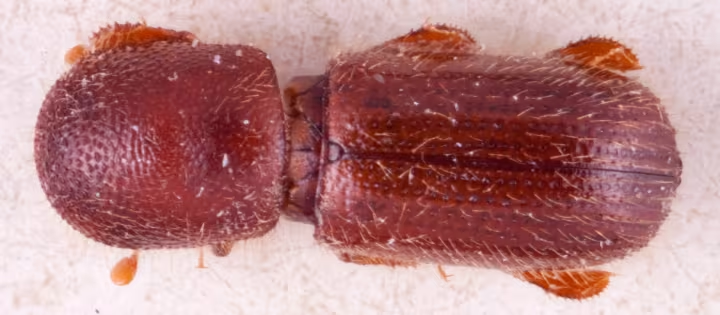
Xyleborus perforans belongs to the order Coleoptera and the family Curculionidae (subfamily Scolytinae). It is a small, cylindrical beetle typically ranging from 2 to 3 millimeters in length.
The adult coloration ranges from reddish-brown to almost black. The surface of the elytra displays characteristic rows of small punctures, which serves as a crucial diagnostic feature when examined under a microscope.
The life cycle of this pest is intimately linked to symbiotic fungi, which serve as the primary food source for the larvae. The beetles transport fungal spores in specialized body structures called mycangia to inoculate their galleries.
Sexual dimorphism is highly pronounced in this species: males are significantly smaller than females, often flightless, and remain inside the galleries to mate with emerging females.
Development occurs deep within the woody tissue, making the visual detection of adult beetles during the early stages of infestation extremely challenging.
What it damages
This beetle is a polyphagous pest capable of infesting a wide range of tree species. Its host list includes numerous tropical and subtropical trees, such as rubber trees, various fruit crops, and valuable timber species.
The greatest economic impact is felt within the logging industry and plantations. Beetles bore tunnels into both sapwood and heartwood, rendering the lumber commercially unsuitable for use.
Stressed, damaged, or recently felled trees are the primary targets. However, under high population pressure, the pest is capable of attacking relatively healthy stands as well.
Beyond mechanical tissue destruction, the beetle's activity promotes fungal infections. The symbiotic fungi introduced by the beetle cause wood discoloration (staining) and accelerate decay processes.
Severe threats also exist for young nursery saplings, where the tunneling activity disrupts vascular tissues, leading to the rapid wilting and eventual death of the plant.
Signs of infestation
A primary external indicator of Xyleborus presence is the appearance of small, circular entry holes in the bark or wood, approximately one millimeter in diameter.
Frass, which appears as fine sawdust, often accumulates around these entry points as beetles excavate their tunnels. The presence of this material at the base of the tree is a strong sign of active infestation.
Peeling back the bark reveals complex, branching galleries that penetrate deep into the wood, rather than remaining just beneath the bark surface, which distinguishes them from many other bark beetle species.
Dark streaks or blotches on cross-sections of the wood indicate the spread of fungal infections, which is a common late-stage symptom of beetle activity.
Crown decline, including yellowing leaves and premature leaf drop, occurs when the tunnels physically sever the tree's xylem, preventing the upward transport of water and essential nutrients.
Control measures
The primary control strategy involves sanitary logging and the immediate removal of infested trees from the area. Timely disposal of wood debris is critical to preventing the spread of the population.
Contact insecticides are effective only during the initial colonization phase, before the beetles have successfully penetrated deep into the wood where they are protected.
Sound forest management practices, such as proper irrigation and fertilization, are essential to maintain tree vigor and reduce the susceptibility to initial attacks.
Pheromone traps are used for monitoring beetle populations to help time protective measures in plantations, forests, and commercial orchards effectively.
- Regular monitoring of tree health.
- Sanitation of infested forest plots.
- Application of systemic insecticides for high-value nursery plants.
- Strict adherence to quarantine regulations for timber transport.
Taxonomy
- Latin name
- Xyleborus perforans
- Order
- Coleoptera (beetles)
- Family
- Curculionidae
- EPPO code
- XYLBPE
Discussion
No discussions yet — be the first.