
Oak ambrosia beetle
Xyleborus monographus
Description
How to identify
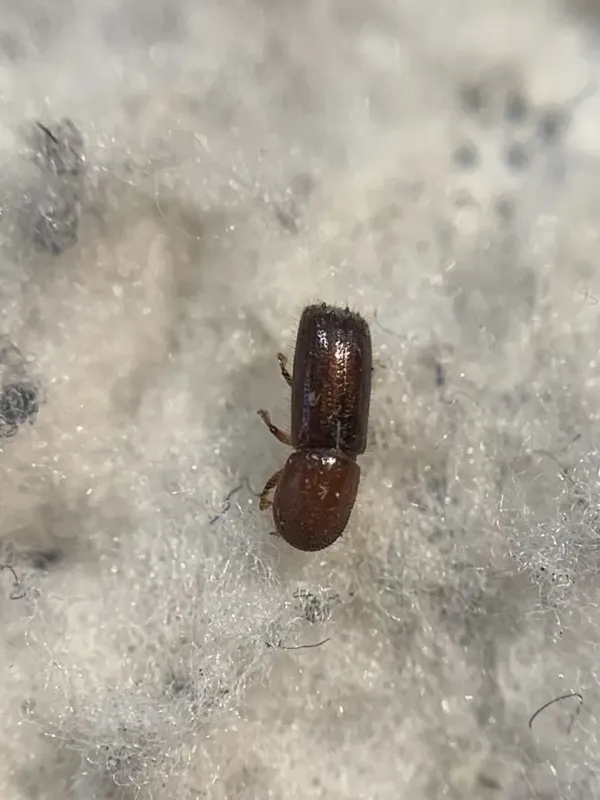
The oak ambrosia beetle (Xyleborus monographus) is a small beetle belonging to the subfamily Scolytinae. Adult insects have a cylindrical body measuring between 2.5 and 3.5 mm in length and are typically dark brown or black.
A notable feature of this species is sexual dimorphism: females are significantly larger than males. The head of the beetle is concealed by the pronotum, which is a common characteristic of Curculionidae family members.
The larvae are white, legless, and have a well-developed head capsule. They develop within galleries constructed by their parents inside the wood, feeding on specialized fungi rather than the wood itself.
These beetles maintain a symbiotic relationship with fungi of the genus Ambrosiella. These fungi serve as the primary nutritional source for both the larvae and the adult beetles within the galleries.
The species is a typical xylomycetophage. It does not infest healthy trees, preferring weakened, dying, or freshly felled logs where wood moisture is sufficient for fungal growth.
What it damages
The primary host for this beetle is the oak tree, particularly English oak and sessile oak. The pest chooses large trees with thick bark, which makes early visual detection challenging for foresters.
Beyond oak trees, the beetle can infest other broadleaved species such as beech and hornbeam. In conditions of forest stress, the insect can cause significant damage to the timber quality.
The galleries bored by the beetles significantly degrade the technical properties of the wood. Numerous exit and entry holes render the timber unsuitable for high-quality furniture or carpentry production.
The impact is exacerbated by the fungal spores carried by the beetle, which trigger pathological processes within the trunk, leading to tissue necrosis and reduced structural stability of the tree.
During outbreaks, the beetle population can infest trees with relatively low levels of stress, accelerating their decline and creating focal points for other secondary forest pests.
When it appears
The flight of adult beetles typically begins in spring, once temperatures remain consistently positive, usually during April and May. During this time, overwintered beetles search for suitable host trees.
Females bore entry holes through the bark, moving deep into the sapwood and heartwood. Inside, they establish a system of maternal galleries to deposit their eggs.
Multiple generations may develop throughout the summer season. The speed of the life cycle is directly dependent on temperature conditions and the availability of suitable host material.
As autumn approaches, beetle activity declines. Adult insects prepare for overwintering, which often takes place in the same galleries where their development was completed or under the bark.
For agronomists and forest managers, tracking the onset of the spring flight is crucial for initiating monitoring programs and deploying pheromone traps in high-risk zones.
Signs of infestation
The main external indicator of infestation is the presence of numerous small holes on the bark surface. Around these holes, one can often find "frass"—fine sawdust ejected by the beetles.
Upon removing the bark, entry holes leading into the wood are clearly visible. These galleries often appear darkened due to the fungal growth that the beetles farm for their food.
General tree weakening, yellowing, or premature leaf drop in the canopy can be indirect indicators, although these symptoms often suggest that the infestation has reached an advanced stage.
In early stages, if the damage is localized, the tree may attempt to flush out the galleries with sap, but this defense mechanism is generally weaker in oaks than in coniferous species.
- Presence of fine sawdust (frass) at the base of the trunk.
- Entry holes approximately 1.0–1.5 mm in diameter.
- Dark staining around the holes caused by fungal growth.
- Withered or dying branches in the upper canopy.
Control measures
The primary control measure is sanitary logging. Timely removal of infested and severely weakened trees prevents the spread of the beetles to healthy forest stands.
It is essential to transport timber out of the forest area before the spring flight begins. Leftover log piles often serve as primary breeding grounds for the population.
The use of pheromone traps allows for effective monitoring of beetle population dynamics and early response to increased infestation pressure in vulnerable forest areas.
Chemical insecticides with systemic action can be used in park and ornamental settings. Application must be carried out preventively before the beetles penetrate deep into the bark.
Maintaining overall biological resilience in forests through proper stand thinning, regular maintenance, and protection of root systems remains the best long-term strategy for pest management.
Taxonomy
- Latin name
- Xyleborus monographus
- Order
- Coleoptera (beetles)
- Family
- Curculionidae
- EPPO code
- XYLBMO
Discussion
No discussions yet — be the first.