
Rust-red ambrosia beetle
Xyleborus ferrugineus
Description
How to identify
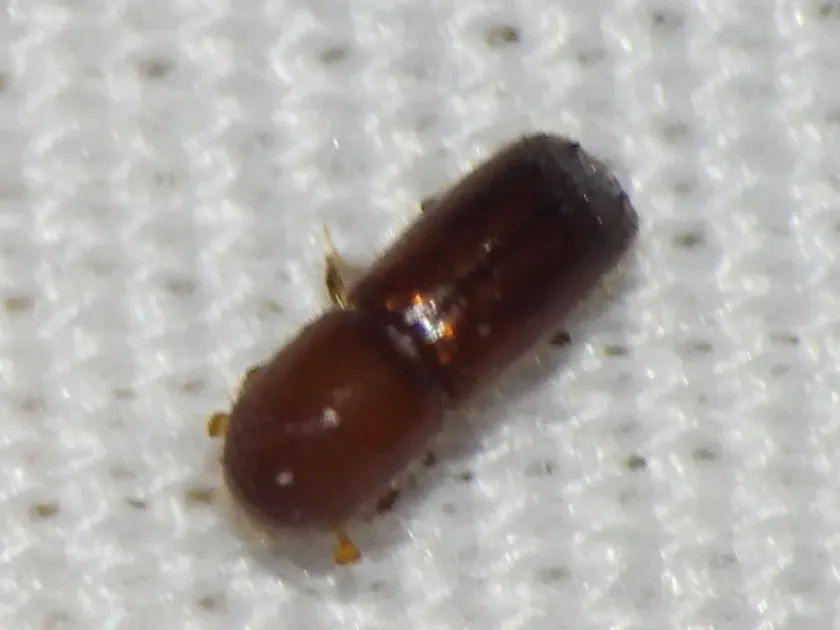
The rust-red ambrosia beetle (Xyleborus ferrugineus) is a tiny insect belonging to the Curculionidae family, specifically the Scolytinae subfamily. Adults typically measure between 2.5 and 3.5 mm in length.
The beetle has a cylindrical body covered with short, dense hairs. Its coloration ranges from light brown to a distinct rusty-brown shade, which is the origin of its common name.
Sexual dimorphism is prominent in this species; females are significantly larger than males. Males often possess vestigial wings, rendering them incapable of flight, while females are active flyers.
Larvae are legless, cream-colored grubs with a brown head capsule. They develop within specialized tunnels bored by the maternal adult inside the tree wood.
These beetles are highly cryptic, spending almost their entire life cycle inside the host plant's tissues, making early detection a significant challenge for growers.
What it damages
As a polyphagous pest, the rust-red ambrosia beetle attacks a wide variety of woody plants, including various fruit trees, coffee, cocoa, and ornamental hardwoods.
The primary damage is caused by the construction of gallery systems within the trunk or branches. These tunnels weaken the structural integrity of the wood.
Crucially, the beetle carries symbiotic fungi into the tunnels, which serve as its primary food source. These fungi can invade the plant's vascular system and cause wilting.
Stressed or recently cut trees are highly susceptible to infestation. Healthy trees with adequate water supply are more resistant but can still be attacked under high beetle pressure.
Infested trees often show signs of branch dieback and, in severe cases, the entire tree may dry out due to the interruption of water and nutrient transport.
When it appears
The activity of Xyleborus ferrugineus is largely temperature-dependent. In tropical and subtropical climates, the beetle can remain active and reproduce throughout the year.
Flight activity, where females seek new hosts, peaks during warm, humid conditions. Temperatures between +25 °C and +30 °C are considered optimal for its development.
The life cycle is relatively rapid, often completed within 30 to 45 days, allowing for several overlapping generations to occur in a single growing season.
Dispersal is achieved by females flying to new trees that emit chemical cues, such as ethanol or other fermentation products indicative of a stressed host.
During colder months, reproduction slows down, but the beetles remain active within the host wood, effectively overwintering as larvae or adults inside the gallery systems.
Signs of infestation
The most reliable indicator of an infestation is the presence of small entry holes, often less than 1 mm in diameter, on the bark of the trunk or branches.
These holes are usually accompanied by "frass" or boring dust — fine wood shavings ejected by the beetles during the excavation of their galleries.
Wilting of leaves and thinning of the canopy are classic symptoms that the vascular system of the tree has been compromised by the introduced fungi.
- Small entry holes resembling needle pricks on the trunk.
- Accumulation of fine wood dust (frass) at the base of the tree.
- Sudden yellowing or wilting of the foliage on specific branches.
- Dark-stained galleries within the wood cross-section.
When cutting into an infested stem, one can observe a network of tunnels with dark walls, stained black or brown due to the growth of the symbiotic ambrosia fungi.
Control measures
Effective management begins with maintaining high tree vigor through proper irrigation and fertilization, as healthy trees are less likely to attract the beetles.
Sanitation is critical. All infested branches or dead trees should be promptly pruned, removed, and destroyed by burning or chipping to eliminate breeding sites.
Pheromone-based monitoring traps are valuable tools for detecting the flight period of adults, which helps in timing any necessary protective treatments.
Systemic insecticides may offer some protection, but their efficacy is limited once the beetles have bored deep into the heartwood, where they are shielded from contact.
Preventing mechanical damage to the bark and avoiding excessive tree stress are essential cultural practices to minimize the risk of colonization by the rust-red ambrosia beetle.
Taxonomy
- Latin name
- Xyleborus ferrugineus
- Order
- Coleoptera (beetles)
- Family
- Curculionidae
- EPPO code
- XYLBFE
Discussion
No discussions yet — be the first.