
Elm bark beetle
Xyleborus celsus
Description
How to identify
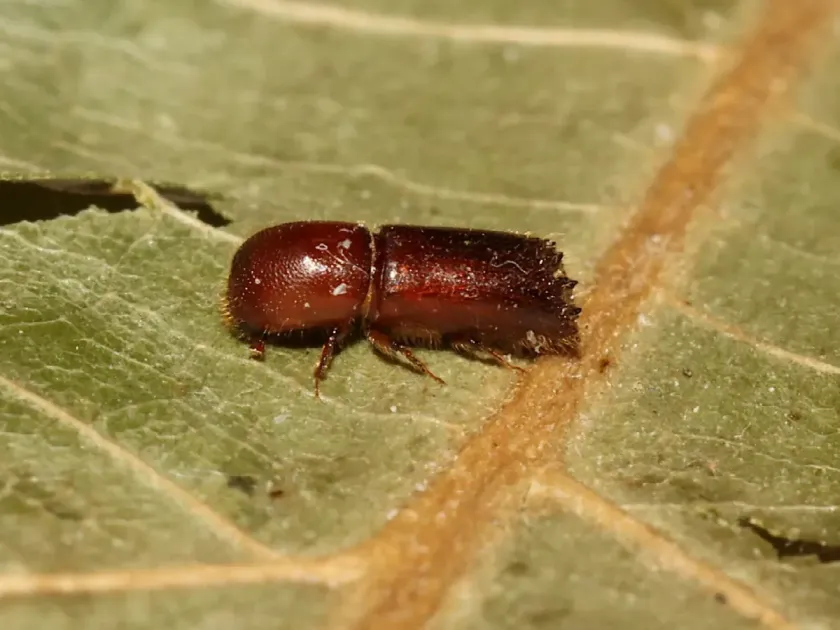
The Elm bark beetle Xyleborus celsus is a wood-boring pest belonging to the Curculionidae family and the Scolytinae subfamily. These insects are relatively small, typically measuring 4 to 5 mm in length.
Adult beetles possess a cylindrical body shape, which is standard for most wood-boring species. Their coloration ranges from dark brown to almost black, and their bodies are covered in fine, short hairs.
A notable feature is the sexual dimorphism; males are significantly smaller than females and are often flightless, spending their entire lifecycle within the galleries inside the host tree.
The larvae are legless, white-colored grubs with a brown head capsule. They develop within the tunnels excavated by the parent beetles deep in the wood of the tree.
This beetle is classified as an ambrosia beetle. It does not feed on wood fibers directly but rather cultivates symbiotic fungi on the walls of its tunnels, which serves as the primary food source for both adults and larvae.
What it damages
The primary host for this pest is the Elm tree Ulmus genus. While it has a strong preference for Elms, it can occasionally attack other weakened deciduous tree species under high population pressure.
The beetles primarily target trees that are already stressed due to drought, physical trauma, or infection. Healthy trees with strong sap flow can often drown out invading beetles with resin or sap.
Damage is caused by the construction of extensive tunnel systems within the sapwood and heartwood. This disrupts the tree's vascular system, hindering the transport of water and nutrients, leading to limb dieback.
Additionally, the beetles act as vectors for various fungal pathogens. These fungi spread through the tree's interior, causing rapid decay of tissues and significantly shortening the lifespan of the host.
Severe infestations weaken the structural integrity of the tree, making it susceptible to windthrow and secondary pest invasions, often resulting in the eventual death of the tree.
When it appears
The flight season for the adults typically begins in late spring, usually in May, when temperatures become sufficiently high to stimulate the activity of the overwintering adults.
Females search for suitable host trees to initiate galleries. Upon finding a vulnerable tree, they bore entry holes and prepare brood chambers where they deposit their eggs.
Depending on the climatic conditions and the duration of the summer, the insect can complete one or two generations per year. Warm and humid conditions generally favor faster development cycles.
As autumn approaches, the beetles prepare for the winter. They remain inside the wood galleries, where they stay dormant during the cold months, protected by the insulation of the tree trunk.
The synchronization of the beetle life cycle with the tree's health is crucial. Periods of prolonged drought often act as a trigger for widespread infestations, as trees lose their defense mechanisms.
Signs of infestation
The first external sign of an infestation is the appearance of tiny entry holes in the bark, often accompanied by the accumulation of frass, which looks like fine sawdust or drilling flour.
The canopy of an infested tree may show signs of thinning, yellowing, or premature leaf drop. This indicates that the vascular system is being compromised by the beetle's gallery construction.
When peeling back the bark of a heavily infested tree, complex tunnel patterns are visible. The walls of these tunnels are often stained black or dark brown due to the growth of fungal mycelia.
In some cases, the bark may start to loosen or crack. If wood is cut, the characteristic ambrosia fungus staining provides definitive evidence of the species' presence.
- Sawdust-like frass on the bark surface.
- Canopy dieback and premature yellowing of leaves.
- Dark fungal growth patterns within wood galleries.
Control measures
The most effective management strategy is the timely removal and disposal of infested trees. It is essential to fell and destroy infected wood before the new generation of beetles emerges.
Regular forest pathology monitoring is critical, especially in urban areas or arboretums where high-value Elm trees are kept, to detect early signs of pest activity.
Promoting tree health is a key preventative measure. Adequate irrigation and fertilization can boost the tree's natural resistance, making it less attractive to wood-boring insects.
Chemical control can be challenging due to the beetle's concealed lifestyle. While systemic insecticides may provide some protection for healthy trees, they are often insufficient once the infestation has begun.
Biological control efforts include encouraging natural predators, such as woodpeckers and predatory insects, which can help regulate beetle populations in forested ecosystems.
Taxonomy
- Latin name
- Xyleborus celsus
- Order
- Coleoptera (beetles)
- Family
- Curculionidae
- EPPO code
- XYLBCE
Discussion
No discussions yet — be the first.