
Brown Xyleborus
Xyleborus aquilus
Description
How to identify
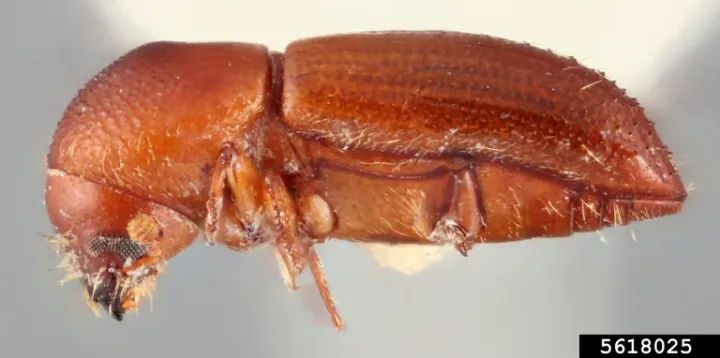
The Brown Xyleborus (Xyleborus aquilus) is a member of the Curculionidae family, specifically within the Scolytinae subfamily. These are small, cylindrical beetles measuring approximately 2–3 mm in length, typically displaying a dark brown to blackish coloration.
Females of this species are equipped with specialized structures called mycangia, used to transport symbiotic ambrosia fungi. These fungi are essential as they serve as the primary food source for the beetle's developing larvae and adults inside the wood.
Physically, they resemble other ambrosia beetles, making accurate identification in the field challenging. They have a compact body shape adapted for tunneling through timber and woody stems.
The life cycle is entirely internal, occurring within the woody tissue. Unlike many other pests, the males are flightless and stay within the galleries, whereas the fertilized females emerge to seek new host trees to establish new colonies.
Due to their cryptic habits, these beetles are rarely seen on the surface, except during the brief period of dispersal when females emerge to colonize stressed or weakened trees.
What it damages
This beetle primarily attacks deciduous trees, including various fruit-bearing species like apple, pear, and plum. They prefer hosts that are already weakened by environmental stress, disease, or physical injury.
The damage is caused by the construction of tunnel galleries that disrupt the vascular system (xylem and phloem) of the tree. This mechanical damage hinders the transport of water and nutrients, leading to progressive dieback.
The ambrosia fungus introduced by the beetles creates dark staining and decay within the galleries. This fungal growth further compromises the wood structure and can weaken the branch or trunk integrity significantly.
Young trees are particularly susceptible to fatal infestations. Even in mature trees, high population densities can lead to reduced fruit yield, branch mortality, and eventual decline of the entire tree.
In addition to direct injury, the tunneling provides entry points for secondary pathogens, such as bacteria or other fungal infections, which accelerate the overall degradation of the woody plant tissue.
Signs of infestation
The most prominent sign of an infestation is the presence of small, perfectly circular entry holes, approximately 1–1.5 mm in diameter, scattered along the bark of the trunk or larger branches.
In early stages, you may observe sap or gum oozing from these entry points. This is the tree's physiological reaction to the invading beetles as it attempts to flush them out with resin or sap.
Upon inspecting a piece of infested wood, you will find intricate, branching galleries lined with dark-colored fungal growth. This dark staining is a diagnostic indicator of ambrosia beetle activity.
Visual symptoms in the canopy include premature yellowing and wilting of leaves. If the infestation is severe, entire branches may die back, showing signs of drought-like symptoms despite sufficient soil moisture.
Peeling back the bark in symptomatic areas often reveals the tunnel network where beetles at various life stages (larvae, pupae, and adults) can be found residing within the wood tissue.
Control measures
The most effective management strategy is cultural control. Maintaining tree vigor through proper irrigation, balanced fertilization, and good soil management is critical, as stressed trees are primary targets for attack.
Sanitation is paramount. Infested branches or dead trees should be removed and destroyed immediately, preferably by burning, to prevent the emergence and dispersal of the adult beetles to healthy parts of the orchard.
Pheromone traps can be utilized for monitoring the flight activity of the beetles. While they may not provide full control, they are excellent tools for timing other management interventions.
Chemical control is difficult because the beetles live protected inside the wood for most of their life cycle. Insecticide applications are usually ineffective unless timed perfectly with the short period of adult dispersal.
Good horticultural practices, including proper pruning to ensure light penetration and airflow, and protecting trunks from sunscald, help keep the trees resilient against potential colonization.
Taxonomy
- Latin name
- Xyleborus aquilus
- Order
- Coleoptera (beetles)
- Family
- Curculionidae
- EPPO code
- XYLBAQ
Discussion
No discussions yet — be the first.