
Xyleborus amplexicauda
Xyleborus amplexicauda
Description
How to identify
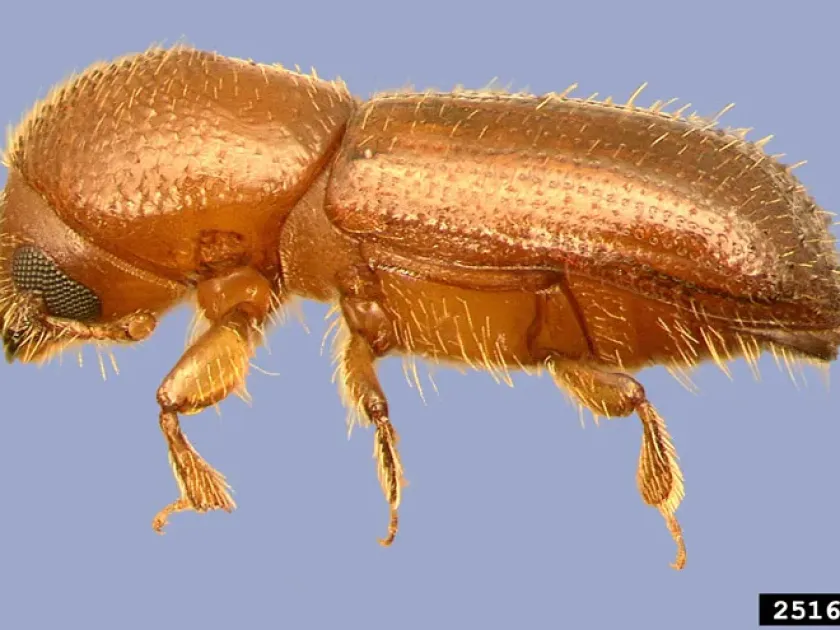
Xyleborus amplexicauda is a species of wood-boring beetle belonging to the family Curculionidae and the subfamily Scolytinae. These insects are well-known as ambrosia beetles due to their unique symbiotic relationship with fungi.
The adult beetle has a cylindrical body with a dark brown or black color, typical of the genus Xyleborus. They are very small, often measuring only a few millimeters in length, making them difficult to detect without careful inspection of the tree bark.
The lifecycle is centered around the cultivation of ambrosia fungi within the galleries bored into the wood. The beetle species relies on these fungi as a primary food source for their larvae, which distinguishes them from typical wood-consuming beetles.
Female beetles are primarily responsible for the colonization of new hosts, while the males are often flightless and remain within the parental galleries. This behavior limits the beetle's natural dispersal but makes the females highly efficient at finding susceptible trees.
Proper identification usually requires an entomologist to examine the specific morphological structures of the beetle’s posterior, as many Xyleborus species share a similar external appearance.
What it damages
This pest attacks a variety of hardwood tree species, including fruit trees and native forest timber. While they prefer stressed or weakened trees, high population densities can lead to attacks on seemingly healthy specimens.
The damage occurs when the beetles bore tunnels deep into the sapwood and heartwood, disrupting the tree’s vascular system. This prevents the normal transport of water and nutrients, leading to branch dieback and eventual tree mortality.
The introduction of ambrosia fungi into the tunnels causes significant staining and wood decay. This decay process further weakens the tree's internal structure and creates an entry point for secondary pathogens, such as bacteria and opportunistic rot fungi.
For the timber industry, the economic impact is substantial because the tunnels leave small, dark-stained holes, often called "shot-holes," which downgrade the quality of the lumber and make it unsuitable for high-value applications.
The cumulative effect of tunneling and fungal infection creates a synergistic stress that can cause rapid decline in orchards and forested areas, particularly during periods of drought or other environmental stressors.
Signs of infestation
The most visible sign of an infestation is the presence of small, perfectly circular entry holes on the bark. These holes are often accompanied by fine, powdery sawdust, known as "frass," which is pushed out by the beetles.
On certain tree species, sap exudation or gumming around the entry points may be observed. This is the tree's natural physiological attempt to flush out the invader and seal the tunnel entrance with resin or gums.
As the infestation progresses, the canopy shows signs of distress, including wilting, yellowing of leaves, and premature leaf drop. These symptoms reflect the compromised hydraulic function of the vascular system deep within the stem.
If the bark is peeled back, one can see the galleries, which are often stained with dark fungal growth. The pattern of these tunnels can range from simple radial bores to more complex branched systems depending on the severity of the attack.
In mature infestations, the affected portions of the tree may exhibit localized decay, and the overall vigor of the host plant decreases noticeably compared to healthy trees in the same vicinity.
Control measures
Sanitation is the most critical component of control. Infested branches or whole trees should be promptly removed, chipped, or burned to eliminate the breeding habitat before the next generation of adults can emerge.
Maintaining tree health through proper irrigation, fertilization, and site management is essential. Healthy, vigorous trees are far more capable of resisting initial colonization attempts by ambrosia beetles.
Monitoring using pheromone-based traps is highly recommended to detect the presence of the beetle early in the season. These traps can help time the application of chemical controls more effectively.
Preventative insecticide applications on the trunks of vulnerable or valuable trees can provide a temporary barrier against colonization. However, such treatments must be applied strictly according to local regulations and prior to peak beetle flight times.
- Removal and destruction of infested wood to reduce local populations.
- Promotion of overall tree vitality to minimize stress-induced susceptibility.
- Strategic use of pheromone traps for early detection and population tracking.
- Proper pruning and maintenance to facilitate tree resilience against boring pests.
Taxonomy
- Latin name
- Xyleborus amplexicauda
- Order
- Coleoptera (beetles)
- Family
- Curculionidae
- EPPO code
- XYLBAM
Discussion
No discussions yet — be the first.