
Xyleborus affinis
Xyleborus affinis
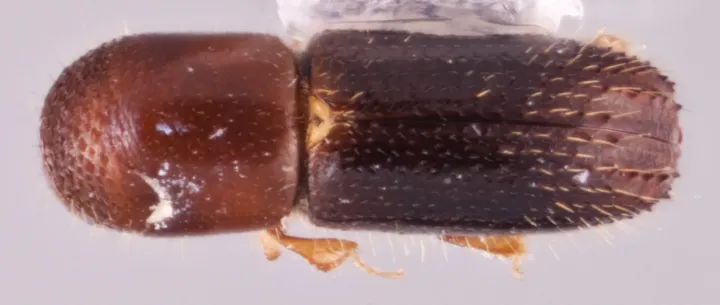
Description
How to identify
Xyleborus affinis is a species of beetle belonging to the family Curculionidae and the subfamily Scolytinae. These insects are commonly known as ambrosia beetles, typically measuring between 2.0 and 2.5 mm in length.
The adult beetle possesses a cylindrical, dark brown or black body. Its morphology is adapted for wood-boring, with a robust thorax and mandibles capable of creating intricate tunnel systems within the host plant's wood.
A distinctive biological trait of this species is its obligate symbiosis with fungi. Adults carry fungal spores in specialized thoracic organs called mycangia to facilitate the colonization of new host tissues.
The life cycle includes eggs, larvae, pupae, and adults. Both the male and female play roles in maintaining the tunnel system, although the female is responsible for dispersal and initiating new galleries.
The taxonomic classification reflects its place within the diverse Scolytinae group, which encompasses many important forest and agricultural pests globally.
What it damages
This species is a polyphagous pest, capable of attacking a wide range of woody plants. It is particularly notorious for damaging fruit trees, coffee, cocoa, and various forest species in tropical and subtropical climates.
The primary damage is caused by the fungal species introduced by the beetle into the vascular system of the tree. This fungus grows within the tunnels, blocking the transport of water and nutrients.
While healthy trees can sometimes produce resin or sap to repel the beetles, trees stressed by drought, disease, or physical damage are highly susceptible to mass infestation.
In high densities, the beetles can cause rapid branch dieback and, in severe cases, the death of the entire tree. This leads to significant economic losses in fruit plantations and timber forests.
The aesthetic and physical quality of the wood is also degraded due to the dark staining of the tunnels caused by the fungal growth, which is often referred to as "ambrosia staining".
Signs of infestation
The most reliable sign of an Xyleborus affinis infestation is the presence of tiny, circular entry holes in the bark, often accompanied by fine, light-colored frass (wood dust).
Wilting of foliage on individual branches is a classic indicator that the beetle-fungus complex has disrupted the xylem, preventing water movement to the upper parts of the tree.
In cross-sections of infected branches, observers will find dark, discolored tunnels. The walls of these galleries are blackened due to the characteristic pigmentation of the symbiotic fungi.
A pervasive fermented odor might be detected around severely infested trees, caused by the metabolic activity of the fungi developing inside the woody galleries.
Periodic monitoring for signs of sawdust accumulation at the base of the tree or on leaf surfaces is essential for early detection, especially during warmer, drier periods of the year.
Control measures
The most effective management strategy is to ensure tree vigor through proper irrigation, fertilization, and site maintenance. Healthy trees are significantly more resistant to initial beetle attacks.
Sanitation practices, such as the immediate removal and destruction (burning or chipping) of infested branches or downed wood, are critical to reduce the local beetle population.
Monitoring using alcohol-based traps is highly effective for detecting the presence of these beetles. These traps can help growers time their management interventions effectively.
Chemical control is rarely effective as a stand-alone method due to the internal nature of the pest's life cycle. Insecticides are primarily useful only as a prophylactic barrier during peak flight periods.
Biological control involves promoting biodiversity within the orchard, including predatory beetles and wasps, which can naturally regulate the populations of ambrosia beetles in the ecosystem.
Taxonomy
- Latin name
- Xyleborus affinis
- Order
- Coleoptera (beetles)
- Family
- Curculionidae
- EPPO code
- XYLBAF
Discussion
No discussions yet — be the first.