
Eight-toothed wood-boring beetle
Xyleborinus octiesdentatus
Description
How to identify
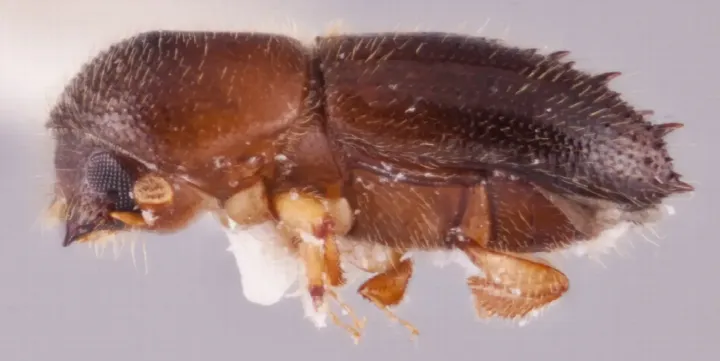
The eight-toothed wood-boring beetle (Xyleborinus octiesdentatus) is a member of the Curculionidae family, specifically within the bark beetle subfamily. Adults are small insects, typically measuring between 3 and 4 millimeters in length.
The body of the beetle is cylindrical in shape and ranges in color from dark brown to black. The defining feature of this species is the set of eight teeth located on the slope of the elytra, which makes identification possible for experts.
Larvae are legless, white-bodied insects with a prominent brown head capsule. They spend their entire developmental period inside the wood, feeding on internal tissues until they pupate.
Adults are highly adept at finding stressed trees, using chemical signals to locate suitable hosts. Because they live inside the tree, they are well-protected from environmental changes and many natural predators.
Proper identification usually requires examining the structure of the teeth on the elytra under magnification, as these beetles often resemble other closely related bark beetle species.
What it damages
This pest affects a variety of deciduous and coniferous tree species, particularly those already weakened by drought, disease, or old age. Healthy trees may also be attacked if the beetle population reaches high levels.
Damage is caused by both adult beetles and larvae tunneling through the bark and deep into the sapwood. These galleries disrupt the flow of nutrients and water, causing significant physiological stress to the tree.
Furthermore, these beetles act as vectors for pathogenic fungi. By introducing these spores into their galleries, they accelerate the decay of the wood, which severely compromises the tree's internal structure.
For commercial timber, the activity of these beetles results in significant economic loss, as the galleries reduce the quality and integrity of the wood.
Once a tree is heavily infested, it typically exhibits signs of crown dieback and rapid decline, often leading to mortality within one or two growing seasons.
When it appears
The activity of the eight-toothed wood-boring beetle is strongly influenced by ambient temperature. Emergence typically begins in early spring, once temperatures remain consistently above 15 degrees Celsius.
The primary reproductive phase occurs during the summer months when adults swarm to find new hosts. Females bore deep into the tree, creating the necessary conditions for egg-laying and larval development.
The entire life cycle, including egg, larval stages, and pupation, occurs within the wood. This protective habitat ensures high survival rates for the offspring even under varying weather conditions.
As autumn arrives and temperatures drop, adults often seek refuge in the galleries or deep within the bark to overwinter. A successful hibernation allows them to continue their life cycle early the following season.
Extended, warm autumns can occasionally trigger a secondary period of activity, which significantly increases the risk of damage to the host population before winter sets in.
Signs of infestation
The most reliable sign of an infestation is the presence of small, round entrance holes on the surface of the bark. These holes are often accompanied by fine, wood-colored frass or sawdust collecting near the base of the tree.
Crown symptoms, such as premature yellowing, thinning, or wilting of branches, are indicators that the tree's transport system has been severely compromised by the internal tunneling.
Sap or resin exudation from the bark surface may also occur as the tree attempts to push out the invaders. In many cases, however, this defense is insufficient to stop a large-scale attack.
- Presence of numerous small circular holes on the trunk.
- Accumulation of fine boring dust (frass) at the base of the tree.
- Softened or sloughing bark in areas of high infestation.
- Gradual loss of foliage color and vitality.
Monitoring for these symptoms is essential, as early detection provides the best chance to manage the pest and prevent it from spreading to nearby healthy trees.
Control measures
The most effective management strategy is the immediate removal and destruction of infested timber. This process, known as sanitation, helps reduce the population by removing breeding sites.
Pheromone traps are valuable tools for monitoring population levels and catching adult beetles during peak flight times. These should be placed strategically away from high-value trees.
In ornamental or garden settings, preventive application of systemic insecticides can protect individual trees from successful colonization during the beetle's peak activity period.
Cultural practices, such as maintaining optimal soil moisture and nutrient levels, improve tree resistance. A vigorous, healthy tree is much better equipped to defend itself against wood-boring pests.
Regular inspections throughout the growing season are crucial. If an infestation is caught early, pruning or removing specific branches may be enough to save the rest of the tree.
Taxonomy
- Latin name
- Xyleborinus octiesdentatus
- Order
- Coleoptera (beetles)
- Family
- Curculionidae
- EPPO code
- XYBIOC
Discussion
No discussions yet — be the first.