
Xyleborinus gracilis
Xyleborinus gracilis
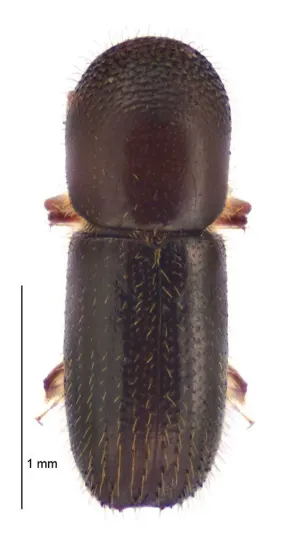
Description
How to identify
Xyleborinus gracilis is a species of bark beetle belonging to the family Curculionidae, subfamily Scolytinae. As a member of the ambrosia beetle group, it does not feed directly on wood tissues but instead cultivates symbiotic fungi within its galleries.
The adult beetle is small and cylindrical, characterized by a dark brown or blackish color. Like other members of the tribe Xyleborini, its morphology is highly adapted for tunnel excavation and the transport of fungal spores in specialized structures on its body.
The larvae are typically legless, white, and grub-like, remaining confined to the galleries prepared by their parents. They rely entirely on the fungal mycelium growing on the walls of the tunnels as their primary source of nutrition.
Sexual dimorphism is distinct in this species, with males being much smaller and flightless. Females are the primary dispersers, responsible for colonizing new host trees and establishing new tunnel networks to start a new generation.
Taxonomic identification requires careful microscopic examination of the pronotum and elytra characteristics. In the field, their presence is often inferred from the specific pattern of their entry holes and the associated fungal discoloration of the wood.
What it damages
This beetle primarily targets weakened, stressed, or recently felled hardwood and softwood trees. Healthy, vigorous trees are usually capable of resisting colonization through defensive mechanisms like resin or sap exudation, which can trap or repel invading beetles.
In orchards and nurseries, Xyleborinus gracilis can become a serious pest if trees are suffering from drought, poor nutrition, or previous mechanical injury. Under such stress, the tree's natural defenses are bypassed, allowing the beetles to establish colonies.
The primary damage is caused by the construction of galleries that interrupt the flow of water and nutrients within the tree. The introduced symbiotic fungi can further cause vascular blockage, leading to the rapid decline and death of the host.
Infestation reduces the timber quality of affected trees, making them unsuitable for commercial use. In severe cases, the combined impact of the beetle's galleries and the fungal infection causes branch dieback or total tree mortality.
Economic damage is most significant in regions experiencing extreme environmental stress. Prolonged drought periods provide ideal conditions for the beetle to multiply and cause widespread damage to stands that are already struggling to survive.
Signs of infestation
The most visible sign of infestation is the presence of tiny, circular entry holes on the bark surface. These holes are often accompanied by fine, light-colored frass or wood dust, which is pushed out by the beetles as they bore into the wood.
Tree bark may show signs of sap or resin weeping around the entry points, reflecting the tree's attempts to seal off the intruders. However, these signs are frequently absent in severely weakened trees that lack the energy to produce defensive secretions.
Interior damage is discovered by peeling back the bark, revealing a complex network of tunnels. The gallery walls are often stained dark by the growth of the symbiotic fungi, which provides a distinct visual signature of an ambrosia beetle attack.
Foliage symptoms include premature yellowing, wilting, and thinning of the canopy. As the beetle population grows within the trunk, the decline of the tree becomes more rapid and irreversible, often starting from the top and moving downwards.
The emergence of a new generation of beetles is marked by the appearance of numerous small exit holes. Monitoring these holes is crucial for determining the timing and intensity of the current beetle generation.
Control measures
The cornerstone of management is cultural control, specifically maintaining tree vigor through proper irrigation and soil management. Healthy trees are naturally resistant and generally do not support beetle colonization.
Sanitation is essential; dead, dying, and heavily infested trees must be removed and destroyed immediately to eliminate breeding grounds. This practice significantly reduces the beetle pressure in forests and nurseries.
Monitoring using pheromone-based traps is an effective strategy for detecting the presence of adults. This allows managers to time potential interventions and gain insight into the activity cycles of the local beetle population.
- Regular inspection of tree trunks for evidence of entry holes.
- Sanitary pruning and removal of infested or stressed branches.
- Destruction of fallen logs and woody debris to minimize habitat.
Chemical control is rarely effective for interior infestations due to the beetles' protected environment within the wood. If insecticide applications are deemed necessary, they should be timed precisely to coincide with the flight periods before the beetles tunnel into the bark.
Taxonomy
- Latin name
- Xyleborinus gracilis
- Order
- Coleoptera (beetles)
- Family
- Curculionidae
- EPPO code
- XYBIGR
Discussion
No discussions yet — be the first.