
Little xylosandrus
Xyleborinus exiguus
Description
How to identify
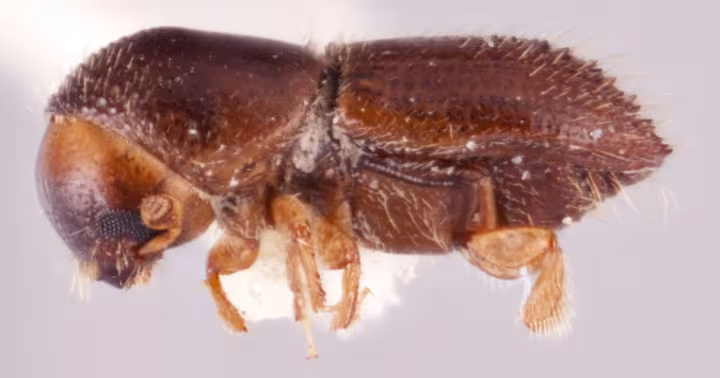
The little xylosandrus (Xyleborinus exiguus) is a small beetle belonging to the family Curculionidae and the subfamily Scolytinae. These insects are microscopic, typically measuring only 2 to 2.5 mm in length.
Their bodies are dark brown or black, cylindrical in shape, and sparsely covered with short hairs. This morphology is specialized for navigating tunnels carved deep within the woody tissues of their hosts.
A unique aspect of their biology is their symbiotic relationship with ambrosia fungi. Adult females possess specialized organs known as mycangia, which transport fungal spores to new galleries to feed their larvae.
They are primarily monogamous, with the female taking the lead in constructing the galleries deep within the sapwood and heartwood of the trees they colonize.
These beetles are cryptic, spending almost their entire life cycle hidden inside the tree, which makes them difficult to observe until significant damage has already occurred.
What it damages
This pest attacks a wide variety of hardwood trees. It shows a preference for stressed or recently felled timber, but can also infest living trees that are physically weakened by environmental factors.
The damage is mainly technical. As the beetles bore into the wood, they create dense networks of tunnels that destroy the structural integrity of the timber, rendering it useless for high-quality carpentry or furniture production.
The larvae feed on the fungal layer lining the galleries. This fungal activity creates characteristic discoloration, often referred to as "ambrosia staining," which lowers the market value of the wood.
In living trees, the tunneling disrupts the xylem vessels. This impairment reduces the tree's ability to transport water and nutrients, which can lead to wilting, branch dieback, or even tree death if the infestation is severe.
Young trees in nurseries or orchards are particularly vulnerable, as even a small number of entry holes can compromise their growth and structural stability, often serving as entry points for secondary pathogens.
When it appears
The activity period of the little xylosandrus is heavily dependent on ambient temperature. Flight and colonization typically begin in the spring when temperatures consistently reach 15-18 degrees Celsius.
Throughout the warmer summer months, the beetles are most active in searching for new hosts. Depending on the climate, the species can produce multiple overlapping generations within a single growing season.
As autumn approaches and temperatures decline, adult beetles begin to seek overwintering sites. They often remain within their galleries in the wood or migrate to the leaf litter and bark crevices at the tree base.
Monitoring for this pest is most effective during the peak flight season when traps can catch the beetles before they successfully penetrate the bark of healthy trees.
In controlled environments, such as greenhouses or tropical climates, these insects can maintain activity year-round, posing a constant risk to the health of the host plants.
Signs of infestation
The most reliable indicator of an active infestation is the presence of fine sawdust, known as "frass," appearing near the base of the tree or on the surface of the bark.
Tiny entrance holes, roughly 1 mm in diameter, are visible upon close inspection. In some cases, sap flow around these holes can be observed if the tree is attempting to defend itself.
Internal damage manifests as complex, branching galleries. These are often dark or stained, providing visual proof of the symbiosis between the beetle and the wood-inhabiting fungi.
Visible decline in the canopy, such as yellowing or browning leaves, serves as a late-stage warning that the vascular system of the tree has been heavily compromised by the tunneling.
Bark peeling in patches can also reveal the entry points and the underlying damage pattern, confirming the presence of an active colony of wood-boring beetles.
Control measures
Sanitation is the most effective management strategy. Removing and destroying infested timber or pruned branches stops the dispersal of new generations of beetles to healthy trees in the vicinity.
Maintaining tree vigor is essential for prevention. Proper irrigation, fertilization, and site maintenance reduce the likelihood of trees becoming attractive targets for colonization.
- Deploying pheromone traps to monitor beetle population levels.
- Applying systemic or contact insecticides to the bark during peak flight periods.
- Removing and incinerating infested host material immediately.
- Encouraging natural predators, such as woodpeckers and predatory beetles, to inhabit the area.
- Protecting trees from mechanical damage that could create entry points.
Chemical control is best utilized as a preventive measure for high-value trees or in nurseries. The insecticide must be applied thoroughly to the bark to ensure that beetles are exposed before they enter the wood.
A long-term approach should involve integrating biological control agents and sustainable forestry practices, ensuring the landscape remains resilient against the establishment of wood-boring pests.
Taxonomy
- Latin name
- Xyleborinus exiguus
- Order
- Coleoptera (beetles)
- Family
- Curculionidae
- EPPO code
- XYBIEX
Discussion
No discussions yet — be the first.