
Xyleborinus attenuatus
Xyleborinus attenuatus
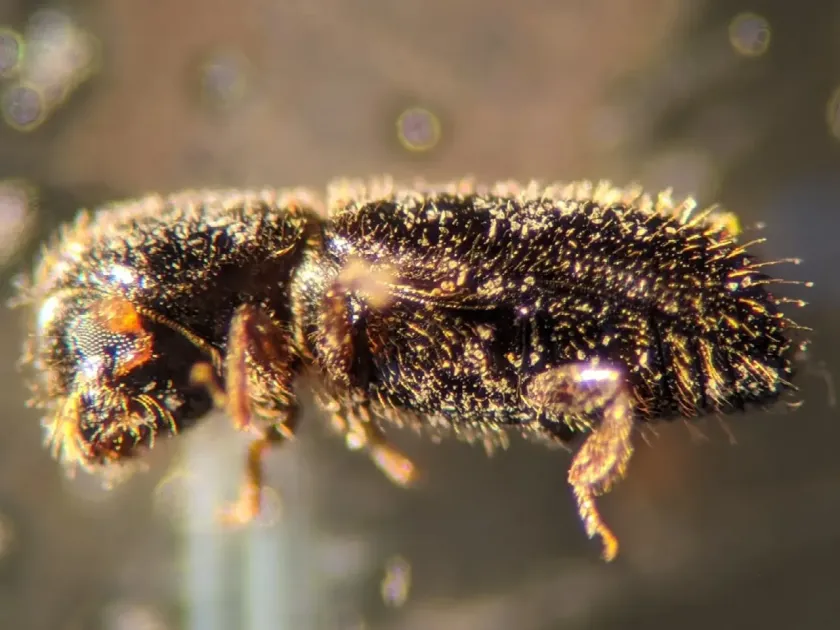
Description
How to identify
Xyleborinus attenuatus is a small beetle belonging to the Curculionidae family, specifically the Scolytinae subfamily (ambrosia beetles). Adult individuals measure approximately 2.5 to 3.5 mm in length.
The body is elongated and cylindrical, typically dark brown or black in color. The elytra are covered with fine, dense setae, giving the insect a matte appearance.
There is clear sexual dimorphism; females are larger and responsible for excavating gallery systems, while males are smaller, often flightless, and remain within the host wood.
This species is characterized by its symbiotic relationship with fungi (Ambrosiella spp.), which the females transport and cultivate in their galleries to feed their larvae.
Identification often requires careful inspection of the pronotum and head morphology, as it closely resembles other species within the Xyleborini tribe.
What it damages
This beetle is a polyphagous pest, primarily attacking various deciduous trees, including alder, oak, beech, and hornbeam, as well as several fruit tree species.
The pest typically selects stressed or weakened trees, focusing on areas with damaged bark or sites prone to environmental stress like sunscald.
The economic impact is significant in forestry, as the galleries bored into the wood degrade timber quality and render the wood unsuitable for high-value applications.
In orchards, heavy infestation can lead to the wilting and eventual death of branches, severely affecting tree productivity and vigor.
Furthermore, the presence of symbiotic fungi introduced by the beetle can cause localized necrosis and vascular blockages in the host plant.
When it appears
The emergence of adult Xyleborinus attenuatus occurs in early spring, triggered by rising temperatures, typically when daily means exceed +12...+14°C.
Peak flight and infestation activity are usually observed in late spring to early summer (May-June), which is the primary period for establishing new galleries.
Depending on regional climatic conditions, the pest may complete one or two generations within a single growing season.
Adults overwinter inside the galleries bored into the wood, which provides insulation against extreme temperatures.
Favorable weather conditions, such as warm springs and mild winters, can lead to exponential population growth and increased pressure on host trees.
Signs of infestation
The first indicator of an infestation is the appearance of tiny, circular entrance holes, about 1–1.5 mm in diameter, on the surface of the bark.
Accumulation of "boring dust" (frass) at the base of the tree or in bark crevices is a reliable sign of active gallery formation inside the wood.
In affected fruit trees, one may observe flagging or wilting of individual branches during the mid-summer months.
Sap exudation can occur at the entry sites, creating dark, wet spots on the bark as the tree attempts to seal the wounds.
Chronic infestations eventually lead to crown dieback, sparse foliage, and the overall decline of the tree's physiological condition.
Control measures
Cultural management is the primary defense, focusing on keeping trees healthy through proper irrigation, fertilization, and avoiding physical damage to the trunk.
Sanitation is critical: all heavily infested wood or fallen branches should be removed and destroyed (burned or chipped) to prevent the spread of the population.
- Use of pheromone traps to monitor adult beetle flight activity and population density.
- Application of systemic insecticides to the bark of stressed trees during the flight period as a preventative measure.
- Maintenance of site hygiene to reduce the availability of suitable hosts for new infestations.
Biological control agents, such as predatory beetles and parasitoid wasps, play a role in regulating populations in natural forest ecosystems.
In managed landscapes, regular inspections of high-risk tree species during the early season are recommended for early detection and intervention.
Taxonomy
- Latin name
- Xyleborinus attenuatus
- Order
- Coleoptera (beetles)
- Family
- Curculionidae
- EPPO code
- XYBIAL
Discussion
No discussions yet — be the first.