
Xyleborinus artestriatus
Xyleborinus artestriatus
Description
How to identify
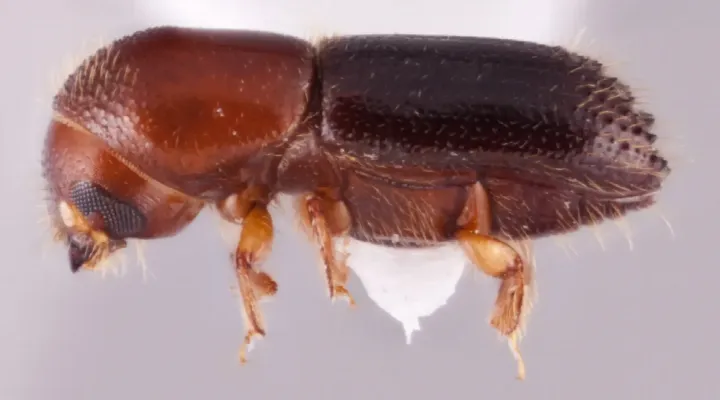
Xyleborinus artestriatus is a small wood-boring beetle belonging to the Curculionidae family, subfamily Scolytinae. Adult beetles are typically 2–3 mm long with a cylindrical shape.
Their bodies are dark brown to black, and the elytra feature distinct longitudinal striae marked with small, deep punctures, which is a key diagnostic feature for this species.
Larvae are white, legless, and grub-like, adapted for life within the woody tissues of trees. They rely on galleries created by adults to survive and feed.
As members of the ambrosia beetle group, these insects have a symbiotic relationship with specific fungi, which they cultivate within their tunnels as a primary food source.
Identifying this pest in the field is difficult due to its small size and tendency to remain hidden inside the tree trunk for most of its life cycle.
What it damages
This beetle species attacks various deciduous tree species, including major fruit trees like apples, pears, and plums, as well as several forest tree types.
It primarily targets trees that are already physiologically stressed due to drought, nutritional deficiencies, mechanical injury, or previous disease infections.
The damage caused by the galleries disrupts the vascular system of the host plant, hindering the flow of water and nutrients throughout the tree canopy.
Beyond physical damage, the beetles introduce pathogenic fungi into the woody tissues, leading to wood rot and significant decay, which can eventually kill the tree.
In high-density populations, even relatively healthy trees may be overwhelmed by the sheer number of entry points and the associated fungal diseases.
When it appears
Adult emergence typically begins in the spring when temperatures consistently reach levels suitable for flight and reproductive activity.
Throughout the growing season, multiple generations can occur depending on the regional climate, leading to continuous risk for orchards during summer months.
The peak activity periods for finding new host trees usually correlate with warm, humid weather conditions that favor both beetle flight and fungal growth.
As autumn approaches and temperatures drop, adult beetles seek out overwintering sites within the wood of their current or new host plants.
Monitoring for flight activity is essential in late spring and early summer to implement timely protection before the beetles settle into the trees.
Signs of infestation
A primary indicator of infestation is the presence of frass (wood dust) appearing near the entry holes on the bark or at the base of the tree trunk.
Small, circular entry holes, often less than 2 mm in diameter, are visible upon close inspection of the tree bark, especially on smooth-barked species.
Infested trees often exhibit canopy thinning, leaf yellowing, and sudden wilting of branches, indicating significant disruption of vascular transport.
Peeling back small sections of bark may reveal intricate, branched tunnel systems often stained by the growth of symbiotic or pathogenic fungi.
- Fine wood dust accumulation at the base.
- Small circular entry holes on the trunk.
- Premature leaf senescence and wilting.
- Fungal staining within the woody tissues.
- Dieback of affected branches.
Control measures
Sanitation is the cornerstone of control: promptly remove and destroy all infested, dead, or severely weakened trees to reduce the local beetle population.
Maintaining optimal tree vigor through proper irrigation, fertilization, and careful pruning makes trees more resistant to beetle colonization.
Deployment of ethanol-based or pheromone-baited traps can serve as an effective monitoring tool and help reduce the population of dispersing adults.
Chemical control remains difficult due to the hidden life cycle; however, targeted insecticide applications during peak flight can protect vulnerable trees.
Biological control methods are still being explored, but encouraging natural predators or using entomopathogenic fungi may provide sustainable long-term options.
Taxonomy
- Latin name
- Xyleborinus artestriatus
- Order
- Coleoptera (beetles)
- Family
- Curculionidae
- EPPO code
- XYBIAR
Discussion
No discussions yet — be the first.