
Andean condor
Vultur gryphus
Description
How to identify
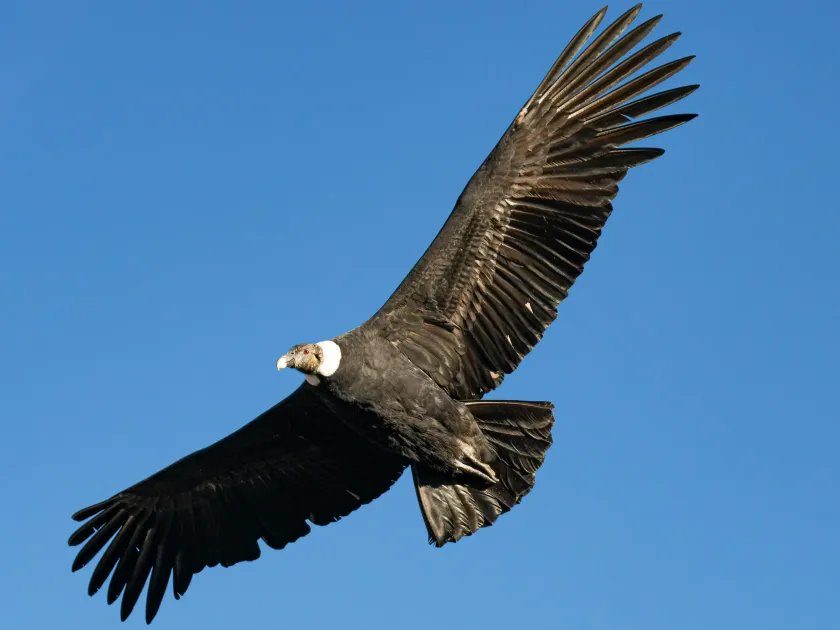
The Andean condor (Vultur gryphus) is a massive bird of prey belonging to the order Accipitriformes and the New World vulture family.
It holds the record for one of the largest wingspans among flying birds, often exceeding three meters in width.
The plumage is predominantly black with a distinct white ruff of feathers around the neck area in mature specimens.
Its head and upper neck are bare of feathers, displaying a reddish skin that facilitates hygiene during its scavenging activities.
Adult males are distinguished by a fleshy caruncle or comb on the head, which serves as a secondary sexual characteristic.
What it damages
The Andean condor is strictly a scavenger and does not consume or damage any form of agricultural crop or vegetation.
Its anatomy and beak structure are perfectly adapted for feeding on carrion, not for processing plant materials like stems or grains.
Claims suggesting that this bird causes damage to farms are entirely unfounded and result from misidentification of wildlife behavior.
Instead of causing damage, the condor provides valuable ecological services by removing carcasses, which prevents the spread of diseases.
It remains a non-factor in agricultural damage assessment and should be considered a neutral or beneficial presence on the landscape.
When it appears
Andean condors are permanent residents and remain active throughout the entire year, showing no migratory patterns related to seasonal crop growth.
Their activity levels are determined by food availability and weather conditions, such as thermals, rather than by agricultural cycles.
Breeding activities occur independently of farming seasons, as condors nest in remote, high-altitude cliff sites.
There are no seasonal spikes in "damage" because the bird has no interest in, or impact on, agricultural fields or vegetable gardens.
Farmers do not encounter seasonal infestations or any form of migratory pressure from this species concerning their harvest.
Signs of infestation
Since the Andean condor is not a phytophagous species, there are no characteristic signs of crop infection or damage to be identified.
The presence of these birds on farmland leaves no physical marks on crops, confirming they do not interact with the vegetation.
If a farmer observes a condor near livestock pastures, it is almost certainly searching for carrion, not interested in crops.
Lack of biting, chewing, or uprooting marks clearly distinguishes their presence from that of actual crop pests like insects or rodents.
No agricultural damage reports for this species exist, as their biological niche is far removed from consuming plant-based materials.
Control measures
No control measures are necessary for the Andean condor because it does not represent an agricultural threat to farmers.
The species is globally recognized as vulnerable and is protected under various conservation laws in the South American region.
Any human-wildlife conflict should be managed through education, emphasizing the ecological benefits provided by these majestic scavengers.
Maintaining proper farm sanitation and quickly removing deceased livestock is the standard practice to avoid drawing vultures to farm grounds.
Protecting the Andean condor is a priority for biodiversity conservation, and they should never be treated as targets for pest control.
Taxonomy
- Latin name
- Vultur gryphus
- Family
- Cathartidae
- EPPO code
- VULTGR
Discussion
No discussions yet — be the first.