
Common wombat
Vombatus ursinus
Description
How to identify
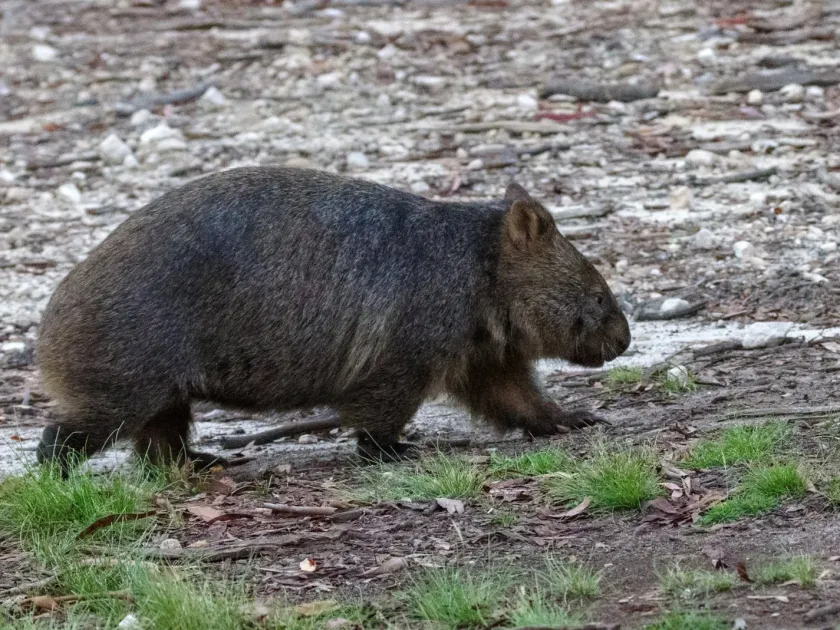
The common wombat (Vombatus ursinus) is a member of the Vombatidae family. It is a large, stout-bodied marsupial weighing up to 35 kg, characterized by powerful limbs and sharp, heavy-duty claws designed for excavation.
Morphologically, the animal resembles a small bear with dense, coarse fur and short, rounded ears. Its robust muscular structure allows it to move large amounts of soil, making it a significant landscape-altering species in agricultural regions.
Wombats are solitary and territorial, establishing complex burrow systems that can span tens of meters. These structures are often re-used for generations, creating long-term structural issues within the agricultural environment.
The reproductive cycle involves a slow maturation process. A single joey stays with the mother for an extended period, which keeps the population density in a localized area relatively stable but persistent over many years.
They are primarily nocturnal or crepuscular, which complicates monitoring and direct control efforts. Farmers often notice the damage long before seeing the animal itself due to their elusive nature during daylight hours.
What it damages
The primary damage caused by wombats is physical destruction to soil structure and root systems. By digging extensive tunnels, they disrupt the root zones of root crops like potatoes, carrots, and sweet potatoes.
Trampling and mechanical damage to young seedlings occur when wombats cross cultivated fields. Their entry and exit points are often surrounded by significant spoil heaps that smother crops and introduce weeds to the area.
Infrastructure damage is a major economic burden. Wombats regularly tunnel beneath fence lines, damage irrigation piping, and undermine the foundations of farm sheds and greenhouse structures, leading to operational downtime.
On grazing lands, the large holes created by wombats pose a significant risk of leg injury to livestock. Furthermore, their browsing habits can impact young orchard trees, where they may strip bark in times of food scarcity.
The cumulative effect of their digging is increased soil erosion and reduced land productivity, as the disturbed areas become prone to water runoff and nutrient loss during heavy rain events.
Signs of infestation
The most diagnostic sign of a wombat presence is the entrance to its burrow. These openings are characteristically large, semi-circular, and located near fences, creek banks, or elevated parts of the field.
Wombat scat is highly distinctive due to its cubic shape. Finding these droppings on prominent rocks, logs, or near burrow entrances is a definitive indicator of the animal's regular activity in that specific area.
Well-worn tracks leading from burrow sites to foraging areas are common. These paths are often compacted and devoid of vegetation, serving as a permanent thoroughfare for the animal's nightly movements.
Physical breaches in fence mesh are clear indicators of entry. Wombats use their weight and strength to force their way under barriers that are not properly buried or reinforced with rigid materials.
Sudden soil subsidence or the appearance of large mounds of fresh dirt near crop rows often indicates that a wombat has been investigating the area for potential foraging or new tunnel construction.
Control measures
Effective defense against wombats requires physical exclusion. The most successful method involves using heavy-duty galvanized wire mesh buried at least 40 cm deep to prevent the animal from burrowing underneath.
Olfactory deterrents can provide temporary relief, especially if used during the initial stages of infestation. Products that mimic the scent of predators may help discourage wombats from establishing new burrows near sensitive areas.
Farm management strategies such as clearing tall vegetation and dense shrubs around the perimeter can reduce the attractiveness of the site, as wombats prefer areas that provide immediate cover from predators.
The use of motion-activated lighting or ultrasonic deterrents can serve as a secondary line of defense, but these should be regularly rotated or adjusted to prevent the animals from habituating to the stimuli.
- Burying wire fencing to a depth of at least 40 cm.
- Application of predator-based repellent sprays.
- Regular clearing of weeds and scrub along fence lines.
- Deployment of motion-sensing deterrent systems.
Taxonomy
- Latin name
- Vombatus ursinus
- Family
- Vombatidae
- EPPO code
- VOMBUR
Discussion
No discussions yet — be the first.