
Wombat
Vombatus
Description
How to identify
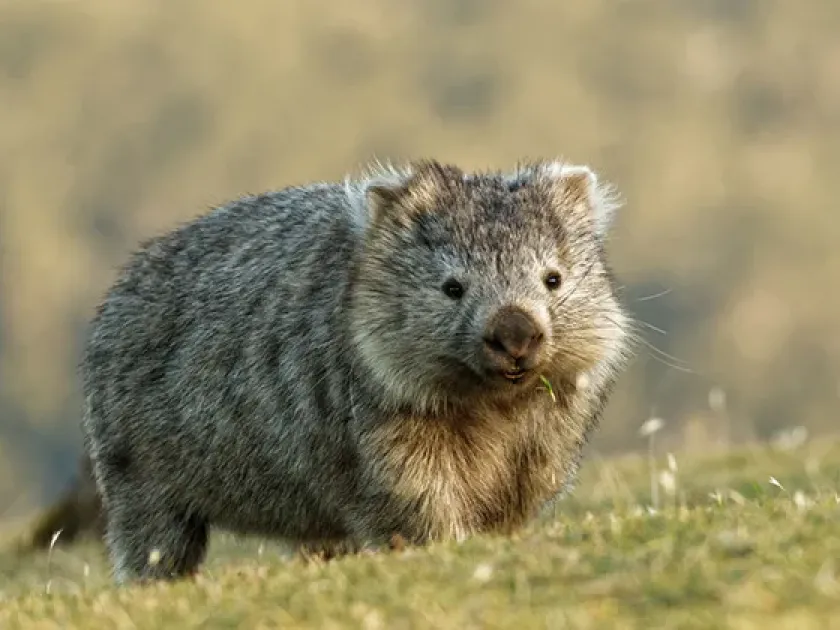
The common wombat (Vombatus ursinus) is a stout, burrowing marsupial native to Australia. It belongs to the Vombatidae family and is known for its sturdy build and powerful limbs.
Adult wombats weigh between 20 and 40 kilograms and are covered in coarse, thick fur that ranges from sandy to dark brown in color, providing excellent camouflage.
These animals have short, muscular legs with strong, sharp claws specifically adapted for extensive digging in various types of soil, from soft earth to rocky ground.
Wombats are nocturnal creatures, spending their days in complex tunnel systems that can stretch for many meters and have multiple entrances and ventilation shafts.
Despite their slow appearance, they can move quite quickly and possess significant strength, allowing them to displace large amounts of soil during their nocturnal foraging activities.
What it damages
Wombats damage crops indirectly by digging tunnels that collapse the root systems of plants, leading to widespread wilting and crop failure in vegetable gardens and fields.
Their burrowing activities often result in soil erosion, as the disturbed earth becomes susceptible to washing away during heavy rain, damaging the overall field structure.
A significant issue for farmers is the destruction of agricultural infrastructure, specifically the chewing of irrigation hoses and the compromising of underground plumbing pipes.
The presence of wombats often creates paths through crops, causing mechanical damage to young plants and making the field unsuitable for mechanized harvesting equipment.
By digging under perimeter fences, wombats create entry points for other pests, significantly increasing the overall biological pressure on the cultivated crops.
Signs of infestation
The presence of a wombat is easily identified by the distinct arch-shaped burrow entrances, which typically measure 25 to 30 centimeters in width.
Finding their unique cube-shaped droppings near entrance holes or along their established trails is a definitive sign of their activity on the property.
Well-worn, compacted tracks through pasture or crops leading toward a burrow indicate the regular routes these animals take during their nightly feeding sessions.
Depressions or lines of sinking soil across a field often reveal the path of underground tunnels that have weakened the surface layer, posing a risk to tractors.
Scuff marks or scratch patterns on fences and gate posts are common indicators of wombats attempting to breach restricted areas to find food or shelter.
Control measures
The most effective strategy is installing robust fencing with the lower portion buried at least 50 centimeters deep, reinforced with heavy-gauge metal wire.
Electric fencing, featuring a live wire placed close to the ground, is highly effective at discouraging wombats from attempting to dig under or climb over the perimeter.
Regular maintenance of fields and the prompt filling of abandoned burrows can help make the area less hospitable, preventing new individuals from taking up residence.
In cases of high infestation, farmers are encouraged to utilize exclusion devices and consult with local wildlife authorities to ensure compliance with animal protection laws.
Strategic planting of natural buffers and non-palatable vegetation around high-value crop areas can serve as a deterrent and reduce the animals' motivation to penetrate the site.
Taxonomy
- Latin name
- Vombatus
- Family
- Vombatidae
- EPPO code
- VOMBSP
Discussion
No discussions yet — be the first.