
Dried fruit moth
Vitula serratilineella
Description
How to identify
The dried fruit moth (Vitula serratilineella) is a moth species belonging to the family Pyralidae. It is a significant pest of stored agricultural products, particularly dried fruits and nuts, commonly found in warehouses and food processing facilities.
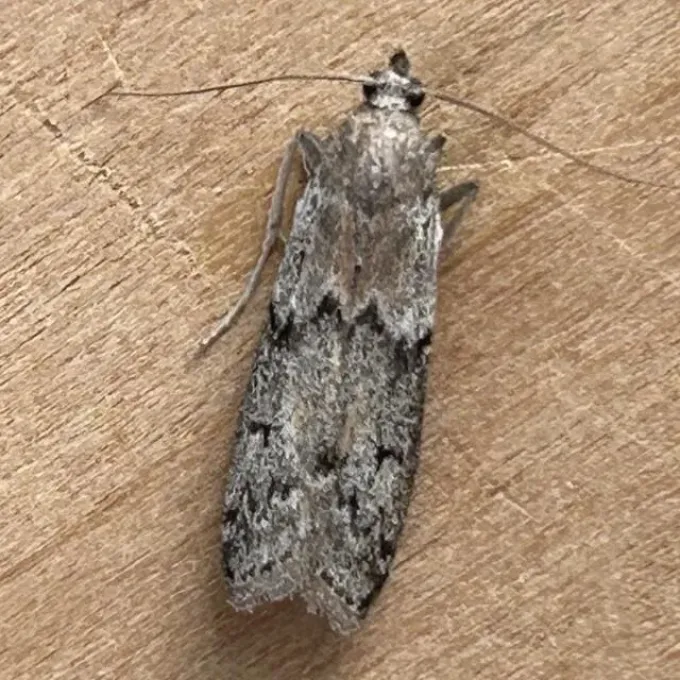
The adult moth has a wingspan of approximately 15–20 mm. Its forewings are typically grayish-brown with irregular, wavy dark lines. The coloration provides excellent camouflage against dust and packaging materials in storage areas.
The larvae are about 12–15 mm long when fully grown. They are whitish or yellowish with a dark brown head capsule. Their bodies are sparsely covered with fine hairs, which is a characteristic feature of this species during the larval stage.
The life cycle consists of four stages: egg, larva, pupa, and adult. The entire development process is highly dependent on ambient temperature and food quality. In optimal conditions, the moth completes its life cycle in just a few weeks.
Adult moths are nocturnal and do not feed on solid food. Their primary function is reproduction, and they are capable of laying several hundred eggs, usually placed directly on or near suitable food sources.
What it damages
The larvae are the primary cause of damage, feeding on a wide variety of dried plant materials. Preferred foods include dried apples, raisins, figs, dates, apricots, and various types of nuts and seeds.
By consuming the internal tissue of the product, larvae render the goods inedible and unsalable. They create tunnels within the fruit, which often leads to the total destruction of the product's structure.
A key sign of larval activity is the production of silk webbing. Larvae spin webs that bind pieces of fruit together, forming large, matted clumps that are difficult to process or sort.
The product is further degraded by the accumulation of larval excrement (frass) and cast-off skins. This contamination significantly lowers the hygienic quality of the food and makes it non-compliant with food safety standards.
In addition to direct damage, the presence of these moths facilitates the entry of secondary pests, such as mites and fungi, which thrive in the moist and debris-filled environment created by the moth larvae.
Signs of infestation
The presence of fine, silky webbing covering the surface of dried fruits is the most reliable indicator of a dried fruit moth infestation. This webbing is often visible even in the early stages of larval development.
Small, dark, granular particles found among the fruit indicate the presence of frass. If the infestation is advanced, these particles may be clumped together with webbing and fragments of the product.
The observation of adult moths resting on walls, ceiling, or near storage containers suggests that an active population is present within the facility and that a new generation is currently emerging.
A distinct, musty odor and a dull appearance of the fruit surface often accompany infestations. The fruit may feel sticky or damp due to the moisture released by larval activity and the degradation of fruit tissues.
Small, irregular holes in the packaging or storage sacks indicate that larvae have been migrating or that adults have emerged, providing clear evidence of a breach in storage protection.
Control measures
Sanitation is the cornerstone of pest management. Keeping storage areas clean, removing spilled products, and ensuring no residual organic debris is left behind prevents the moth from establishing a foothold.
Temperature control is a highly effective non-chemical solution. Storing goods at temperatures below 10°C slows down or halts development, while freezing or heating products effectively eliminates larvae, pupae, and eggs.
Sealing storage containers is essential to prevent adults from laying eggs on the produce. Airtight packaging is the most reliable method for long-term protection of sensitive dried products.
For industrial-scale storage, fumigation with approved gaseous treatments (such as phosphine) is used to eradicate pests within stacked pallets where other methods might fail to reach.
- Maintain cold storage temperatures (below 10°C).
- Use pheromone-based monitoring traps to detect early activity.
- Implement strict FIFO (First-In, First-Out) stock rotation.
- Regularly inspect warehouse surfaces for webbing.
- Ensure all incoming shipments are inspected for pre-existing larvae.
Taxonomy
- Latin name
- Vitula serratilineella
- Order
- Lepidoptera (butterflies)
- Family
- Pyralidae
- EPPO code
- VITUSE
Discussion
No discussions yet — be the first.