
Tent spider
Uroctea durandi
Description
How to identify
The tent spider (Uroctea durandi) belongs to the Oecobiidae family. It is distinctively recognized by its tent-like silk retreat built on bark or stones.
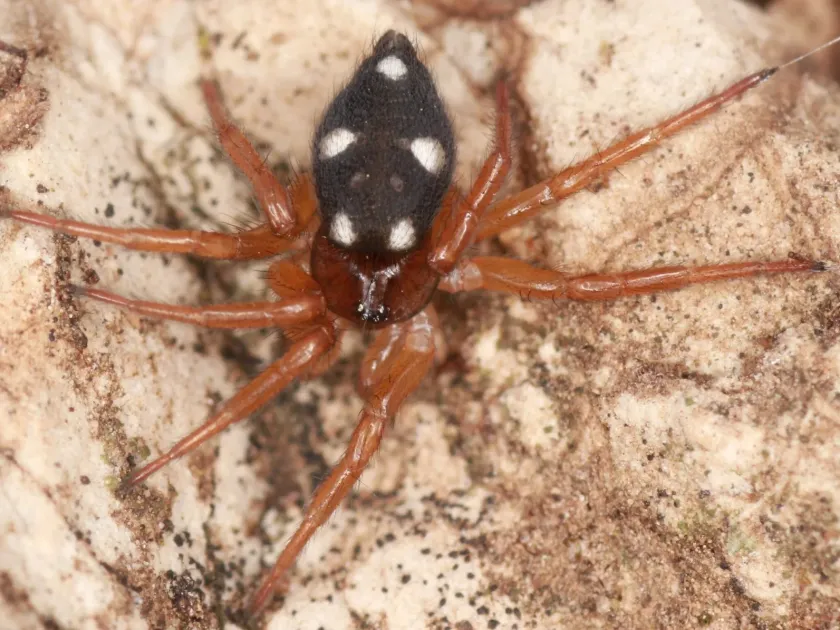
Females are relatively large, reaching up to 16 mm in length, with a flattened abdomen and a pattern of light spots on a dark dorsal surface, which helps them blend into their surroundings.
Unlike orb-weavers, this spider does not construct a traditional web. Instead, it creates a flat, dome-shaped silk nest anchored securely to the surface, serving as both a home and a hunting base.
The spider is a nocturnal predator, relying on sensitive trip-lines radiating from its nest entrance to detect nearby insect prey.
This species is highly adapted to warm and dry environments, making it a common inhabitant of orchards and rocky landscapes in Mediterranean and similar climates.
What it damages
While Uroctea durandi is essentially a predator beneficial in controlling some insect populations, its presence on young plants can be problematic.
The construction of silk nests can cause minor mechanical interference, potentially hindering the development of sensitive buds or shoots on young saplings.
The accumulation of debris and dust within the spider's silk structures on the bark can create localized damp spots, potentially favoring the growth of fungi.
In dense populations, these spiders may physically interfere with professional orchard management, specifically during manual bark cleaning or trunk inspections.
Although they do not feed on plant tissues, the constant friction and attachment of silk threads can lead to surface-level irritation of delicate plant structures over time.
When it appears
Activity of the tent spider is heavily dictated by temperature, with emergence typically occurring in early spring as temperatures begin to rise.
The peak activity period is during late spring and summer, when prey is most abundant and the spiders focus on reproduction and web maintenance.
As autumn approaches, the spiders focus on securing their nests for winter, often making the silk tents thicker and more prominent on the tree trunks.
Wintering occurs in the mature stage, where the spiders remain dormant within their sheltered tents, protected from cold and environmental stress.
Regular spring monitoring is recommended to assess the population density and determine if any intervention is necessary before the start of the growth season.
Signs of infestation
The most reliable sign of a tent spider infestation is the presence of silk-covered, dome-shaped nests on the bark of trees or between rocks.
Early in the morning, dew-covered signal threads radiating from the center of the nest are easily visible, highlighting the extent of the spider's hunting territory.
Small chitinous remains of insects found around the base of the nest indicate a long-term habitation and successful hunting by the spider in that specific spot.
If you notice localized discolorations or small patches of inhibited growth on the bark beneath the silk structure, this confirms the spider's presence.
Visual identification is easiest during the day, as the spiders remain hidden inside the tent, which can be easily spotted due to its unique shape compared to regular webbing.
Control measures
Control of Uroctea durandi is rarely required in standard orchard practices, but if populations become excessive, simple methods are effective.
Mechanical removal, such as scrubbing the bark with a stiff brush or using a pressurized water stream, effectively destroys the nests without chemicals.
Sanitary pruning and the removal of dead bark or dry, brittle twigs are excellent preventative measures that reduce available nesting sites.
Promoting a healthy ecosystem by encouraging natural predators such as birds and beneficial insects can naturally regulate the spider population.
Chemical intervention should be avoided unless absolutely necessary, as these spiders contribute to natural pest control and are not considered primary agricultural threats.
Taxonomy
- Latin name
- Uroctea durandi
- Family
- Oecobiidae
- EPPO code
- URCTDU
Discussion
No discussions yet — be the first.