
Uroctea spider
Uroctea
Description
How to identify
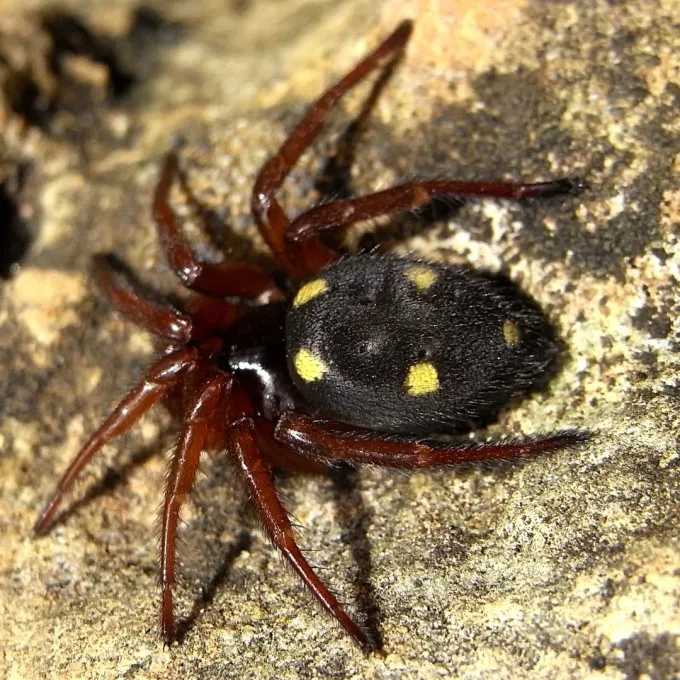
The Uroctea spider belongs to the family Oecobiidae. These arachnids possess a characteristically flattened body, which allows them to easily penetrate narrow crevices and hide under bark or stones.
A distinctive feature of this genus is the presence of specific spinnerets that form recognizable "tents" or tent-like webs attached to the substrate with triangular projections.
The appearance of adults often includes a contrasting pattern on the abdomen, which aids in camouflage, making them nearly invisible against the natural environment.
Mature females are significantly larger than males and have a more pronounced protective coloration, while males are more mobile and move frequently in search of territory.
The biology of this species is that of a predator; however, in agroecosystems, they are considered undesirable organisms due to the formation of web colonies that disrupt plant physiology.
What it damages
The pest affects a wide range of ornamental and fruit crops, preferring plants with dense bark or thick foliage, where they can conveniently anchor their tent-like webs.
The primary damage occurs because the dense web prevents normal photosynthesis of the leaves it covers, causing gradual wilting and necrosis of the plant tissue.
Furthermore, the accumulation of large amounts of silk contributes to the buildup of dust and fungal spores, which promotes the development of secondary infections on weakened plants.
In nurseries and greenhouses, the Uroctea spider may colonize young seedlings, hindering their development and reducing the market value of the stock due to the characteristic white webbing.
Although the spider itself is a predator, its activity creates a favorable microenvironment for other parasitic organisms, which requires timely monitoring of plantings.
When it appears
Peak activity of the Uroctea spider is observed in the spring and summer, when ambient temperatures favor rapid population growth and the search for new hunting sites.
The first signs of "tents" are recorded in early May, when, after the soil and tree bark warm up, spiders leave their winter shelters to begin web construction.
During the summer, a peak in reproduction occurs, accompanied by an expansion of their range and the colonization of new areas on cultivated plants.
In autumn, activity declines as spiders transition into a dormant state, moving deep into bark fissures or soil refugia where they can withstand lower temperatures.
The life cycle is continuous given sufficient food availability and stable weather conditions, making them permanent residents of orchard ecosystems.
Signs of infestation
The main sign of infestation is the presence of specific triangular tents made of silk, tightly pressed against the surface of the bark or the underside of large leaves.
Affected plant areas often appear stunted, showing signs of color change in the leaf blade at the attachment points of the silken threads.
Upon closer inspection, remains of insect chitinous shells can be found around the capture webs, confirming the presence of an active predator on the plant.
A slowdown in shoot growth is observed in areas where the web encases stems, limiting their normal contact with sunlight and fresh air.
Frequent detection of these "tents" on tree branches indicates a high population density that requires immediate professional intervention.
Control measures
The most effective method is the mechanical removal of silken tents from the bark surface using stiff brushes or high-pressure water jets.
In cases of heavy infestation, the use of broad-spectrum acaricides, effective against arachnids during their peak activity, is recommended.
Agronomic practices include regular pruning and cleaning of trunks to remove dead bark where spiders find shelter, significantly reducing the pest population.
Ensuring proper air circulation within the plant canopy through timely thinning pruning is important, as it makes the habitat less favorable for spider colonization.
Applying biological control agents aimed at reducing the spider's prey population also contributes to decreasing their presence in the agroecosystem.
Taxonomy
- Latin name
- Uroctea
- Family
- Oecobiidae
- EPPO code
- URCTSP
Discussion
No discussions yet — be the first.