
Hoopoe
Upupa epops
Description
How to identify
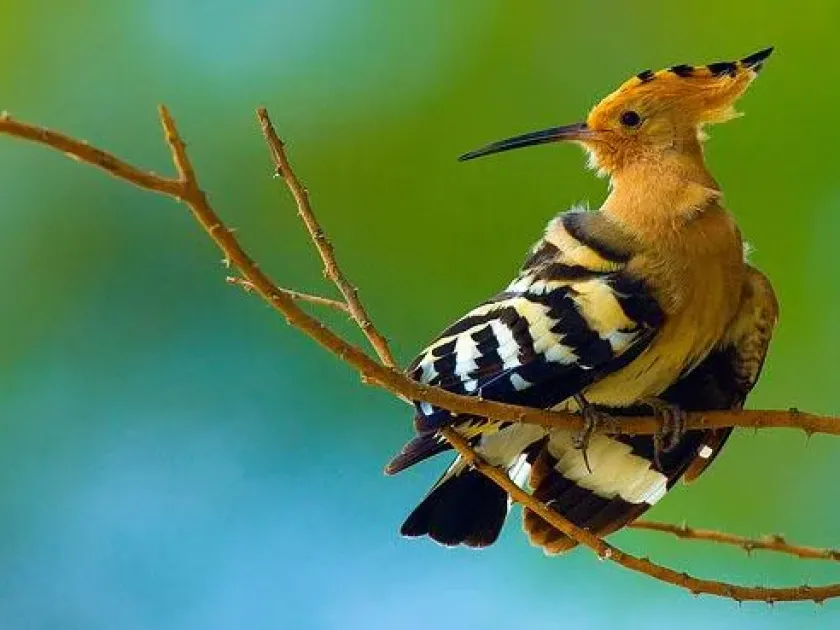
The hoopoe (Upupa epops) is a unique bird belonging to the order Coraciiformes and the family Upupidae, easily recognized by its distinctive appearance.
Its most prominent feature is a long, thin, down-curved bill and a large, erectile crest that the bird unfolds when alerted or excited.
The plumage displays a stunning combination of pinkish-brown, black, and white patterns, making the bird highly noticeable during its butterfly-like flight.
Hoopoes prefer open landscapes, including orchards, pastures, and woodland edges, where they find suitable nesting sites in tree hollows or crevices.
The biology of the species involves ground-feeding behavior, where the bird probes the soil with its specialized bill to extract invertebrate prey.
What it damages
The primary concern for farmers is the mechanical damage to the topsoil layer and the root zones of seedlings caused by the bird's foraging habits.
While probing for soil-dwelling insects, the hoopoe can inadvertently damage the roots of vegetable crops, causing growth stagnation or plant mortality.
In garden beds with young shoots, the bird's search for food can lead to the displacement of soil and the accidental uprooting of fragile seedlings.
Hoopoes are frequently attracted to areas with high concentrations of insect larvae, which often leads to intensified probing activity in productive zones.
Repeated digging in the same area can leave the root system exposed, leaving the plant susceptible to environmental stress and secondary pathogen infections.
When it appears
Hoopoes typically arrive in their breeding grounds during the spring, with activity increasing significantly throughout the summer months.
The period of egg-laying and feeding the chicks, which spans from May to July, represents the most active time for their foraging on cultivated land.
During the late summer, juveniles join the adults in searching for food, which may broaden the scope of affected areas across the farm.
Seasonal patterns are strongly influenced by the availability of prey and local climate conditions, which dictate the birds' migration schedule.
As autumn approaches, activity levels drop as the birds prepare for migration, eventually leaving the area entirely for their wintering grounds.
Signs of infestation
The most reliable sign of hoopoe activity is the presence of small, cone-shaped holes in the soil, created by the bird's long, thin bill.
Disturbed soil around the base of vegetable plants, often accompanied by exposed roots, is a strong indicator of recent foraging activity.
The bird's presence is often signaled by its distinct, muffled "oop-oop-oop" call, which can be heard at a considerable distance.
The sight of the bird running across the ground and probing the dirt, along with its striking crest, makes visual identification straightforward.
Occasionally, an unpleasant odor near nesting sites can serve as an additional, though less common, sign of their presence in the vicinity.
Control measures
Visual deterrents such as reflective tape, holographic scare tape, and mirrors can effectively discourage hoopoes from landing on small garden plots.
Applying protective netting or row covers over vulnerable young seedlings is the most reliable method for preventing direct root damage.
Bio-acoustic systems that broadcast the calls of predatory birds are highly effective at creating a sense of danger, forcing the birds to relocate.
Ultrasonic devices specifically designed for bird control can be strategically placed to make the environment inhospitable for foraging hoopoes.
- Implement integrated pest management to reduce soil insect populations.
- Use mulching to cover the bare ground and reduce access to larvae.
- Rotate crops frequently to disrupt the life cycle of soil-dwelling pests.
Taxonomy
- Latin name
- Upupa epops
- Family
- Upupidae
- EPPO code
- UPUPEP
Discussion
No discussions yet — be the first.