
Eastern Kingbird
Tyrannus tyrannus
Description
How to identify
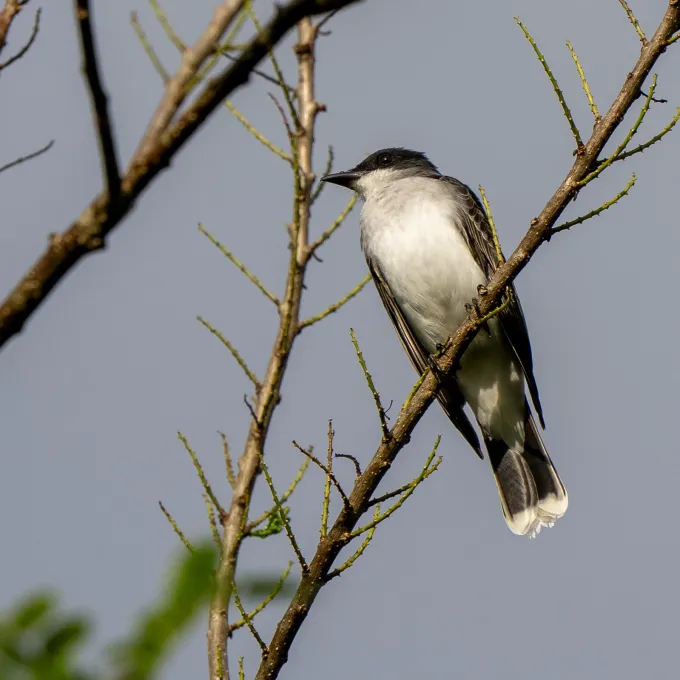
The Eastern Kingbird (latin Tyrannus tyrannus) is a member of the tyrant flycatcher family. It is a medium-sized songbird, measuring about 20 cm, easily recognized by its dark slate-grey upperparts, stark white underparts, and a distinct black tail with a white terminal band.
This bird is well-known for its bold and aggressive behavior, especially during the nesting season. They are highly territorial and will vigorously defend their space against other birds, including much larger species, which earns them their aggressive reputation.
Systematically, this species belongs to the order Passeriformes. While often perceived as a potential threat to orchards, the bird is fundamentally insectivorous, serving as a natural predator of many agricultural pests throughout the growing season.
Identification is easiest when observing their hunting habits. They typically perch on high, exposed wires or tree tops, scanning for flying insects. Once prey is spotted, they swoop down, catch the insect in mid-air, and return to their perch.
Nesting sites are diverse, ranging from woodland edges to fence rows bordering agricultural lands. Identifying these nest locations helps farmers determine whether the local population of Kingbirds is likely to interfere with high-value berry crops.
What it damages
Direct damage to agricultural production occurs primarily in berry orchards during the peak of the ripening season. Although insects are their preferred diet, Kingbirds will readily consume berries like mulberries, grapes, and elderberries during late summer.
The bird's aggressive territoriality can also cause indirect damage. By driving away other beneficial insectivorous bird species from the orchard area, the Kingbird may inadvertently allow certain insect populations to go unchecked, causing subsequent foliage or fruit loss.
Economic impact is generally low in large-scale operations but can become significant for small-scale berry growers. Damage typically involves pecking at the fruit, which ruins the appearance and marketability of the produce.
It is crucial to balance the negative aspects of fruit consumption against the bird's high efficiency in controlling beetles, flies, and moths. In many cases, the reduction in insect pests provided by the Kingbird is more valuable than the berries consumed.
Monitoring fruit ripening is essential. If Kingbirds are seen congregating near ripening berries in large numbers, it is a sign that the local insect population has declined and the birds have shifted their focus to fruits, warranting protective intervention.
When it appears
The Eastern Kingbird is a migratory species. They arrive in their northern breeding grounds in late spring, typically around May, and begin their southern migration toward South America as autumn approaches.
The period of highest activity in agricultural areas is during the summer months of June and July, coinciding with the feeding of their nestlings. During this time, they provide significant pest control benefits to the farm.
As autumn arrives and insect populations begin to decline, the Kingbirds adjust their diet toward available fruits. This shift typically occurs in late August and September, making this the critical window for potential crop damage.
The life cycle is closely linked to seasonal fluctuations. Recognizing that their primary interest in fruit is tied to a specific seasonal transition helps farmers plan their crop protection strategies more effectively without unnecessary expenses.
By late September, the birds generally vacate their summer habitats. Any protection measures, such as netting, can be removed once the birds have migrated, allowing for easier maintenance of the orchard equipment and landscape.
Control measures
When implementing control measures, it is important to remember that the Eastern Kingbird is protected by various international and national wildlife conservation acts, prohibiting any lethal methods of population control.
Physical exclusion, such as the use of bird-proof netting over berry bushes, remains the most effective and reliable method for protecting high-value crops. This method is highly recommended for small to medium-sized orchards.
Visual deterrents, including reflective tape, holographic devices, or predator decoys, can be useful. To maintain their effectiveness, these devices must be moved frequently, as birds quickly habituate to static stimuli in their environment.
Acoustic deterrents that broadcast predator calls or alarm sounds can be used in larger orchards. These systems are most effective when they use randomized intervals and a variety of sounds to prevent the birds from learning that the threat is not real.
Effective orchard management, including the timely harvesting of berries, is key. Reducing the availability of ripe fruit minimizes the attractiveness of the site to the Kingbirds, thereby reducing the likelihood of bird-related harvest losses.
Taxonomy
- Latin name
- Tyrannus tyrannus
- Family
- Tyrannidae
- EPPO code
- TYRATY
Discussion
No discussions yet — be the first.