
Clover seed weevil
Tychius picirostris
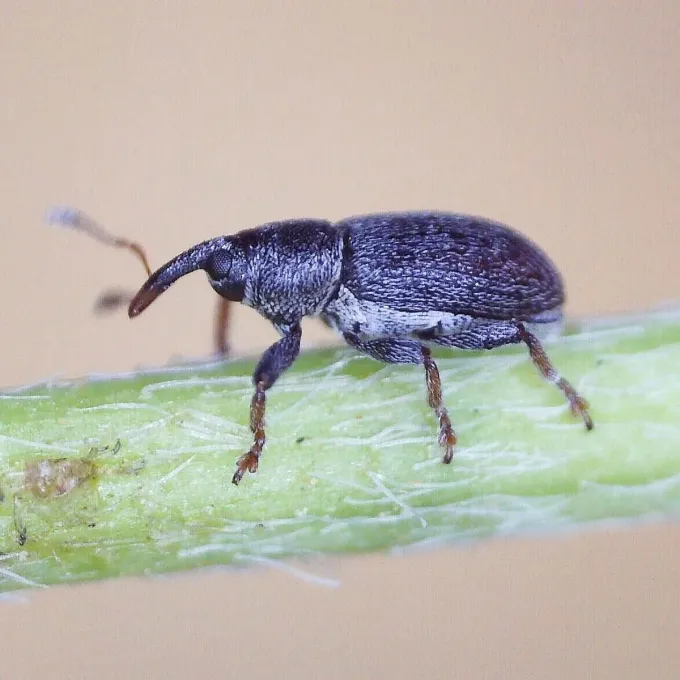
Description
How to identify
The clover seed weevil (Tychius picirostris) is a small beetle belonging to the Curculionidae family. Adult beetles are approximately 2–2.5 mm long, with a body covered in dense, greyish or brownish hair.
The insect possesses a distinctive elongated snout (rostrum), which is a key diagnostic feature used for feeding and piercing plant tissues for egg-laying. The larvae are small, legless, and white, typically found hiding inside the developing seed pods.
To identify the presence of these pests in the field, agronomists use a sweep net during the budding and flowering phases. Adult beetles are less active in the early morning, making them easier to sample.
The species undergoes a complete metamorphosis, passing through egg, larval, pupal, and adult stages. Because the larvae develop inside the seed, the pest is difficult to detect without opening the pods.
Adults overwinter in the soil or under plant debris, often residing near the edges of clover fields. This persistence in the soil makes field rotation and tillage critical components of the control strategy.
What it damages
This beetle specifically targets white clover (Trifolium repens), although it can impact other clover varieties. It is a highly specialized pest that aligns its reproductive cycle with the flowering time of its host plant.
Both adults and larvae cause damage, but the larvae are the primary culprits for economic loss. They tunnel directly into the pods and consume the developing seeds, effectively destroying them before maturity.
Adult feeding on foliage and buds causes minimal impact compared to the larval destruction of the seed crop. High populations of the weevil can lead to a significant decline in seed yield, often reaching 30–50% in untreated fields.
Besides quantity, the quality of the harvested seed is also reduced. Infested fields yield a high percentage of empty or damaged pods, which can lower the germination rates of the seed lots.
Producers often observe lower seed weights and irregular crop development in heavily infested areas, leading to major economic losses for seed growers.
When it appears
Adults emerge from their overwintering sites in the soil when spring temperatures rise, typically around +10...+12°C. They begin feeding on young clover foliage immediately upon emergence.
The mating and oviposition phase is closely synced with the onset of clover flowering. Females pierce the ovary of the flower and deposit a single egg inside, where the larva will eventually begin to feed.
The larval stage lasts approximately two to three weeks. Once the larva completes its development, it exits the seed pod, drops to the soil, and digs in to form a pupa.
Adults of the new generation emerge by the end of the summer. They do not produce a second generation that year, instead preparing for the upcoming winter by finding suitable soil refuges.
Since the species is univoltine (has one generation per year), farmers have a specific window of opportunity to intervene before egg-laying causes irreversible damage to the crop.
Control measures
Effective management begins with crop rotation. Keeping new clover seed fields at a significant distance from fields cropped with clover in the previous two years helps reduce initial pest migration.
Agronomic practices, such as early mowing, are highly effective. Harvesting the clover for hay before the larvae mature and exit the pods can kill the larvae, thereby suppressing the population for the next season.
Chemical control is required when pest levels exceed the economic threshold. Applying systemic insecticides during the budding phase is the most effective approach to kill adults before they lay eggs.
Regular field scouting using sticky traps or sweep nets is necessary to determine the timing of insecticide applications. Treatment must occur before the pods become susceptible to egg-laying.
- Deep autumn plowing to disturb overwintering sites.
- Maintaining high crop vigor to help plants withstand minor feeding damage.
- Using certified pest-free seed to prevent introduction into new areas.
Taxonomy
- Latin name
- Tychius picirostris
- Order
- Coleoptera (beetles)
- Family
- Curculionidae
- EPPO code
- TYCHPI
Discussion
No discussions yet — be the first.