
Lucerne seed weevil
Tychius junceus
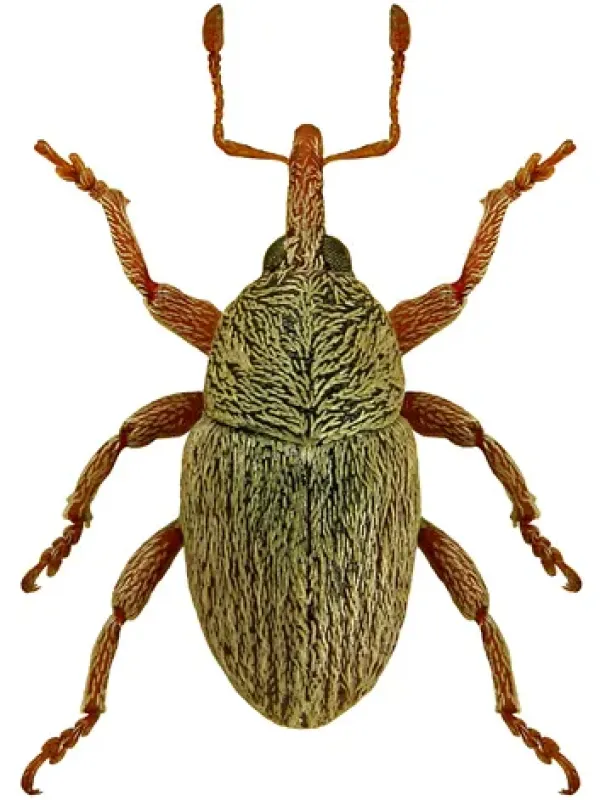
Description
How to identify
The lucerne seed weevil (Tychius junceus) is a small beetle belonging to the Curculionidae family, which is a significant group of agricultural pests.
Adult beetles are approximately 2.5 to 3.5 mm long, with a characteristic elongated snout and a body covered in dense, greyish or yellowish scales.
The larvae are small, legless, and curved, with a pale body and a distinct brown head, perfectly adapted for living inside the pods of leguminous plants.
As a holometabolous insect, the life cycle includes egg, larval, pupal, and adult stages, with typically one generation produced per year in temperate climates.
Adults overwinter in the soil or under plant debris, emerging in spring to begin their feeding cycle on available host plants.
What it damages
This species primarily targets alfalfa (Medicago sativa), specifically focusing on the reproductive organs, which leads to direct yield losses in seed production.
While adults feed on leaves and buds, the real damage is caused by larvae that penetrate the developing pods and consume the interior of the seeds.
A heavy infestation can destroy the majority of the seeds within the pods, leaving them hollow and rendering the harvest commercially unviable.
The nutritional and physical quality of the remaining seeds is severely degraded, making them unsuitable for agricultural use or sale.
High population densities often result in total crop failure for alfalfa growers specialized in seed harvesting if control measures are not implemented.
When it appears
Emergence from overwintering sites occurs in late spring, synchronized with the resumption of alfalfa growth and the development of new plant tissues.
The primary feeding and mating period occurs throughout the budding phase, as adults need energy to produce eggs for the next generation.
Larval development takes place during the summer, as the larvae consume the developing seeds within the pods throughout the flowering and fruiting period.
After completing their development, larvae exit the pods and burrow into the soil to pupate, which typically happens towards the end of the summer.
New adults emerge shortly after pupation, feed briefly, and then seek overwintering sites as temperatures begin to drop in autumn.
Signs of infestation
Visual identification starts with the presence of tiny, circular holes on leaves, known as 'shot-holes', resulting from the feeding activities of adult beetles.
Unusual bud drop or the premature wilting of flower racemes can indicate that adult weevils are actively present in the field.
Upon inspecting the pods, growers may notice dark patches or structural deformities, which indicate that a larva has invaded the interior.
If a pod is opened, the presence of empty seed shells, larval frass, or the larvae themselves confirms an infestation of the lucerne seed weevil.
A significant reduction in seed weight and overall yield is the ultimate sign of a long-term infestation problem that requires immediate attention.
Control measures
Cultural control practices, such as harvesting the alfalfa as forage early, can physically remove the larvae from the field before they migrate into the soil.
Implementing proper crop rotation and maintaining spatial distance between seed-producing fields and older forage stands helps to manage population growth.
Chemical control is effective when applied during the budding stage, targeting the adult weevils before they lay eggs on the newly formed pods.
Timing the insecticide application is crucial; it must be done before full bloom to avoid harming bees and other essential pollinators in the ecosystem.
Regular monitoring using sweep nets helps to determine if the population density exceeds the economic threshold, justifying the use of professional control products.
Taxonomy
- Latin name
- Tychius junceus
- Order
- Coleoptera (beetles)
- Family
- Curculionidae
- EPPO code
- TYCHJU
Discussion
No discussions yet — be the first.