
Tychius griseus
Tychius griseus
Description
How to identify
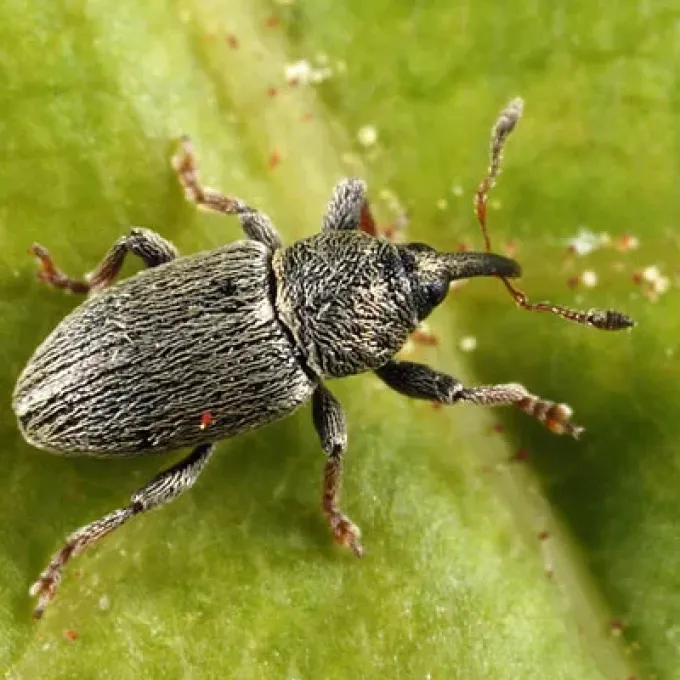
Tychius griseus is a small species of true weevil belonging to the Curculionidae family. Adult beetles are typically 2–3 mm in length, making them difficult to detect without careful field scouting.
The beetle’s body is covered in dense gray to grayish-brown scales, providing excellent camouflage against the foliage of host plants. They possess a characteristic medium-length, slightly curved snout.
Equipped with functional wings, these beetles are capable of active migration, allowing them to colonize new fields in search of suitable host crops.
The larvae are cream-colored, legless, and typically complete their development while feeding inside the reproductive parts of legume plants.
As members of the Coleoptera order, these weevils require systematic monitoring using standard entomological tools like sweep nets during the crop blooming period.
What it damages
The primary hosts for Tychius griseus are legume crops, with alfalfa being the most frequently and severely affected agricultural plant.
Damage is caused by both adults and larvae. Adults feed on leaves and flower buds, but the most significant impact occurs during the pod-forming stage.
Larvae feed directly on the developing seeds within the pods, leading to substantial yield losses and poor-quality crop harvest.
Infested seeds lose their viability and weight, rendering them unsuitable for seeding and reducing their value in forage and seed production markets.
In cases of high infestation, if not controlled, this pest can cause yield reductions of up to 50% in seed-production fields.
When it appears
Adults overwinter primarily in the soil or under plant debris remaining from the previous season's legume crops.
Emergence from overwintering sites coincides with the beginning of the growing season and the onset of warmer spring temperatures.
Peak activity and colonization of legume fields typically occur during the bud formation and early flowering stages of the host plants.
Females lay eggs inside the buds or young pods, where the larvae feed throughout their development until reaching maturity.
Pupation takes place in the soil, after which the new generation of adults emerges or enters dormancy depending on environmental conditions.
Signs of infestation
Early symptoms of an infestation include small, ragged feeding holes on leaves and buds caused by adult weevil activity.
Withering of flower buds and premature blossom drop are common indicators that the pest is actively feeding on the reproductive tissues.
Dissecting pods will reveal infested seeds, chewed-out cavities, and the presence of larval frass, confirming an active infestation.
The presence of gray beetles on plants can be visually confirmed by shaking foliage over a light-colored surface during sunny, warm weather.
Overall, infested fields may appear stunted, with visible gaps in fruit set and lower seed yield per hectare compared to uninfested zones.
Control measures
Effective management begins with proper crop rotation and maintaining sufficient spatial distance between new and old legume fields.
Deep autumn plowing is a recommended cultural practice to bury and destroy overwintering adults residing in the soil surface.
Chemical control measures involve the strategic application of contact or systemic insecticides just before the onset of flowering, targeting adults.
Timely harvesting of alfalfa for forage or hay is an effective mechanical method to disrupt the larval life cycle before they exit to the soil.
- Use sweep nets to monitor adult population density regularly.
- Select high-quality, vigorous seeds to promote rapid early-season growth.
- Apply spot treatments to field borders if initial pest presence is detected.
Taxonomy
- Latin name
- Tychius griseus
- Order
- Coleoptera (beetles)
- Family
- Curculionidae
- EPPO code
- TYCHGR
Discussion
No discussions yet — be the first.