
Alfalfa seed weevil
Tychius crassirostris
Description
How to identify
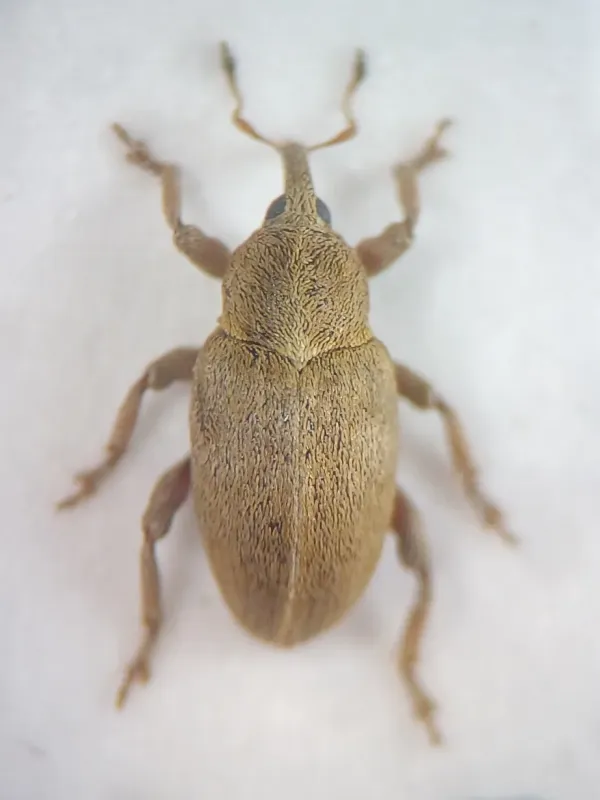
The alfalfa seed weevil (Tychius crassirostris) is a beetle belonging to the Curculionidae family, order Coleoptera. The adult insect reaches a length of 2.5–3.5 mm and is covered with dense, grayish-yellow scales that provide effective camouflage.
The snout of this species is of medium length and slightly curved. The antennae are geniculate and attached near the tip of the snout. The larvae are legless, white with a yellowish head, and have a characteristic C-shaped body.
In the field, adults are most visible during the alfalfa blooming period, as they congregate on the inflorescences. Their protective coloration makes them difficult to detect at low population densities.
Adults overwinter in the soil or plant debris at depths of 5–10 cm. In the spring, when soil temperatures reach 10-12°C, they emerge and begin feeding on vegetative plant parts before moving to the floral parts.
The insect completes one generation per year. Its peak activity coincides with the budding and flowering stages of the alfalfa crop, which are the most critical phases for seed development.
What it damages
The primary host plant is alfalfa, specifically its seed crops. While adults cause minor damage to leaves and buds, the real economic impact comes from the larvae, which feed directly on the developing seeds.
The female lays eggs inside the developing alfalfa pods through small punctures. The larvae hatch and consume the seed content, effectively destroying the seed embryo and endosperm.
Damaged pods often turn yellow prematurely and wither. This results in a significant reduction in seed yield, as a single larva can destroy all the seeds within a single pod.
High infestation levels can reduce seed yield by 40-60% or more, making seed production unprofitable. Furthermore, the damage reduces the overall vigor of the crop for subsequent years.
Indirect damage occurs when the punctures made by females during oviposition serve as entry points for secondary fungal infections, leading to further decay of the seed pods.
Signs of infestation
The first sign of an infestation is the appearance of tiny pin-prick punctures on the buds, which adults create to feed. Field observations should be conducted during morning or evening hours for better accuracy.
Premature pod drop or pod deformation is a strong indicator of larval activity inside. Careful inspection may reveal characteristic scarring where eggs were deposited.
Dissecting pods often reveals the white larvae or empty husks, which are clear evidence of the seed weevil's activity. This allows growers to assess the actual level of damage.
Once the larvae finish feeding, they chew an exit hole in the pod wall to drop into the soil for pupation. Finding these holes in mature pods confirms that the seed has been destroyed.
If high numbers of adults are captured during sweep net monitoring at the onset of flowering, it indicates that the potential for significant seed loss is high.
Control measures
Agronomic practices include harvesting alfalfa for hay earlier than planned if high infestation levels are detected before seed maturity, effectively disrupting the pest's life cycle.
Deep plowing after the seed harvest helps destroy overwintering populations in the soil. Maintaining proper spatial isolation between fields of different ages also helps reduce pressure.
Chemical control focuses on applying insecticides during the budding stage, before egg-laying begins. It is essential to use products approved for forage crops while respecting pre-harvest intervals.
Monitoring using a standard sweep net is critical for timing interventions. The economic threshold is generally set at 2-3 adult weevils per 10 sweeps during the early flowering stage.
Biological control through the preservation of natural predators and parasitic wasps is a viable strategy in low-intensity systems to keep populations below economic damage levels.
Taxonomy
- Latin name
- Tychius crassirostris
- Order
- Coleoptera (beetles)
- Family
- Curculionidae
- EPPO code
- TYCHCR
Discussion
No discussions yet — be the first.