
Alfalfa seed weevil
Tychius aureolus
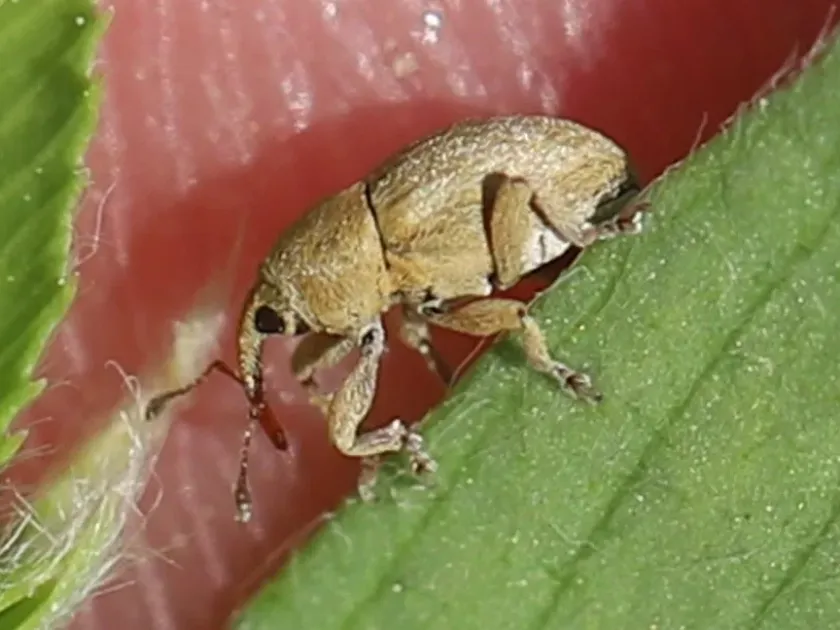
Description
How to identify
The alfalfa seed weevil (Tychius aureolus) is a small beetle belonging to the Curculionidae family, known as a significant pest of alfalfa seed crops.
Adult beetles measure between 2.5 and 3.5 mm and are covered with dense, metallic-golden scales, which provide effective camouflage on host plants.
The larvae are typically legless, curved, and white with a brown head, adapted for a life cycle inside the pods and seeds of the host plant.
The species completes one generation per year, with adults hibernating in the top layers of the soil or beneath dense vegetation during the winter months.
Their morphological structure, including the characteristic rostrum, allows them to efficiently feed on the reproductive parts of alfalfa plants during the growing season.
What it damages
Tychius aureolus primarily targets Medicago sativa (alfalfa) but may also affect various wild legume species found in surrounding areas.
Both adults and larvae contribute to yield loss; however, the larvae are the most destructive stage as they consume the developing seeds within the pods.
Adult feeding on flower buds and ovaries reduces the total number of pods produced by the plant, impacting the overall seed yield potential.
Larval infestation results in hollowed-out seeds, which lose all commercial value and germination capability, leading to significant economic losses.
Heavy infestations can lead to premature pod drop and a dramatic reduction in the quality and quantity of harvested seed material.
When it appears
Emergence from overwintering sites occurs in the spring when temperatures rise, usually coinciding with the onset of alfalfa budding and flowering.
The population reaches its peak activity during the main flowering period when mating and oviposition take place on the developing pods.
Larvae feed internally for approximately three to four weeks before exiting the pods to pupate in the soil environment.
Pupation occurs throughout the summer, after which the new generation of adults enters diapause until the following spring.
Climatic factors such as moisture and ambient temperature play a critical role in the rate of adult movement and larval survival rates during the summer.
Signs of infestation
One of the earliest indicators of an infestation is the presence of dried or deformed flower buds that fail to develop into healthy pods.
Visible tiny exit holes in the mature pods indicate that the larvae have matured and emerged from the seed to complete their life cycle.
Careful inspection of harvested pods often reveals the presence of damaged seeds, which appear as empty husks or debris inside the pod.
Widespread premature shedding of pods across the alfalfa field is a strong diagnostic sign of a serious infestation by the seed weevil.
Uneven seed development or significantly reduced seed count in seemingly healthy-looking plants often points to internal pest activity.
Control measures
Cultural control measures, such as deep plowing after harvest, are effective in disrupting the pupation cycle of the weevil in the soil.
Maintaining proper spatial isolation between new alfalfa seed fields and older alfalfa crops helps minimize the migration of the pest.
Chemical intervention with systemic insecticides during the budding stage is often necessary to control adult populations before eggs are laid.
Early harvesting or cutting the crop for hay can sometimes be utilized as a management tactic to prevent larvae from completing their development.
- Application of approved insecticides at the budding stage.
- Deep autumn plowing to destroy overwintering sites.
- Spatial isolation of seed production plots.
- Regular monitoring using sweep nets during flowering.
Taxonomy
- Latin name
- Tychius aureolus
- Order
- Coleoptera (beetles)
- Family
- Curculionidae
- EPPO code
- TYCHAU
Discussion
No discussions yet — be the first.