
Common tower shell
Turritella communis
Description
How to identify
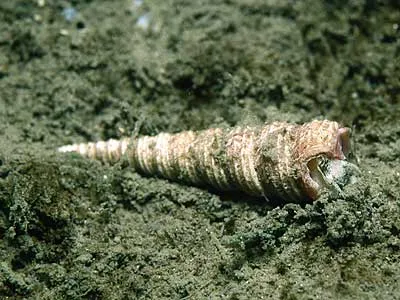
The common tower shell (Turritella communis) is a marine gastropod mollusk belonging to the family Turritellidae. Its shell has a characteristic elongated, sharply conical shape that resembles a spirally coiled tower.
Adult individuals typically reach a height of 3 to 5 centimeters. The surface of the shell is covered with fine sculpture consisting of spiral ridges, giving it a specific texture.
The color of the shells varies from light brown to yellowish-white, often featuring darker stripes or spots. The body of the mollusk is hidden inside the shell and protected by a hard operculum.
Systematically, this species belongs to the order Sorbeoconcha. It is primarily a benthic marine dweller found in coastal zones.
This species is not a terrestrial agricultural pest, but it is often included in agricultural databases due to its role in coastal aquaculture environments.
What it damages
As a marine organism, Turritella communis does not damage traditional agricultural crops like grains or vegetables. It is considered a nuisance only in specific aquaculture settings.
Mollusks can physically clog water intake systems in coastal farms growing seaweed or seafood. Their accumulations can disrupt normal water flow.
In their natural habitat, they feed on detritus and suspended organic particles, acting as filter feeders in the benthic layer.
There is no direct damage to conventional crops, as their range is limited to the seabed, where they spend most of their life cycle buried in the substrate.
The presence of large populations of tower shells near farms may indicate high levels of organic water pollution.
When it appears
Reproduction of the tower shell occurs during warm months when seawater temperatures are optimal for larval development. The peak of activity is observed during the spring and summer.
The larval stage is pelagic, allowing mollusks to disperse actively across the seabed via currents over significant distances.
Adult individuals are sedentary, preferring silty and sandy-silty bottoms, where they burrow to a depth of several centimeters.
The seasonality of their impact on aquaculture systems depends on storm cycles, which can dislodge mollusks from the bottom and transport them into filtration systems.
The period of highest population density occurs in the second half of the summer, following the completion of the active larval metamorphosis cycle.
Signs of infestation
The primary sign of the presence of tower shells is empty or live shells found in primary water filtration systems at coastal farms.
Clogging of mesh filters by mechanical debris and the mollusks themselves indicates that the population has entered the farm's operational zone.
The presence of characteristic cone-shaped shells in settling tanks indicates that water is being drawn from areas with active silty bottoms.
Visual inspection of the benthic layer near intake pipes can reveal dense colonies of mollusks, provided the water is sufficiently clear.
The presence of a large number of their shells in bottom sediments may indirectly point to changes in the hydrodynamic regime of the area.
Control measures
The main control measure is the installation of multi-level water filtration systems to prevent young individuals from entering production tanks.
Regular cleaning and high-pressure flushing of water intake pipes help remove mollusk build-ups before they reach critical accumulation levels.
Monitoring the composition of bottom sediments at water intake points helps predict potential risks of clogging in aquaculture systems.
The use of physical barriers, such as fine-mesh screens, remains the most effective and environmentally friendly method of protection.
The use of chemical protective agents in aquaculture is strictly discouraged, as it can cause significant harm to the targeted seafood species.
Taxonomy
- Latin name
- Turritella communis
- Order
- Molluscs
- Family
- Turritellidae
- EPPO code
- TURRCO
Discussion
No discussions yet — be the first.