
Turritella
Turritella
Description
How to identify
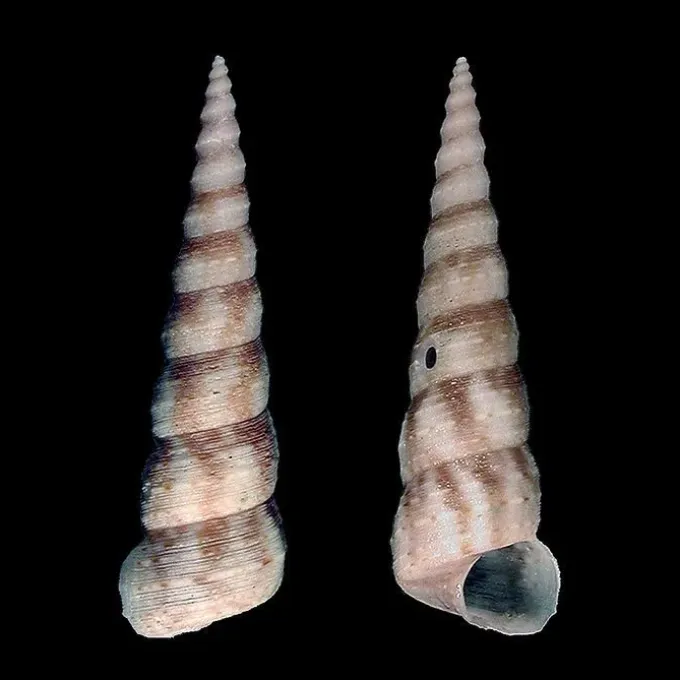
Turritella (genus Turritella) is a group of marine gastropod mollusks belonging to the family Turritellidae, often recognized by their tall, spiraling shells.
The shell features numerous tight whorls, creating a distinct, elongated, screw-like appearance that sets them apart from terrestrial gastropods.
In agronomy, their presence is not as a typical crop-eating pest, but rather as a contaminant originating from the application of untreated marine-based fertilizers.
These organisms are filter feeders by nature, adapted to aquatic environments, and do not possess biological mechanisms to actively attack terrestrial plants.
Proper identification is crucial for farmers using bottom sediments or coastal mud as a source of soil organic matter to avoid accidental contamination.
What it damages
The primary damage caused by Turritella in a farming environment is not direct herbivory, but the alteration of soil chemistry and physical structure.
The accumulation of calcium carbonate from decaying shells significantly raises the soil pH, leading to an alkaline environment detrimental to many crops.
Excessive shell material can clog soil pores, reducing aeration and drainage, which forces plant roots to struggle in an over-compacted medium.
When used in greenhouse substrates, these shells can promote the growth of unwanted marine-derived micro-flora that compete with agricultural crops for nutrients.
The shift in chemical balance can lead to severe nutrient lockout, particularly of essential micronutrients that become unavailable in highly alkaline soils.
When it appears
The presence of Turritella shells in the field is usually observed following the application of organic fertilizers, typically in early spring.
During the summer months, the shells become more visible after heavy rains wash away topsoil, exposing the stubborn, non-degradable fragments.
Autumn is the ideal time to assess the degree of shell accumulation, as the field preparation process reveals the long-term impact on the soil surface.
There is no specific biological activity cycle in terrestrial fields as they are not indigenous to these environments, and they remain dormant as calcium deposits.
Annual cycle depends entirely on the agricultural management practices and the origin of the composts or manures imported to the farm.
Signs of infestation
The most obvious sign of contamination is the physical presence of distinct, pointed, screw-shaped shells scattered throughout the topsoil.
Soil quality markers often show a localized increase in pH levels, coupled with poor root development in young seedlings growing in these patches.
Plants may exhibit signs of nutritional deficiency, such as yellowing leaves or stunted growth, resulting from the chemical imbalance created by the shell decay.
A crusty, grayish surface layer often develops where marine sediments were applied, indicating high mineral salt concentrations.
- Presence of spiral-shaped white shell fragments
- Soil pH spike in treated areas
- Poor water drainage and soil compaction
- Stunted plant growth and localized chlorosis
Control measures
The most effective control strategy is the strict verification of the source and processing history of all marine-derived organic fertilizers.
Thermal treatment or thorough composting of organic inputs is required to neutralize any marine contaminants before they are applied to the fields.
If contamination has already occurred, deep mechanical tilling followed by the addition of acidifying organic matter can help restore soil balance.
Physically removing large shell fragments is recommended to alleviate soil compaction and improve the overall porosity of the growing medium.
Continuous monitoring of soil pH levels is essential in fields where marine-based amendments have been used to ensure they remain within the optimal range.
Taxonomy
- Latin name
- Turritella
- Order
- Molluscs
- Family
- Turritellidae
- EPPO code
- TURRSP
Discussion
No discussions yet — be the first.