
Common treeshrew
Tupaia glis
Description
How to identify
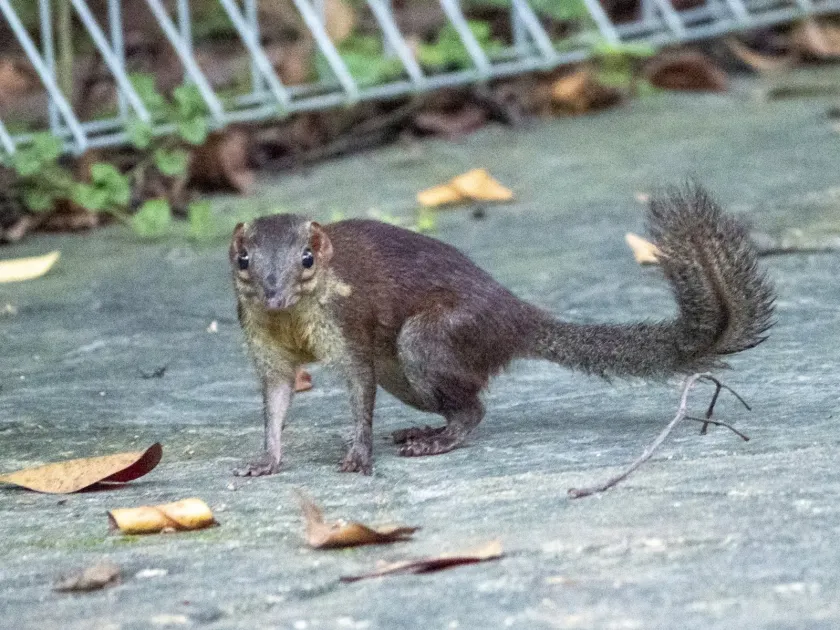
The common treeshrew (Tupaia glis) belongs to the order Scandentia, family Tupaiidae. Visually, this small animal resembles a squirrel with an elongated snout and a long, bushy tail.
The body length of an adult specimen ranges from 16 to 20 centimeters, with the tail often comparable in length to the body. Its fur has a brownish or olive hue, which allows the animal to remain unnoticed in dense thickets.
Treeshrews are diurnal animals with a semi-arboreal lifestyle. They are extremely agile, excellent at climbing trees, and move quickly on the ground, which makes them difficult to detect during active foraging.
A behavioral feature of the species is high curiosity and a lack of fear toward humans, allowing them to approach agricultural buildings and fields closely.
The reproductive biology of the species is characterized by the absence of strict seasonality; females can produce offspring multiple times a year, facilitating rapid population growth under favorable conditions.
What it damages
The primary damage from treeshrews is recorded on tropical crop plantations, especially oil palms, cacao, and coffee trees. These animals feed on fruits, seeds, and young plant shoots.
In regions where oil palms are cultivated, treeshrews damage young inflorescences and the bases of leaf stalks, which can lead to reduced yields and stunted growth in young seedlings.
On coffee and cacao plantations, the animals feed on the juicy pulp of the fruits, leaving characteristic tooth marks that cause the damaged berries to rot and drop prematurely.
Damage is caused not only by direct consumption of the harvest but also by damage to tree bark, which creates entry points for fungal and bacterial infections that weaken the entire plant.
Occasionally, treeshrews raid vegetable crops located near forest areas, destroying root vegetables and fresh greens, making them a significant risk factor for small-scale farming operations.
Signs of infestation
The first sign of a treeshrew presence is the discovery of characteristic bite marks on fruits: small, precise teeth impressions that differ from damage caused by birds or insects.
Remnants of fruits with hollowed-out seeds can often be found on the ground beneath trees, as treeshrews frequently carry their loot to a safer location to feed.
Increased activity of the animals is observed in tree canopies, often accompanied by specific vocalizations like whistling or chattering, which is characteristic of their territorial behavior.
On tree trunks, especially young ones, one can notice claw marks and damaged bark caused by the animals' regular use of the same paths to reach food sources.
During inspections near plantations, one can spot paths trampled by the animals in the leaf litter or dense grass, leading directly from forest edges to the most productive crops.
Control measures
The primary method of protection is the installation of mechanical barriers: placing metal or plastic collars on the trunks of young trees prevents the animals from climbing into the canopy.
Sanitary clearing of areas adjacent to plantations helps deprive the animals of natural shelters and approach routes to crops, which significantly reduces the intensity of attacks.
The use of deterrents, such as ultrasonic devices or special aromatic repellents, can have short-term success but requires periodic updating.
In cases of critical damage on large agricultural enterprises, trapping methods can be used, which allow for minimizing contact with the pests without the use of chemical poisons.
- Fencing plantations with fine-mesh netting.
- Regular inspection of trees for signs of damage.
- Encouraging natural predators (birds of prey).
- Timely harvesting to minimize the duration that ripe fruits remain on branches.
Taxonomy
- Latin name
- Tupaia glis
- Family
- Tupaiidae
- EPPO code
- TUPAGL
Discussion
No discussions yet — be the first.