
Aspen bark beetle
Trypophloeus granulatus
Description
How to identify
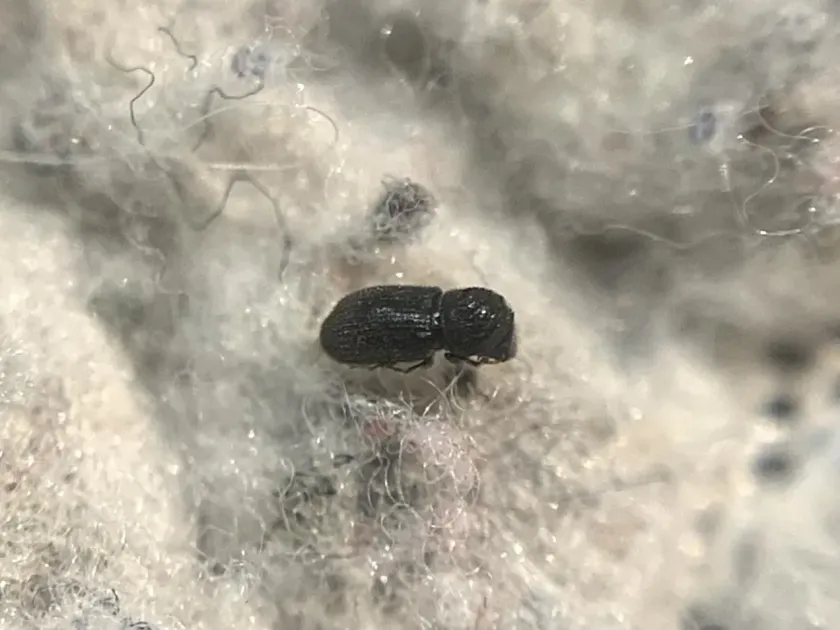
The Aspen bark beetle (Trypophloeus granulatus) is a small insect belonging to the Curculionidae family, specifically the Scolytinae subfamily. Adult beetles are typically 1.5–2.0 mm long, featuring a cylindrical body shape and a dark brown to black coloration.
The species is distinguished by granular textures on its elytra, which provides its specific epithet. The head of the beetle is mostly concealed under the pronotum, a common trait for many bark beetle species that thrive in hidden environments.
The larvae are white, legless, and possess a yellowish head capsule. They develop within the cambium layer of the bark, creating intricate galleries as they feed on the nutritious tissues located between the bark and the wood.
As a subcortical insect, Trypophloeus granulatus is taxonomically classified under the order Coleoptera, family Curculionidae. These beetles play a natural role in forest dynamics, often targeting weakened trees that are already stressed.
Due to their tiny size and habit of staying beneath the bark, they are often overlooked until significant populations build up within a grove. Their presence is primarily associated with Populus tremula and related species in natural habitats.
What it damages
The primary host for the Aspen bark beetle is the aspen tree (Populus tremula). The beetles gravitate toward trees that are suffering from drought stress, physical damage, or infections, which render the tree less capable of defending itself.
On rare occasions, when beetle populations are high, they may also inhabit other poplar species in the vicinity. The damage is most frequently concentrated in the middle and lower parts of the trunk where the bark is thick enough to support galleries.
The primary economic damage occurs when larvae girdle the cambium layer, effectively disrupting the tree's vascular system. This blockage prevents the movement of water and nutrients, leading to crown thinning, branch dieback, and eventually tree death.
The galleries created by the beetle also serve as entry points for various fungal pathogens, which further degrade the wood quality. This makes the affected trees unsuitable for timber production and increases the mortality rate of the stand.
Increased mortality rates from this pest can also contribute to fire hazards in forests by increasing the amount of dry, dead wood. Effective monitoring of these stands is essential to minimize financial losses in forestry operations.
When it appears
The adult flight period and the initiation of new tree colonization typically occur during spring, spanning from May through early June. During this time, overwintered adults emerge to find suitable host trees for reproduction.
Reproductive activity continues throughout the summer months. Females bore into the bark to construct egg-laying galleries, and the subsequent larval development follows, with the larvae actively consuming the inner bark tissues.
Pupation generally occurs towards the late summer, and the new generation of adults remains under the bark throughout the fall. They utilize this protected space as their primary wintering site to survive cold temperatures.
The development rate of the beetle is highly dependent on ambient temperatures. Warmer climates may allow for faster development and potentially a higher rate of colonization compared to cooler northern environments.
By late autumn, the beetles enter a state of dormancy, or diapause, remaining inactive beneath the bark until the following spring. This hibernation strategy is critical for their survival during harsh winter months.
Signs of infestation
The first external sign of an infestation is the presence of small entry holes in the bark. In some cases, these holes may show minor sap or resin flow as the tree attempts to push out the attacking beetle.
Fine "frass" or boring dust, which resembles sawdust, is often visible near these entry points or at the base of the trunk. This material accumulates in the bark crevices as the beetle clears its galleries.
Visual symptoms in the tree's canopy, such as premature yellowing of leaves or the death of individual branches, indicate that the tree is severely compromised. These symptoms often reflect damage that has already reached an advanced stage.
If the bark is carefully peeled away, the complex network of maternal and larval galleries becomes visible. This is a definitive sign of long-term infestation and the beetles' active role in the tree's decline.
Advanced infestations often cause the bark to loosen and slough off in large patches, exposing the damaged cambium layer. Early detection through regular surveying is the most effective way to address the issue before widespread damage occurs.
Control measures
The cornerstone of management for the Aspen bark beetle is the timely identification and removal of infested trees. Sanitizing the forest stand by extracting these trees prevents the beetle population from spreading to healthy neighbors.
Maintaining high forest hygiene, which includes the prompt removal of slash and logging debris, is crucial. Such debris can provide a breeding reservoir for the beetle and should not be left in or near aspen stands.
Biological control methods, such as encouraging local insectivorous bird populations and preserving natural predators, help keep beetle numbers at a manageable level within the forest ecosystem.
Chemical control is generally impractical for large-scale forest stands but may be used as a targeted solution for individual high-value trees or in nursery settings where beetle pressure is exceptionally high.
- Selective removal of infested trees during the dormant season.
- Effective slash and debris management after timber harvesting.
- Regular forest pathology surveys to track beetle outbreaks.
- Use of pheromone lures to monitor beetle population levels.
Taxonomy
- Latin name
- Trypophloeus granulatus
- Order
- Coleoptera (beetles)
- Family
- Curculionidae
- EPPO code
- TRYOGR
Discussion
No discussions yet — be the first.