
Aspen bark beetle
Trypophloeus asperatus
Description
How to identify
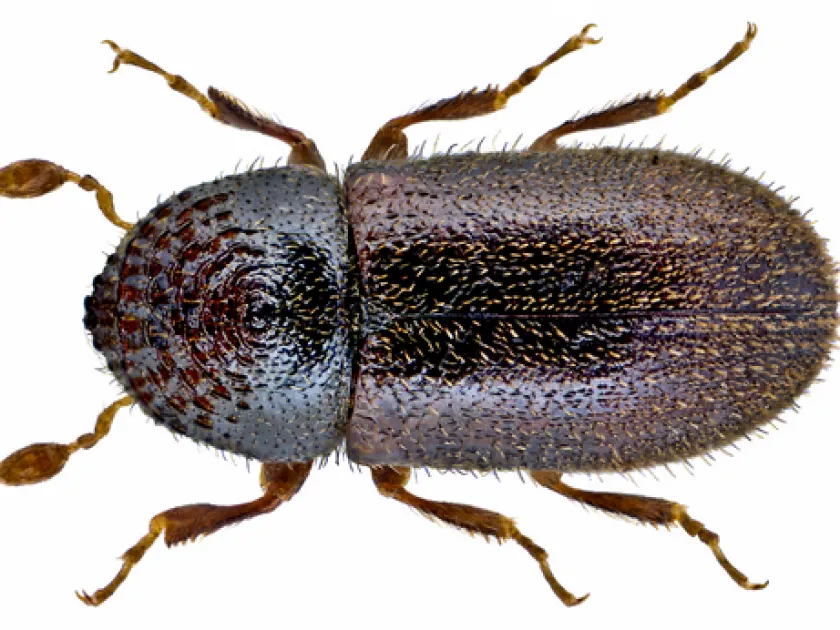
The aspen bark beetle (Trypophloeus asperatus) belongs to the order Coleoptera and the family Curculionidae (subfamily Scolytinae). These are tiny insects, typically measuring between 1.5 and 2.0 mm in length.
The adult beetle has a cylindrical body shape and is colored in dark brown or black. The surface of the elytra is covered with short hairs, providing a matte appearance that helps them blend into the bark.
Key morphological features include small, distinct tubercles on the pronotum. The larvae are white, legless, and possess a yellowish head, adapted for a life inside the inner bark of the host tree.
These beetles are specialized pests of aspen and certain poplar species. They are cryptic insects, and their presence is often overlooked until significant damage to the tree's health is already done.
Unlike some other bark beetles, they prefer trees with thin bark. While they often target stressed or weakened trees, high populations can allow them to infest healthy aspen stands as well.
What it damages
The beetle primarily targets the European aspen (Populus tremula). The damage is concentrated in the phloem and cambium layers, which are essential for nutrient transport and tree vigor.
By creating extensive galleries under the bark, the larvae and adults disrupt the tree's vascular system. This mechanical damage prevents the flow of water and nutrients, leading to progressive tree decline.
Infestation usually results in the dieback of branches and, in severe cases, the death of the entire tree. The damage site becomes a point of entry for secondary fungi and pathogens.
The economic impact involves timber quality reduction and the loss of young trees in nurseries or forest plantations. Infested trees lose their aesthetic and ecological value relatively quickly.
Environmental stress, such as prolonged drought, makes aspen stands significantly more susceptible to attacks, as the tree cannot produce enough defense compounds to repel the beetle.
When it appears
Adult beetles typically emerge in late spring, around May or June, once temperatures reach favorable levels for their flight and mating activities.
After mating, females excavate maternal galleries within the bark to lay their eggs. Larvae hatch and begin feeding during the summer months, growing and developing beneath the bark surface.
Pupation occurs under the bark, and the new generation of adults usually emerges by the end of the summer season to prepare for overwintering.
Overwintering takes place in the bark of the host tree or within the leaf litter at the base of the trunk, where the beetles are protected from extreme winter temperatures.
The species generally completes one generation per year, although temperature fluctuations can influence the timing and intensity of the life cycle events.
Signs of infestation
Evidence of infestation starts with tiny entry holes on the bark surface. Fine sawdust, or frass, may often be seen accumulating in crevices or at the base of the tree.
Tree canopy health is a major indicator; thinning leaves, yellowing foliage, and early leaf drop are common symptoms of a tree struggling with a bark beetle infestation.
- Small pin-prick holes on the tree trunk.
- Necrotic bark patches or discoloration.
- Dieback of the crown or specific branches.
- Evidence of woodpecker activity seeking the larvae.
- Loose or peeling bark on the infested areas of the stem.
Peeling back a piece of bark reveals the characteristic gallery patterns. These galleries are often tangled and complex, serving as a signature of the species' feeding activity.
The stress caused by the beetle also invites other opportunistic pests and diseases, which can complicate the initial signs of damage with secondary symptoms.
Control measures
Sanitation is the most effective management strategy. Removing and destroying infested trees helps to significantly reduce the beetle population within a forest stand.
Maintaining tree vigor is crucial. By ensuring trees are not stressed by lack of water or poor soil conditions, the risk of successful beetle colonization is lowered.
In ornamental or nursery settings, systemic or contact insecticides can be applied during the peak flight period to prevent new attacks on healthy trees.
Promoting a diverse environment that supports natural enemies, such as parasitic wasps and insectivorous birds, is an essential component of integrated pest management.
Regular monitoring through forest health surveys allows for the early detection of localized outbreaks, enabling timely intervention before the beetle can spread to adjacent healthy trees.
Taxonomy
- Latin name
- Trypophloeus asperatus
- Order
- Coleoptera (beetles)
- Family
- Curculionidae
- EPPO code
- TRYOAS
Discussion
No discussions yet — be the first.