
Wood-boring ambrosia beetle
Trypodendron signatum
Description
How to identify
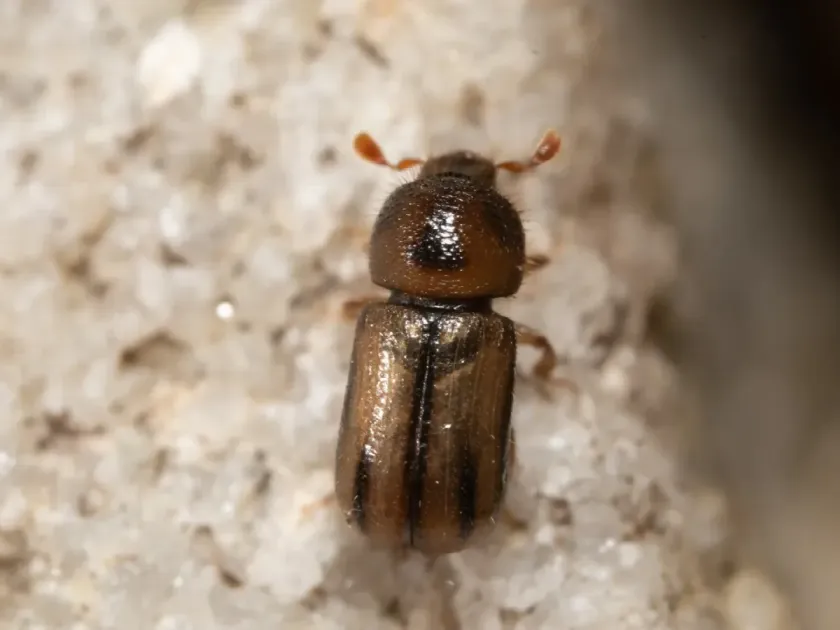
The wood-boring ambrosia beetle (Trypodendron signatum) belongs to the order Coleoptera and the family Curculionidae (subfamily Scolytinae). These beetles are small, cylindrical, measuring approximately 3 to 3.5 mm in length, with a dark brown to black coloration.
A distinctive feature of this species is the presence of longitudinal yellowish stripes on the elytra, which helps in identifying them from related ambrosia beetles. Their head is retracted into the pronotum, typical for wood-boring bark beetles.
The larvae are white, legless, and reside within the tunnels created by the parents. They are completely dependent on symbiotic fungi, known as ambrosia, which the beetles cultivate on the walls of the tunnel galleries.
Unlike bark beetles that feed on phloem, these insects are true wood-borers that penetrate deep into the sapwood and heartwood. They rely entirely on their fungal partners for nutrition, as they cannot digest the wood cellulose themselves.
The beetle's biology is characterized by specialized mating behavior and fungal farming. Once a suitable tree is found, the male initiates the tunnel, and the female follows to expand the gallery system to support their offspring.
What it damages
Trypodendron signatum primarily targets broadleaved tree species, including beech, oak, hornbeam, linden, birch, and alder. It prefers weakened, dying, or felled trees, which provide the stable moisture content required for the fungi.
The primary economic damage is caused by the tunnels drilled deep into the timber. This activity leaves a characteristic dark stain around the galleries, caused by the symbiotic fungus, rendering the wood unsuitable for high-quality carpentry.
While usually considered a secondary pest that attacks already stressed or dead trees, in favorable conditions, mass attacks can occur on living trees that are severely weakened by drought, disease, or environmental stressors.
The tunnels created by the beetles disrupt the structural integrity of the wood. In timber production, this results in significant financial losses as affected logs are downgraded or rejected due to "wormholes" and fungal discoloration.
The presence of the beetles accelerates the decay process of dead trees. While this is a natural component of forest ecosystems, it poses a significant threat to stored logs and freshly harvested timber in forest depots.
When it appears
The flight period typically begins in early spring, once temperatures exceed 12–15 degrees Celsius. In most regions, this corresponds to the period between April and May, depending on the current year's weather patterns.
The beetles follow a seasonal development cycle, with the primary activity occurring during the spring months. Depending on the climate, the species may produce one or two generations per year, with activity peaking in late spring.
Larval development takes place during the summer months. As the larvae grow, they rely on the constant supply of fungal mycelium provided by the parents, which is continuously maintained until the larvae reach maturity.
The new generation of adults usually emerges in late summer or early autumn. After completing their development inside the wood, they exit through the original entrance holes to prepare for the overwintering phase.
Overwintering occurs outside the wood, typically in the leaf litter at the base of trees or in the crevices of bark. Survival during this stage depends on the availability of appropriate shelter from winter freezing temperatures.
Signs of infestation
The most reliable sign of an infestation is the appearance of tiny, perfectly round entrance holes on the bark, measuring about 1–1.5 mm in diameter. These are often accompanied by fine, light-colored wood dust on the surface.
Unlike many other bark beetles, the wood dust (frass) produced by this species is very fine and does not remain packed in the entrance holes. Instead, it is usually found as loose powder on the ground near the base of the infested tree.
Internal damage is characterized by intricate galleries that branch out into the timber. On a cross-section of a log, these galleries appear as dark, radiating channels, often surrounded by a blackened, fungal-stained zone.
Externally, heavily infested living trees may show signs of stress such as yellowing foliage, wilting branches, or a sparse canopy. In severe cases, the bark may show small entry points along the main stem.
Detection is often confirmed by examining the wood surface for the distinct entry holes or by observing the presence of dark staining on the cut ends of logs, which is a classic diagnostic marker for ambrosia beetle activity.
Control measures
Sanitation felling is the most effective management strategy. Removing fallen trees, wind-damaged logs, and drought-stressed timber from the forest before the spring flight period significantly reduces the breeding base.
Timely extraction and processing of timber are essential. Logs left in the forest after the onset of warm weather in spring are highly susceptible to infestation; therefore, inventory should be processed or protected promptly.
The use of trap trees, laid out in the spring and removed before the new generation of beetles emerges, can help monitor and reduce local beetle populations in high-risk areas.
For high-value trees in urban or park settings, preventive insecticide treatments applied to the bark can be effective. These must be timed correctly with the onset of the spring flight to create a protective barrier against colonizing beetles.
Promoting forest health through selective thinning and maintaining natural predator populations, such as woodpeckers and parasitic wasps, helps keep beetle populations below economic damage thresholds.
Taxonomy
- Latin name
- Trypodendron signatum
- Order
- Coleoptera (beetles)
- Family
- Curculionidae
- EPPO code
- TRYDSI
Discussion
No discussions yet — be the first.