
Conifer ambrosia beetle
Trypodendron rufitarsus
Description
How to identify
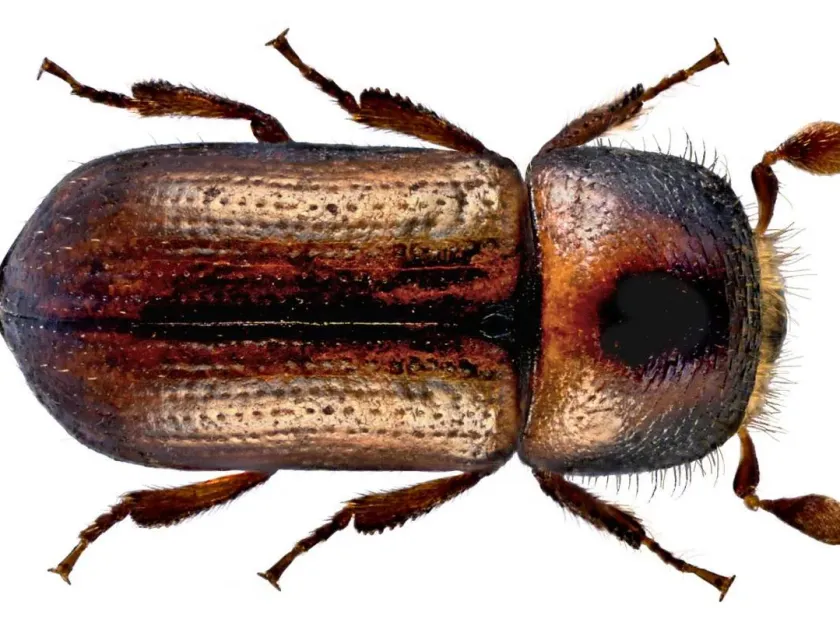
The conifer ambrosia beetle, Trypodendron rufitarsus, is a small wood-boring insect belonging to the family Curculionidae, subfamily Scolytinae. Adult beetles are typically 3 to 3.5 mm long, with a cylindrical, dark-brown or black body and characteristic reddish-yellow tarsi.
The head of the beetle is mostly hidden beneath the pronotum, a structural adaptation common among wood-boring beetles to facilitate movement within tight galleries. Their morphology is perfectly adapted for life within the woody tissue of coniferous trees.
Larvae are legless, white-colored grubs with a brown head capsule. They live within specialized galleries created by the parents, where they remain protected from the external environment and many natural predators.
Unlike traditional bark beetles that feed on phloem, this species is a symbiotic fungus farmer. It carries fungal spores into the wood, and the developing larvae feed on these cultivated fungi rather than on the wood itself.
This species is widely distributed throughout Eurasia's coniferous forests. It tends to favor weakened, stressed, or freshly fallen trees, although high populations can lead to attacks on seemingly healthy specimens.
What it damages
The primary hosts for the conifer ambrosia beetle are species of pine, spruce, and fir. The pests attack the main trunk of the tree, creating a complex network of tunnels that reach deep into the heartwood, significantly compromising the tree's internal vascular system.
The most severe damage is not just physical, but also biochemical. The beetles introduce ambrosia fungi into the tunnels, which stain the wood dark or blue-black. This degradation reduces the structural integrity and market value of the timber.
Even for trees that do not die immediately, the presence of these beetles causes significant physiological stress. The interruption of water and nutrient transport leads to crown thinning and premature browning of needles.
In the timber industry, logs infested with these beetles are often downgraded or rejected. The presence of 'wormholes' and associated fungal discoloration makes the wood unsuitable for high-quality furniture or construction purposes.
Persistent infestations in forest stands often necessitate immediate sanitation logging. If left unchecked, the beetle population can explode, spreading to healthy areas and causing widespread degradation of the forest resource.
When it appears
Adult emergence typically begins in early spring, as soon as temperatures consistently reach 10–12°C. This period is critical for forest monitoring and the implementation of management strategies.
Activity continues throughout the summer months as beetles seek out new host materials. The length of the activity period is strongly dependent on local climate conditions and the availability of suitable weakened timber.
The total lifecycle from egg to adult takes approximately two months. Under optimal conditions, particularly in warmer regions, there is the potential for two overlapping generations within a single growing season.
As autumn approaches and temperatures drop, the beetles seek hibernation sites. They typically overwinter in the litter layer or at the base of trees, sheltering beneath the bark or within the soil to survive the winter cold.
Effective pest management relies on precise timing. Using pheromone-based monitoring tools, foresters can identify the exact onset of the flight period to apply control measures before the beetles penetrate deep into the tree trunks.
Signs of infestation
The most visible sign of an infestation is the presence of small, round entry holes on the bark, approximately 1–1.5 mm in diameter. These holes are often accompanied by fine, white or tan-colored frass, also known as boring dust, which collects around the base of the tree.
Upon cutting into the wood, you will see a series of branching galleries. These galleries are characteristically stained dark by the ambrosia fungi that the beetles farm, distinguishing them from other wood-boring insects.
Crown symptoms are also important indicators. Infected trees often exhibit yellowing or wilting needles, especially in the upper canopy, resulting from the vascular disruption caused by the gallery network.
Timber processing reveals the true extent of the damage. Discolored streaks and hollow tunnels are standard indicators of a current or previous attack by these beetles.
- Tiny entry holes on the bark
- Accumulation of fine boring dust
- Darkly stained tunnels in the heartwood
- Yellowing and thinning of the tree crown
- Presence of adults when de-barking or splitting wood
Control measures
Sanitation is the cornerstone of control. Removing and utilizing wind-felled or damaged trees before the beetles emerge in the spring prevents the establishment of a breeding population and keeps the overall beetle density at low, manageable levels.
Pheromone traps are highly effective for both monitoring and mass trapping. By deploying these tools at the start of the season, foresters can significantly reduce the number of attacking adults in sensitive areas.
For high-value timber or decorative trees, chemical treatment may be required. Application should be performed before the beetles bore into the wood, using contact insecticides that target the adult beetles during their initial contact with the bark.
Maintaining healthy forest stands through proper thinning and species selection increases the resilience of the trees. A healthy tree can often repel initial attacks by producing sufficient resin to drown the invading beetles.
Biological control, including the protection and encouragement of natural enemies such as woodpeckers and predatory wasps, contributes to a balanced forest environment that naturally limits the proliferation of the conifer ambrosia beetle.
Taxonomy
- Latin name
- Trypodendron rufitarsus
- Order
- Coleoptera (beetles)
- Family
- Curculionidae
- EPPO code
- TRYDPO
Discussion
No discussions yet — be the first.