
Striped ambrosia beetle
Trypodendron lineatum
Description
How to identify
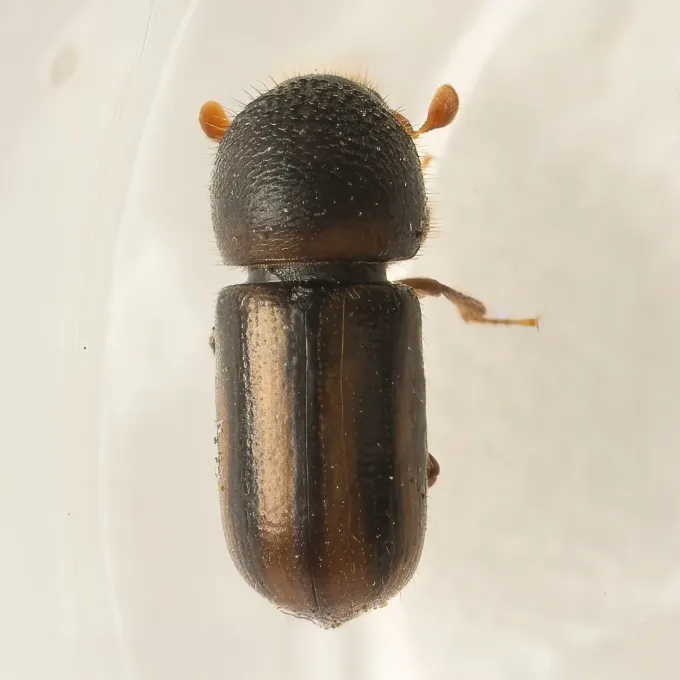
The striped ambrosia beetle (Trypodendron lineatum) is a small wood-boring insect belonging to the Curculionidae family. The adult beetle is cylindrical, roughly 3 mm long, and dark brown or black with distinct yellowish longitudinal stripes on its elytra.
The larvae are white, legless grubs that develop within the tunnels created by the parents. Unlike typical wood-boring beetles, they feed on specialized "ambrosia" fungi, which the female beetle carries into the tree gallery, facilitating the spread of fungal spores throughout the wood.
What it damages
This beetle is a significant pest of coniferous trees, including spruce, fir, and pine. It typically attacks stressed, fallen, or freshly felled trees, making it a critical concern for timber and logging industries worldwide.
The damage is caused by the deep tunnels the beetles bore into the sapwood and heartwood. These tunnels, combined with the introduced fungi that cause blue-staining, significantly degrade the quality of the timber, rendering it unsuitable for high-grade commercial applications.
When it appears
The flight period typically occurs in early spring, once temperatures consistently exceed 12-15 degrees Celsius. The adults emerge from their overwintering sites in the leaf litter or base of trees to seek out suitable host material for reproduction.
The life cycle involves the colonization of the wood, where the gallery system is created and eggs are deposited. The new generation completes its development during the summer months, with the young adults emerging in late summer to prepare for overwintering.
Signs of infestation
The presence of the beetle is indicated by tiny, round entry holes on the bark, usually accompanied by fine, pale sawdust (frass) that accumulates around the holes. This frass is a byproduct of the tunneling activity within the wood.
Internally, the damage is characterized by dark, radial galleries that penetrate deep into the wood. The surrounding tissue often exhibits a dark blue or black discoloration caused by the growth of the symbiotic fungi, which is a clear diagnostic feature upon cutting the timber.
Control measures
The most effective management strategy is rapid timber extraction. By removing freshly cut logs from the forest before the spring flight period, landowners can significantly reduce the risk of infestation by the striped ambrosia beetle.
- Utilization of trap logs to attract and collect beetles.
- Installation of pheromone-baited traps for population monitoring.
- Sanitary logging practices to remove potential breeding sites.
- Prompt milling of timber to stop further gallery development.
Taxonomy
- Latin name
- Trypodendron lineatum
- Order
- Coleoptera (beetles)
- Family
- Curculionidae
- EPPO code
- TRYDLI
Discussion
No discussions yet — be the first.