
Striped woodworm
Trypodendron domesticum
Description
How to identify
The striped woodworm (Trypodendron domesticum) is a small beetle belonging to the Curculionidae family, specifically the Scolytinae subfamily. It is commonly referred to as an ambrosia beetle due to its unique feeding habits.
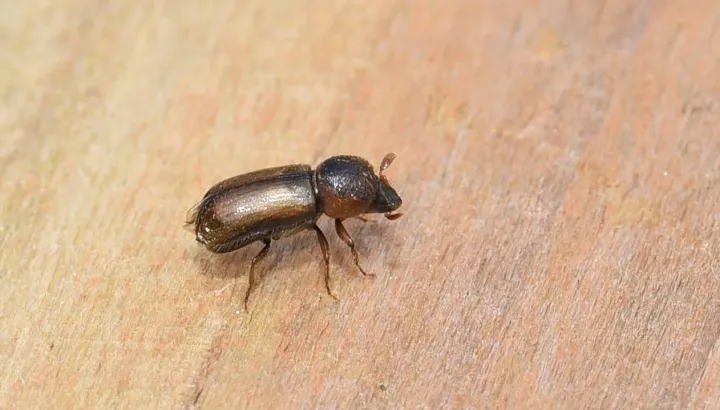
The adult beetle is small, measuring approximately 3 to 3.5 mm in length. Its body is elongated and typically colored dark brown or black, often featuring a subtle pattern on the elytra.
This species is closely related to other wood-boring insects. It carries symbiotic fungi into the wood, which serve as the primary food source for its developing larvae, rather than the wood itself.
The life cycle involves an egg stage, several larval instars, a pupal stage, and finally the adult beetle. The entire development process occurs deep within the tree trunk or timber.
Adults are strong fliers and are attracted to the volatile organic compounds released by stressed, dying, or freshly cut deciduous trees, allowing them to locate suitable hosts quickly.
What it damages
This pest primarily attacks deciduous trees, with a strong preference for oak, beech, birch, and alder. It rarely infests coniferous trees, making it a specific threat to hardwood forest industries.
The damage is considered technical rather than physiological because it targets dead or severely weakened wood. Stored timber, lumber at sawmills, and logs left in the forest are at the highest risk.
Beetles tunnel into the sapwood and heartwood. These tunnels are generally 1–2 mm in diameter and penetrate deep into the material, causing structural degradation in high-value hardwood products.
The symbiotic fungi transported by the beetles cause dark staining within the wood tunnels. This discoloration is often referred to as "ambrosia staining," which significantly reduces the aesthetic and commercial value of the timber.
In cases of heavy infestation, the wood may become riddled with holes and stains, rendering it entirely unsuitable for furniture making, flooring, or fine woodwork production.
When it appears
The flight period for the striped woodworm typically begins in spring, from April to May, depending on local temperatures. Rising spring temperatures act as the primary trigger for adult activity.
Depending on the climatic zone, the beetle may complete one or two generations per year. Warm, humid summers significantly accelerate the larval development process inside the wood.
As autumn approaches, the beetles begin to prepare for overwintering. They usually hibernate as adults in sheltered locations, such as the galleries they excavated or deep within the bark of trees.
The beetle's activity is highly dependent on temperature. The optimal range for development is between 18°C and 25°C; extreme cold or sustained heat waves can interrupt the normal life cycle.
Monitoring for the presence of the pest is best performed during the spring flight window, using pheromone-baited traps placed near timber storage sites to assess population levels.
Signs of infestation
The most reliable sign of an infestation is the presence of fine, light-colored boring dust (frass) on the surface of the bark or logs, which accumulates as the beetles tunnel into the wood.
Small, perfectly circular entrance holes, about 1.5–2 mm in diameter, are visible upon close inspection of the timber surface. These holes are the portals for the initial galleries.
Dissecting a piece of damaged timber reveals a network of branching tunnels. These galleries are often stained black or dark brown, which is a tell-tale sign of the associated ambrosia fungus.
Affected logs may show signs of moisture stress or localized discoloration on the bark surface. However, the internal damage is often far more extensive than what is visible from the outside.
In large timber yards, the sound of wood-boring activity or the presence of numerous small holes in freshly cut stacks is a definitive indicator that control measures must be implemented immediately.
Control measures
The most effective strategy is the rapid removal of logs from the forest after felling. Timber should be transported to mills and processed before the spring flight period begins.
Debarking logs is a highly effective preventative measure, as it makes the wood less attractive to beetles and removes the entry points they typically exploit.
Storage management is crucial: timber should be stored in dry, well-ventilated areas off the ground to ensure air circulation, which prevents the moisture conditions required by the fungi and the beetles.
Sanitary forestry practices, including the removal of deadwood and wind-felled trees, are essential to reducing the total beetle population within a forest area, thereby protecting healthy stands.
If logs must be stored during the flight season, applying insecticide sprays to the log surfaces can provide a temporary barrier against colonization, provided the treatment is applied thoroughly.
Taxonomy
- Latin name
- Trypodendron domesticum
- Order
- Coleoptera (beetles)
- Family
- Curculionidae
- EPPO code
- TRYDDO
Discussion
No discussions yet — be the first.